Popular

General Relativity gr-qc

377 articles

Gravitational physics: detection and interpretation of gravitational waves, tests of gravitational theories, computational general relativity, relativistic astrophysics, solutions to Einstein's equations, alternative theories of gravity, classical and quantum cosmology, quantum gravity.

articles

Toy Black Hole and the New Rules of Gravity

Physicists studied a black hole in two-dimensional space to test a modified theory of gravity. It turned out that even in such a universe, a black hole exists, but its property responsible for accelerated expansion changes. Then the scientists calculated the motion of particles and light around it.
arXiv:2410.11922 · 2024-10-15

Gravitational Waves to Test the Quantum Graininess of Space

The Generalized Uncertainty Principle (GUP) posits that space is made of quantum 'pixels.' This feature acted as dark energy in the early universe, and today it influences galaxy formation and leaves a trace in gravitational waves. New observatories will be able to measure this effect.
arXiv:2502.10043 · 2025-02-14

How a Neural Network Learned to See Quantum Foam

At the quantum level, space and time resemble a foam of microscopic bubbles. Neural networks have learned to instantly compute their interactions, replacing hours of calculations. This brings us closer to understanding the structure of the Universe at the smallest scales.
arXiv:2505.03255 · 2025-05-06

A Black Hole with Three Event Horizons: A New Recipe

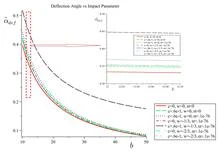
A new model combines loop quantum gravity and dark energy, giving birth to a black hole with a triple horizon. This layered structure affects the shadow, vibrations, and light deflection, promising to become a key to testing quantum gravity and the nature of the universe's accelerating expansion.
arXiv:2505.12291 · 2025-05-18

Quantum gas unlocks the secrets of the universe's birth

Scientists used a Bose–Einstein condensate (Bose and Einstein) — a state where atoms move as a single wave — to simulate the first moments after the Big Bang. By tuning interactions, they made it mimic the behavior of spacetime at the tiniest scales. This allowed them to observe “Planckian damping”
arXiv:2506.02719v3 · 2025-06-03

How Closed Space Breaks the Quantum Rules of Rotation

In a closed space, like the surface of a donut, orbital rotation loses its discreteness. Its values become continuous—from fractional to irrational—and the effect persists on the scale of the entire Universe. Scientists suggest searching for its traces in the cosmic microwave background.
arXiv:2506.03254v1 · 2025-06-03

Particle Dance on Curved Spacetime

Researchers examined how tiny bumps in spacetime affect the quantum link between particles. It turns out that altered rules for energy exchange give rise to an interaction that protects this link from breaking. Even as spacetime loses track of the particles, it helps them stay in sync. This discover
arXiv:2506.03282v2 · 2025-06-03

When Quantum Meets Gravity, Weirdness Fades

Mixing quantum theory and gravity often requires bending the rules into nonlinear forms. A fresh study uncovers a stunning side effect: this bending kills contextuality—the hallmark of quantum strangeness where a particle’s properties depend on how you look. If real, these models would make the worl
arXiv:2506.04298v1 · 2025-06-04

How to Tame Infinity in Space?

At the edge of the observable Universe, curved spacetime creates mysterious twistings — linked to infinite values. Roger Penrose's method compresses infinity into a point and yields a finite result. This is key to gravitational waves and the permanent deformation of space.
arXiv:2507.04245 · 2025-07-06

Black Holes Like Boiling Water

Some black holes behave like water that can boil and condense. Quantum effects complicate the picture but don't break the underlying pattern. This brings us closer to understanding spacetime at the micro level.
arXiv:2507.21663 · 2025-07-29

Why Does Time Only Move Forward?

A cup of coffee cools down but never heats up on its own—that's the arrow of time at work. Scientists have discovered: the direction from past to future depends not only on increasing disorder but also on how the cosmos expands.
arXiv:2508.01803 · 2025-08-03

The Key to Quantum Gravity Lies in a Single Atom

Physicists have found a workaround: instead of complex experiments to entangle massive objects, you can track the motion of a single atom. If its quantum dance obeys the Schrödinger equation, two atoms automatically become entangled through gravity. This brings us closer to answering the question ab
arXiv:2508.03052 · 2025-08-05

Gold Isn't Just from Neutron Stars: Where's the Hidden Source?

Astronomers compared data from ripples in space, cosmic flashes, and the chemical makeup of stars. It turned out: neutron star mergers can't saturate the galaxy with gold and platinum. Even counting exotic collisions between black holes and neutron stars, there's still a shortfall. There must be a h
arXiv:2508.06020 · 2025-08-08

The Mystery of the Gamma-Ray Burst: When the Speed of Light Is Not Constant

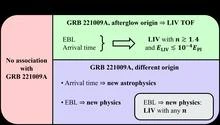
The brightest gamma-ray burst GRB 221009A produced a photon with the energy of a flying mosquito. It arrived an hour and a half late and didn't scatter on background light, although physics laws demand otherwise. Perhaps the speed of light changes with energy.
arXiv:2508.07153 · 2025-08-10

Tiny Giants: Black Holes Grow from Primordial Seeds

The merger of two unusually heavy black holes — GW231123 — suggests they might have originated from primordial seeds. Over billions of years, they sucked in matter, gaining mass and spinning up. Future observations will test this hypothesis and perhaps reveal the nature of dark matter.
arXiv:2508.09965 · 2025-08-13

Dark Energy: How a New Survey Changes the Picture

The DESI survey examined the motion of galaxies and supernovae, testing the constancy of dark energy. Faint signals point to its evolution, and the Mirage model gave the best but not definitive result. If the energy is indeed growing, the Universe could face a tearing apart of matter.
arXiv:2508.10514 · 2025-08-14

Speed Outsmarts the Laws of Heat Engines

A heat engine made of quantum particles, flying almost as fast as light, perceives temperature in a whole new way. Einstein’s effects make the hot even hotter and the cold even colder, boosting useful work and bypassing the classical barrier. Speed becomes a thermodynamic trump card.
arXiv:2508.11554 · 2025-08-15

Black Mirrors: How Gravitational Waves Will Reveal Black Hole Twins

One reflects, the other swallows. Black holes and black mirrors alter the music of gravitational waves, and future detectors will tell them apart by the rhythm of falling stars.
arXiv:2508.13272 · 2025-08-18

Time won't disappear when the stars go out

Many think time is movement from order to chaos. But physicists found out: even when the Universe cools and everything freezes, time will remain. It will become a river flowing into an ocean: the current is gone, but the water is there. Only the difference between past and future will disappear.
arXiv:2508.14312 · 2025-08-19

Quantum Glue for the Universe

Physicists have found that in the extreme gravity of neutron stars and black holes, a Bose–Einstein condensate emerges — a quantum state where particles merge into a single whole, like droplets of mercury. If dark matter consists of ultra-light axions, it naturally turns into a cosmic glue that keep
arXiv:2508.15864 · 2025-08-20

Interstellar Visitor with Carbonated Breath

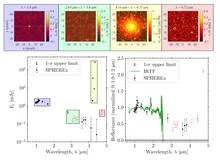
The SPHEREx telescope split the light of the interstellar wanderer 3I ATLAS into colors. It revealed that it's actively emitting carbon dioxide, while water ice absorbs some of the rays like tinted glass. All visible glow is a dusty shell, with the solid core inside being hundreds of times smaller.
arXiv:2508.15469 · 2025-08-21

How Information Gives Birth to Particles from Nothing

Physicists have derived formulas proving: when quantum ties are broken, the vacuum responds by birthing matter. The calculations hold for acceleration, black holes, and radioactive decay. Information is no longer a shadow of reality — it's its architect.
arXiv:2508.17067 · 2025-08-23

How Twisted Light Reveals a Black Hole's Charge

Light bending around a black hole gets twisted — by the spiraling of the beams you can measure its electric charge. Astrophysicists applied this approach to images of the M87 galaxy and obtained an upper limit for the first time: the hole is almost neutral. The method is universal and suitable for h
arXiv:2508.17300 · 2025-08-24

Melody of Disorder: What a Black Hole's Light Says About Chaos

Gas clumps around black holes move either in predictable orbits or chaotically. Scientists have found a way to distinguish them by analyzing the frequency spectrum of light. Chaotic orbits produce a blurred signal, like noise, while regular ones produce sharp peaks, like a pure note. This method wil
arXiv:2508.17384 · 2025-08-24

Moon Bell: A New Way to Catch Gravitational Waves

Scientists from the LILA mission aim to transform the Moon into a gravitational wave detector. Devoid of noise, the Moon will ring like a bell when hit by waves, and laser sensors will measure these vibrations. This opens the low-frequency band and lets us study black hole mergers right back to the
arXiv:2508.18437 · 2025-08-25

Black Hole Yields: Weak Spot Found

Black holes are not always perfectly rigid. Under the influence of a field of matter particles (such as electrons), they bend, although it was previously thought that weak influences couldn't deform them. Ordinary fields, like light or gravity, leave them unperturbed, but matter does not.
arXiv:2508.20155 · 2025-08-27

The Master Key to the Secrets of Spinning Black Holes

Spinning black holes and neutron stars: their calculations used to be incredibly cumbersome. Scientists proposed a method where everything reduces to a generating function. It's like a universal dough — from it, by simple differentiation, you get any characteristic of the system. The new approach ha
arXiv:2509.04425 · 2025-09-04

The Higgs Field Opens a Passage Through a Black Hole

Usually passive, the Higgs field inside a black hole gives rise to antigravity, preventing collapse into a point and creating a tunnel. The i(SM+GR) theory unites particle physics and gravity, predicting traversable black holes and the possibility of a universe before the Big Bang.
arXiv:2509.06800 · 2025-09-08

How Acceleration Heats Up the Void

Physicists have simulated the radiation that appears when electrons are suddenly accelerated by a laser. This 'heat from nothing,' predicted by the Unruh effect, was teased out from other signals using ultra-precise simulations and extremely small observation angles. The finding brings us closer to
arXiv:2509.07386 · 2025-09-09

Time from Disorder: How Atoms Revealed an Internal Clock

Scientists split a cloud of atoms and, by tracking rising disorder, ordered events in one half without seeing the other. This confirms that time emerges from internal changes. Such an approach will help us understand how time flows in black holes and right after the Big Bang.
arXiv:2509.07745 · 2025-09-09

Black hole merger confirms Hawking's area law

A clear signal from the merger of two black holes, each about 33 solar masses, confirmed Hawking's theorem: the final horizon area turned out larger than the sum of the initial ones. This strengthens the link between black hole area and entropy.
arXiv:2509.08054 · 2025-09-09

Binary Stars Build Dark Matter Molecules

Simulations show that a cloud of dark matter around two stars takes the shape of a molecule. The elongated orbits of the stars knock particles out of the cloud, causing their trajectories to round out. This process could leave a noticeable imprint in the gravitational-wave background, helping to rev
arXiv:2509.09643 · 2025-09-11

Black Hole or Impostor: The Ring of the Final Plunge

By analyzing the final 'plunge' of matter, scientists search for spectral signatures of impostors. The fakes produce a ringing: a comb of resonances at low frequencies and a sharp cutoff at high ones. Stacking signals from many events lets them hear even the quietest notes.
arXiv:2509.09986 · 2025-09-12

The Birth of a Gravastar: How a Star Escapes a Black Hole

New simulations show that a dying star can turn into a glowing bubble—a gravastar. At its core, a microscopic seed of dark energy emerges, expanding and halting the collapse exactly at the boundary where a black hole would normally form. Researchers pinpointed the key condition: a sufficiently 'fluf
arXiv:2509.15302 · 2025-09-18

Dark Energy: Constancy Questioned

Recent observations of supernovae, galaxy distribution, and the Big Bang afterglow show that dark energy density is not constant. This challenges the standard cosmological model and promises a revision of the Universe's evolution.
arXiv:2509.17124 · 2025-09-21

Gravitational Ringing Unveils Neutron Star Mysteries

After neutron stars merge, a ringing clump of ultra-dense matter remains. Analyzing how fast this gravitational chiming fades relative to the spin-down rate allows, for the first time, measurement of matter’s elasticity in the interior, where densities are 5–6 times nuclear. Paradoxically, it can be
arXiv:2509.18665 · 2025-09-23

How Dark Energy Makes Black Holes Less Destructive

Calculations show: dark energy weakens tidal forces at the black hole’s horizon. So a large object has a chance to survive if the universe’s expansion is accelerating. Without dark energy, any body would be torn apart.
arXiv:2509.18903 · 2025-09-23

How to Make a Black Hole Perfectly Black

Black holes usually reflect some waves. By shaping these waves to hit a precise resonance, physicists forced a black hole to absorb all energy, turning perfectly black. The absorbed energy is then released as a distinct ring, like a bell's tone revealing its shape. This technique could unveil the se
arXiv:2509.19451 · 2025-09-23

Quantum Network Grabs Gravity by the Tail

The study describes a quantum web of many atomic groups. Atoms within are entangled like knots in a spiderweb, reacting sensitively to gravity changes. The network can notice how gravity alters time’s flow: at different heights, clocks tick differently. This is a first step toward testing gravity’s
arXiv:2509.19501 · 2025-09-23

Black Holes Remember Everything: Memory Burden Alters Their Oscillations

Scientists have theoretically demonstrated that the information accumulated by a black hole (its “memory burden”) affects its oscillations under external perturbations. Two black holes of identical mass but with different information loads emit different gravitational wave spectra. This discovery pr
arXiv:2509.22540 · 2025-09-26

Mysterious Red Dots: Light from a Gravitational Trap

Astronomers have spotted strange red dots in the early Universe. They might be objects resembling black holes but lacking an event horizon. When a star collapses, its matter undergoes a phase change into a negative-energy state, releasing hidden heat. Monstrous gravity saps light of its energy, redd
arXiv:2509.23490 · 2025-09-27

Black Holes: A Rip Instead of an Event Horizon

Combining the expansion of the universe with a black hole, physicists have found that at the event horizon, spacetime doesn't just bend — it tears, with curvature shooting to infinity. Inside, the ban on faster-than-light energy flow is violated, making the hole unstable. This challenges the usual i
arXiv:2510.04165 · 2025-10-05

Listening to the Shudder of Space: The Nano-Mirror Experiment

Physicists have proposed an experiment with a nano-mirror suspended on a laser beam. It vibrates like an ultra-sensitive tuning fork, and if space is foam-like at the micro-level, its oscillations will be disrupted. A special optical amplifier turns this disruption into an audible signal, opening a
arXiv:2510.07844 · 2025-10-09

Tiny black holes from cosmic collisions

When particle rays collide in space, they can create microscopic black holes that instantly evaporate into a stream of neutrinos. Already, by studying neutrinos from a distant galaxy, scientists have tested energy limits where gravity changes the rules. Upcoming observatories will search even deeper
arXiv:2510.11879 · 2025-10-13

Quantum Bounce: How the Universe Became Uniform

Scientists have proposed a model where the universe didn’t explode from a point but first contracted and then bounced. Quantum effects during the bounce smooth out any distortions, making space uniform and the same in all directions. This is a natural explanation for the cosmos’s smoothness, requiri
arXiv:2510.14021 · 2025-10-15

Gravitational Waves Gain Overtones

Event GW250114 helped physicists capture not only the main wave from the black hole merger, but also the quiet overtones. These nonlinear oscillations, born from the self-interaction of spacetime, refined the black hole’s parameters and opened a new way to test relativity in strong fields.
arXiv:2510.16903 · 2025-10-19

Superfluid Helium Feels How the Earth Spins

Earth drags the fabric of space-time along with it — an effect predicted by Einstein. Scientists propose catching it with superfluid helium and a highly precise detector. The device will notice rotation slower than one revolution in the entire history of Earth.
arXiv:2510.20772 · 2025-10-23

Dark Energy Is Not Constant: A New Look at the Universe's Acceleration

Analysis of galaxy maps, quasar light, and supernovae shows that the simple model of constant dark energy is losing to a version with a smoothly changing force. This needs verification, but it's intriguing.
arXiv:2510.21976 · 2025-10-24

Black Holes Where You'd Least Expect Them: Solving the Mass Gap Mystery

It was thought that the most massive stars explode completely, leaving no black holes, so none exist in the 50 to 130 solar mass range. New observations found several such anomalies with low spin. The reason lies in the nuclear reaction rate inside stars, which shifts the boundaries of what's possib
arXiv:2510.22698 · 2025-10-26

A Black Hole Cooks Up Radiation Like a Pot of Soup

The double copy trick turns the cold birth of particles in a strong electric field into warm Hawking radiation. The horizon and temperature pop up by themselves, even though the original recipe doesn’t include them. This kitchen wizardry bridges gravity and the forces of the microworld.
arXiv:2510.25852 · 2025-10-29

Tiny Black Holes: A New Key to Dark Matter

Dark matter—the universe's invisible mass—might be a swarm of primordial black holes. Scientists have found a way to spot them: a hole with the mass of an asteroid would disrupt the precise ticking of pulsars; a more massive one, crashing into an icy body beyond Pluto, would light up like a searchli
arXiv:2511.04895 · 2025-11-07

How a Whirlpool in a Cup Becomes a Black Hole Bomb

New research shows that if you swirl water vigorously in a shallow dish, a vortex with an empty center forms. Waves on its surface, reflecting off the edges, accumulate energy — exactly like around a rotating black hole. This vortex became the first desktop model for a dangerous cosmic phenomenon —
arXiv:2511.05351 · 2025-11-07

Dark Stars: Cradle of Giant Black Holes

Dark stars, shining from collisions of dark matter particles, became the progenitors of the largest black holes in the Universe. They grew to millions of solar masses, then collapsed, leaving behind seeds for future giants.
arXiv:2511.08578 · 2025-11-11

Gravitational Atoms: The New Voice of Black Holes

Clouds of ultra-light particles turn black holes into gravitational atoms. New calculations show that after black hole mergers, such clouds noticeably change their ring, which can be detected by gravitational wave detectors.
arXiv:2511.13848 · 2025-11-17

Light Gets Even Lighter: A New Upper Limit for the Photon’s Mass

The Universe arranged a race of light beams. Fast radio bursts from distant galaxies made it possible to test: if the photon had mass, blue light would arrive later than red. In reality, the delay is explained only by gas. New mass limit: 5×10⁻⁵¹ kg – light is practically weightless.
arXiv:2511.14163 · 2025-11-18

A Tabletop Light Maze Captures Gravity

For the first time in a lab, researchers directly measured how gravity alters the path of single photons. They built a tabletop labyrinth from 50 km of fiber. The device compared the paths of two halves of a photon wave and detected a delay of millionths of a radian—a result of spacetime curvature.
arXiv:2511.17022 · 2025-11-21

Black Holes Instead of Dark Energy

Researchers simulated how primordial black holes with a repulsive core accelerate the expansion of the universe. Ultra-light ones triggered inflation, while black holes with the mass of an asteroid and the size of a proton mimic early dark energy, resolving the famous discrepancy in the measurement
arXiv:2511.18080 · 2025-11-22

A Chain Reaction of Black Holes Generates Gravitational Waves

The evaporation of primordial black holes may not have just destroyed them but also spawned new ones — like a spark igniting a forest fire. This self-sustaining reaction left behind a characteristic gravitational-wave hum with a sharp low-frequency cutoff. Future observatories like LISA could captur
arXiv:2511.18110 · 2025-11-22

Black Holes — Portals to a Mirror Universe

New research has shown: a rotating black hole can serve as a passage to another world. At its center lies not a point, but a ring of infinitely compressed matter. Light that passes precisely through this ring ends up in a strange universe with an upside-down sky. The work explains the nature of myst
arXiv:2511.18502 · 2025-11-23

Can gravity entangle particles?

Physicists have found: if gravity obeys only classical laws, it cannot entangle two particles. If entanglement occurs in an experiment, it means something else is at work — dark matter, new fields, or unknown particles. This turns tests of quantum gravity into a search for unexpected forces.
arXiv:2511.19242 · 2025-11-24

Ghost Stars as Precise Cosmic Clocks

Astrophysicists have shown that hypothetical boson stars—clumps of the lightest particles—can act as gravitational lenses with their own rhythm. The breathing lens oscillates its focus, and any light source caught in it begins to blink rhythmically. This can be tested with modern telescopes, offerin
arXiv:2511.19606 · 2025-11-24

The Mystery of Massive Early Galaxies: A Solution in Motion

The James Webb Space Telescope discovered massive galaxies that formed just a few hundred million years after the Big Bang. Existing models couldn’t explain such rapid growth. To solve the mystery, scientists considered that galaxies not only recede from each other but also have their own motions du
arXiv:2511.19736 · 2025-11-24

How a Black Hole Splits Light by Polarization

A spinning black hole acts like a giant whirlpool: it twists the fabric of space and separates light rays by their twist. Left and right polarizations are focused at points spread trillions of kilometers apart — more than Earth’s diameter. Changing location on the planet causes the polarization to s
arXiv:2511.22276 · 2025-11-27

Echo in a Wormhole

Physicists modeled a signal passing through a traversable wormhole. It turns out the tunnel works like a mirrored hallway: the wave bounces between two gravitational barriers, creating echo signals. The more twisted the wave, the louder the echo. This repeating pattern could be used to search for wo
arXiv:2511.22671 · 2025-11-27

The Klein Bottle Mystery: Where Matter Came From

A hidden dimension in the shape of a Klein bottle inherently breaks the mirror symmetry that keeps matter and antimatter in balance. As our 3D universe slips through a layer of virtual particles in this dimension, real matter is born.
arXiv:2511.23447 · 2025-11-28

Black Holes: Absolute Rigidity

The most precise measurements of gravitational waves from a black hole collision have set a record limit on their deformability. It turns out that black holes keep their shape even under unimaginable tidal loads — just as Einstein predicted. This closes a loophole for 'soft' quantum models.
arXiv:2512.01918 · 2025-12-01

Hidden Wormholes in the Hydrogen Atom

The ER=EPR hypothesis links entangled particles with a wormhole, like two water drops connected by a single straw. Scientists calculated that an electric field leaking into such a tunnel would shift hydrogen's 'radio voice' and give atoms a tiny charge. Comparison with lab data ruled out any noticea
arXiv:2512.02156 · 2025-12-01

Invisible Black Holes: Planets or Something Else?

Scientists reexamined data from the hunt for planets around other stars and identified objects detectable only through gravity. Six suspicious 'planets' and two cases of light bending might actually be primordial black holes. They don't glow, they don't eclipse stars, but they could be the key to da
arXiv:2512.03118 · 2025-12-02

Time is not a river, but a one-way street

Scientists have proven: black holes and wormholes cannot turn back time. These cosmic “detours” merely redistribute disorder, but the total chaos in the Universe keeps growing. That’s the relentless arrow of time.
arXiv:2512.03380 · 2025-12-03

Whirlpools Around Black Holes: A Key to Dark Matter

A rapidly spinning black hole twists the space around it. In this swirl, stable whirlpools can form from ultralight particles — likely components of dark matter. These vortices live long, not falling into the hole, and their motion reveals how strongly space is curved. The discovery refines the natu
arXiv:2512.03561 · 2025-12-03

How the Quantum Vacuum Blurs Time

Time is usually the same for all. But in the microcosm, the void is not empty: it bubbles with virtual particles, and this jitter disrupts tiny clocks in different ways. Researchers have shown that two timekeeping devices can drift apart due to the quantum backdrop — even when placed side by side.
arXiv:2512.06076 · 2025-12-05

Quantum Test of Falling Bodies

The equivalence principle states: all objects fall at the same rate because the mass that creates gravity equals the mass that resists acceleration. To test this at the quantum level, scientists place weights in a state where their mass is as if blurred. Supersensitive torsion balances capture not o
arXiv:2512.06333 · 2025-12-06

Vortons: Invisible Rings of Dark Matter

Scientists calculated how light and matter move near vortons—rotating loops of spacetime. It turns out their gravity creates bizarre trajectories and can reveal their presence through distortions of starlight. This is a new way to search for the universe's hidden mass.
arXiv:2512.07364 · 2025-12-08

Gravitational waves and galaxy maps measure the expansion of the Universe

The expansion rate of the Universe — the Hubble constant — is key to the age and fate of the cosmos. The 'peak siren' method compared distances from galaxy light and gravitational waves. A match was found with 5.9 sigma confidence: H₀ = 67 km/s/Mpc. This is a new way to measure without relying on tr
arXiv:2512.15380 · 2025-12-17

Gravity vs. Superposition: Why the World Isn't Blurred

Scientists discovered that an object's own gravity destabilizes quantum superposition: the object quickly loses its fuzziness and ends up in one place. The collapse time is inversely proportional to mass—for heavy bodies it's almost instantaneous. The effect works even in free fall, explaining why l
arXiv:2512.15393 · 2025-12-17

Heat from the void: how to catch the Unruh effect

The Unruh effect predicts that the vacuum appears hot to an accelerating observer. But for ordinary particles, this heating is vanishingly small. New work explains how to bypass the impasse: in a superconducting circuit, an ultra-light 'effective mass' is created, making the thermal glow of accelera
arXiv:2512.17959 · 2025-12-18

Warp Drive Without Turbulence: A Cheaper Path to the Stars?

A new warp drive model uses a smooth curvature of spacetime without turbulence and requires tens of times less negative energy than previous versions: now a tiny energy imbalance is enough.
arXiv:2512.18008 · 2025-12-19

Muonium: How Antimatter Falls in Gravity

Physicists have produced a directed stream of muonium — an atom where the nucleus is replaced by an antimuon, while the electron remains ordinary. Superfluid helium allowed them to achieve nearly identical velocities for all particles, paving the way for wave experiments and precise measurement of g
arXiv:2512.19923 · 2025-12-22

Dark Matter Gave Rise to Galactic Magnetic Fields

A new hypothesis: dark matter acted like a sound amplifier. Its rhythmic oscillations, like microphone feedback on stage, turned faint magnetic seeds into the fields that shrouded galaxies. This explains the origin of cosmic magnetism without exotic additions.
arXiv:2601.00443v1 · 2026-01-01

How to Make Light Late

Gravity causes light to be delayed — this Shapiro effect has only been tested in space. Now scientists aim to measure it in a lab with a fiber-optic loop. The precision will increase a thousandfold, paving the way to discover unknown laws of nature.
arXiv:2601.00468v2 · 2026-01-01

How quantum fog tests the laws of gravity

Scientists created modified gravity conditions (MOND) for a quantum fog and saw that the cloud expands and oscillates according to simple mathematical rules. This opens the door to lab-based tests of gravity theories that replace dark matter.
arXiv:2601.01039v1 · 2026-01-03

How to Hear Stellar Collisions More Clearly

Scientists improved a model of neutron star mergers by including heating. This cut the error by a factor of 10 and showed that the main burst frequency shifts by 150 Hz depending on the star's composition. The finding will help next-generation detectors study ultra-dense matter.
arXiv:2601.01402v1 · 2026-01-04

Gravity Without Dark Matter: The Entropic Approach Triumphs

Analysis of star motions in 23 dwarf galaxies showed that emergent gravity — a theory explaining attraction through the information capacity of space — is more accurate than modified Newtonian dynamics. The result with a confidence of 5.2σ casts doubt on the existence of dark matter.
arXiv:2601.01715v1 · 2026-01-05

The Universe is a Giant Heat Engine

Scientists have shown that the expanding universe can be described by the same equations as a steam engine. They calculated the efficiency of this 'cosmic motor' and confirmed: even the universe cannot break the laws of thermodynamics.
arXiv:2601.01851 · 2026-01-05

Dark Energy as a Falling Pencil

New research explains dark energy as a loss of spatial equilibrium. A tiny dilaton field, born from that event, drives the repulsive push. It resolves the conflict in expansion rate measurements and hints at the cosmos's future trajectory.
arXiv:2601.01938v1 · 2026-01-05

A Black Hole Like a Bell: How a Light Pulse Gives Rise to Echoes

Light delayed by a black hole generates a prolonged echo with bright bands—like a bell tolling after a strike. Physicists recreated this on a tabletop using a curved surface, and can now study the echoes in the lab.
arXiv:2601.02197 · 2026-01-05

Bubbles in a Boiling Universe: How Dark Matter and Gravitational Waves Were Born

In the first moments after the Big Bang, the universe boiled, spawning bubbles of a new reality. Their collisions accelerated particles more powerfully than any collider. This is how super-heavy neutrinos were born – particles that explain both dark matter and the mysterious excess of matter, and th
arXiv:2601.02458v3 · 2026-01-05

Perfect Entanglement Defies Infinite Acceleration

Usually acceleration destroys quantum entanglement—the invisible bond between particles. But in a new study, physicists found a four-particle state where entanglement freezes entirely at its maximum level. This challenges old notions and paves the way for ultra-stable quantum links in space.
arXiv:2601.02976 · 2026-01-06

The Ultimate Stiffness Limit of Neutron Stars

In a neutron star, matter is compressed to the limit. But even that limit has a limit: physicists have calculated that the ratio of pressure to energy density never exceeds 0.385. This law holds for any ultra-dense matter in the universe.
arXiv:2601.02980v1 · 2026-01-06

Dark Dance: How Energy and Matter Swap Roles

Eight models of interaction between dark energy and dark matter fit observations better than the standard theory. Surprisingly, in the past, dark energy density could have been negative—like an energy debt in the dance. The finding refines the history of the expansion of the universe.
arXiv:2601.03122v1 · 2026-01-06

Black Holes 'Weigh' the Expansion Rate of the Universe

Analysis of 137 black hole mergers revealed three favorite masses: around 10, 18, and 33 solar masses. A flexible analysis, like a tuner, picked out these 'notes' more precisely than previous methods. As a result, the expansion rate of the universe was refined by 21%. This shows that the better we h
arXiv:2601.03347v2 · 2026-01-06

Invisible Vortices Sculpt Supermassive Black Holes

In the early universe, giant black holes were born at a dizzying pace. The key lies in a dance of invisible fields: the trembling of the axion field and dark photons created vortex mixers that prevented matter clouds from fragmenting and whisked away their spin. Thus, quantum crumbs sculpted the see
arXiv:2601.04145v1 · 2026-01-07

How Weak Gravity Does Without Dark Matter

This approach rewrites gravity's rules where it's barely felt—at the edges of galaxies. Under normal conditions, it aligns with Einstein's theory, but for weak fields, it adds a tweak. The solution needs no new particles and explains why galaxies spin faster than their visible mass permits.
arXiv:2601.04290v1 · 2026-01-07

A black hole rings nonlinearly: new gravitational overtones heard

In the gravitational waves from the black hole merger GW250114, nonlinear overtones—vibrations born from the interaction of the fundamental tones—have been directly detected for the first time. This discovery proves the complex nature of strong gravity and provides a new way to test relativity.
arXiv:2601.05734v1 · 2026-01-09

How Dark Matter Was Born from the Geometry of the Universe

A new model shows how dark matter—a dust-like, invisible substance—could have emerged from the geometry of space during the rapid expansion. The mechanism works without fine-tuning: the right amount of matter automatically results from the expansion rate. After matter came to dominate over radiation
arXiv:2601.05931v1 · 2026-01-09

Galaxy Rotation in Voids Tests Inflation

In giant cosmic voids, galaxies spin like a single ensemble. Their dance creates a barely noticeable difference in glow from different sides. It turns out that this effect is the most accurate indicator of how uniformly matter was foamed up at the moment of inflation. It is enough to measure it to f
arXiv:2601.06589v1 · 2026-01-10

The Universe Falls Silent Smoothly, Not with a Bang

Scientists have built a model where dark energy loses its push. Instead of a shredding tear or a crunch into a point, the Universe’s expansion smoothly tapers off. The end result — a flat, table-smooth, empty space. Observations back this up.
arXiv:2601.07007v1 · 2026-01-11

How Gravitational Waves Twist Light

Scientists have described for the first time a mechanism by which gravitational waves flip the twist of light. The effect resembles the action of sugar syrup on polarization, but here curved spacetime does the work. The exchange of spin between the wave and the photon is rigidly fixed: gravity's spi
arXiv:2601.07179v1 · 2026-01-12

The Universe Whispers: [tag:dark_energy]dark energy[/tag] is not alone

Scientists have long debated: is dark energy constant or does it change? Fresh measurements point to a third path — it is conversing with dark matter. This turns a lone cosmic force into a duet of invisible interlocutors.
arXiv:2601.07361v1 · 2026-01-12

Dark Matter from the Bends of Space

After rapid expansion (inflation), spacetime quickly restructures, triggering instability in the dark matter field. This kicks off an avalanche of particle creation — a purely gravitational mechanism. Calculations and computer simulations confirm that this can explain the observed density of dark ma
arXiv:2601.07670v2 · 2026-01-12

How to Hear a Swarm of Black Holes

Future detectors will catch the hum from mergers of tiny black holes. New work shows how to distinguish this hum from other sources by its volume and frequency, and peer into the first second after the Big Bang.
arXiv:2601.07774v1 · 2026-01-12

A hiccup in the early Universe gave rise to a gravitational hum

In the first moments after the Big Bang, the Universe expanded at an enormous speed. If the expansion briefly paused, it generated powerful gravitational waves. Future detectors on Earth will be able to catch them, opening a window into an era hidden from any telescopes.
arXiv:2601.09834v1 · 2026-01-14

A Black Hole with an Icy Surface

Scientists have proposed a model of a black hole where matter and light freeze at the edge, like a whirlpool gripped by ice. Its shadow betrays itself with unexpected brightness—a path to testing quantum gravity.
arXiv:2601.10806v2 · 2026-01-15

Why Superluminal Signals Tangle Time

To keep the usual order of events with superluminal signals, the world must possess infinite precision—and quantum randomness might turn out to be an illusion.
arXiv:2601.15263 · 2026-01-21

Gravity and Charge: Physics' Blind Spot

New work exposes a gap: the effect of charge on gravity has never been systematically studied. The authors predict a tiny change in acceleration depending on the charge-to-mass ratio and propose modifying a torsion balance to illuminate this blind spot for the first time. Surprise: for the electron,
arXiv:2601.16325 · 2026-01-22

The Moon as a Gravitational Wave Detector

The first accurate model of the Moon's response to gravitational waves reveals: uneven crust amplifies the signal tenfold. Energy transfers into extra vibration modes — like a bell with irregular walls. This will help pinpoint the ideal location for a lunar detector capable of catching the 'echo' of
arXiv:2601.16567 · 2026-01-23

Lack of Information Accelerates the Universe

Scientists have found a new explanation for why measurements of the universe's expansion rate don't match: a tiny fraction of information may be 'erased' from its visible edge. This shortage creates extra energy that slightly accelerates expansion in the last few billion years, without affecting the
arXiv:2601.17938 · 2026-01-25

Diffusion and Light Speed No Longer Quarrel

The diffusion equation was seen as a violator of relativity due to the instant spread of signals. It turned out to be an artifact of a rough approximation. On the micro level, everything is lawful, and paradoxes vanish with the right 'focus': track the particles, not the blurry picture.
arXiv:2601.19464 · 2026-01-27

Spun to the Limit: Black Hole Bypasses Laws

A numerical experiment showed that in five-dimensional space, an ordinary black hole can reach maximum spin in finite time, as well as emerge from nothing. This is the first violation of the third law of black hole mechanics in pure gravity, forcing a rethinking of the evolution of such objects.
arXiv:2601.20955 · 2026-01-28

Black Holes Are Born When the Universe Bounces

The universe behaves like a spring: it periodically compresses and then expands again. During compression, dense clumps form that survive the bounce and become the seeds of black holes and dark matter. This model explains the origin of dark matter, why supermassive black holes appeared so early, and
arXiv:2602.17702 · 2026-02-08

Dark matter from eternal inflation

Tiny black holes, born in ever-expanding pockets of the universe, may make up all dark matter. This scenario not only explains its abundance but also predicts a detectable hum of gravitational waves.
arXiv:2602.08338 · 2026-02-09

Warm Emptiness Instead of Dark Energy

Many explain the galaxies' recession with dark energy — a mysterious force that does not change over time. But there's an idea to replace it with the heat of emptiness itself. The cosmic horizon — the boundary of what we see — is slightly heated. This heat pushes the Universe apart. This approach re
arXiv:2602.08522 · 2026-02-09

Quantum Copying: Encryption Beats the Ban

The no-cloning theorem says a qubit can't be copied. But physicists found a loophole — encrypted cloning with a one-time key. An experiment on IBM's 154-qubit processor proved the method works under real noise. The real ban is not on copying, but on reading an extra copy.
arXiv:2602.10695 · 2026-02-11

Two Giant Galaxies Spin in a Cosmic Waltz

Astronomers measured the motion of Centaurus A and M83 and found that the galaxies are gravitationally bound and impossibly drifting closer. Together, they pack about 6 trillion solar masses. This dance mirrors the future scenario of the Milky Way meeting Andromeda, helping us understand galaxy evol
arXiv:2602.11268 · 2026-02-11

Black Hole Did Not Destroy Quantum Entanglement

Physicists tested a special entangled state of four particles near a black hole. Usually, temperature and gravity destroy any quantum bonds, but here the entanglement remained maximal, as if frozen. This is the first case where strong gravity does not suppress but preserves a quantum link.
arXiv:2602.11586 · 2026-02-12

The Quiet Phantom Before a Black Hole Rings

Scientists have discovered that after a collision, black holes don't immediately start to 'ring'. A hidden pause occurs — a phantom trap that holds back gravitational waves. The silence ends with a sudden burst. This discovery changes our understanding of how black holes settle down and provides new
arXiv:2602.12101 · 2026-02-12

Gravity Can Push Away — A Quantum Experiment

Ordinary gravity only attracts. But if the source of gravity is in two places at once, you can make it push a test particle. This is impossible in classical physics and serves as proof of gravity's quantum nature.
arXiv:2602.12266 · 2026-02-12

A black hole can turn into a wormhole

Scientists have modeled how streams of negative energy transform a black hole into a stable wormhole. Colliding, they create a through-tunnel that doesn't collapse. This is a new look at the birth of traversable portals.
arXiv:2602.13609 · 2026-02-14

Wormhole Shadow: Sharp Angles When Rotating

New calculations show: if a wormhole rotates and lets light pass through its throat, its shadow unexpectedly gains jagged edges. The sharp transition from a smooth shadow to a 'gear' could help tell wormholes apart from black holes in telescope images.
arXiv:2602.14182 · 2026-02-15

Black Hole Throws Off Its Rhythm

At the supermassive black hole 'Ansky,' X-ray flares follow a steadily slowing rhythm. Each day, the gap between them grows by nearly half an hour. This defies all models: when a star falls into a black hole, flares should speed up, not slow down. The cause remains unknown.
arXiv:2602.16776 · 2026-02-18

Warp Drives Ranked: The Gentlest Way to Bend Spacetime

Scientists built a toolkit that checks warp drives for any observer, even at warp speeds. It ranks them by how much they violate nature's energy laws. The Rodal design is the calmest, Alcubierre's the wildest. This steers research toward more realistic warp concepts.
arXiv:2602.18023 · 2026-02-20

Black hole vortex shifts quantum rhythm

When a black hole spins, it drags spacetime with it, like a spoon stirring thick honey. This cosmic vortex can alter the internal rhythm of quantum particles even when they feel no forces. Scientists have calculated that for a supermassive black hole this shift reaches 10²⁴ radians — a number that m
arXiv:2602.20337 · 2026-02-23

Time in Reverse: Dark Energy Saves the Universe from Exploding

Chaplygin gas is an exotic medium that behaves like dark energy. When the universe contracts, it makes time flow backward for matter, turning a catastrophic collapse into a smooth bounce. Surprisingly, adding other particles doesn't disrupt the mechanism.
arXiv:2602.21642 · 2026-02-25

Shadows of Colossal Black Holes on Ancient Light

Supermassive black holes heavier than a trillion Suns have an unexpected property: their shadow doesn't shrink with distance—it grows. This helps astronomers set strict limits: black holes with masses over a hundred million billion Suns simply cannot hide in the observable Universe.
arXiv:2602.22587 · 2026-02-26

Can Gravity Repel? A Quantum Trick

Scientists have found that a body smeared across two points simultaneously can repel gravitationally. The weak negative value effect makes attraction turn into a push. This suggests the fabric of spacetime itself follows quantum laws.
arXiv:2602.22715 · 2026-02-26

Gravitational Waves Create Invisible Patterns in Space

When many gravitational waves overlap, special zones appear—like ripples on water freezing into predictable patterns. These structures aren’t random; they’re a regular feature of the cosmic background. By studying them, we can measure waves more accurately and glimpse the era of the universe’s birth
arXiv:2602.23425 · 2026-02-26

Freezing Ice and Expanding Space

When scientists accounted for the fact that water under ice constantly moves and mixes, the equations for ice growth suddenly matched those describing the expansion of the entire cosmos. Moreover, a term appeared in these equations that behaves exactly like mysterious dark energy—the very thing that
arXiv:2602.24019 · 2026-02-27

Quantum Bounce: A Universe Without Singularity

Classical gravity theory predicts that the universe was born from a singularity—a point of infinite density. New research shows that quantum effects replace this moment with a smooth bounce. In a model of space closed like a ball, a special energy, akin to a spring, makes it contract and expand. Phy
arXiv:2603.06481 · 2026-03-06

Black Holes with a Surprise from the Fifth Dimension

New research shows that if gravity leaks into a fifth dimension, black holes gain a minimum mass and never cool down to zero. This changes our understanding of their final fate and their connection to the quantum world.
arXiv:2603.07125 · 2026-03-07

Secret of a Black Hole's Fastest Chaos

Astrophysicists have shown: the merger of two non-spinning black holes always produces an object with maximally chaotic movement of light rays at the horizon. The discovery helps better decode gravitational waves and test general relativity.
arXiv:2603.08643 · 2026-03-09

Dark matter stars mimic black holes

A small neutron star, orbiting a huge ball of dark matter, accelerates its fall due to friction and creates gravitational waves. This signal closely resembles a black hole merger. Future detectors, like LISA, will be able to distinguish these cosmic impostors.
arXiv:2603.08795 · 2026-03-09

Gravitational Waves: Echo of the Cosmic Bounce

Researchers have shown: if the Universe first contracted and then expanded, the gravitational waves from both events mixed, like a double echo, creating a unique rhythmic pattern. Unlike the standard Big Bang, where the waves are chaotic, a clear pulsation emerges here. The signal is strong enough t
arXiv:2603.13924 · 2026-03-14

Black Holes Sing Gravitational Songs

Scientists have discovered how rapidly spinning black holes produce the lightest particles—axions. These particles accumulate and vibrate, emitting gravitational waves at a single constant frequency. The hum from millions of such holes in our Galaxy can already be 'heard' by existing detectors, open
arXiv:2603.15734 · 2026-03-16

Mirror Universe: Time Reversed and the Mystery of Matter

Physicists have proposed a model where the universe is born alongside its reflection. In this twin, time runs backward and left and right are swapped. A slight difference in the properties of twin particles could have given a tiny edge to matter over antimatter—thus stars and planets emerged.
arXiv:2603.22381 · 2026-03-23

Ancient Black Holes Could Burst into White Holes

This study calculates how often ancient black holes could suddenly turn into white holes—events that would look like intense radio flashes from deep space. But the chance is extremely low, and only matches reality in very specific, precise conditions. Most evidence, from gravitational waves to gamma
arXiv:2603.22516 · 2026-03-23

Levitating Magnet Catches Dark Matter

The invisible substance that makes up most of the cosmos might reveal itself through the faintest nudges. A new method uses a levitating superconductor that picks up the slightest influences. Analysis shows that the magnetic response will be especially bright – this opens the door to a laboratory se
arXiv:2603.22647 · 2026-03-23

All Atoms Fall Alike: A Cosmic Verdict

The idea that all objects fall equally underpins Einstein's theory. On the Chinese space station, physicists compared the fall of two types of rubidium atoms. The result matched the prediction with an error of a few ten-millionths.
arXiv:2603.22981 · 2026-03-24

Dark Energy Turns On When Galaxies Are Born

The universe began expanding faster only after large clumps of matter appeared. Dark energy wasn't always there — it switched on like a pump when dark matter gathered into galaxies. Calculations match observations, linking two major cosmic phenomena to a single cause.
arXiv:2603.23473 · 2026-03-24

How Dark Energy Dresses Up Black Holes

If dark energy is not constant but evolves, it accumulates around black holes as a 'cosmic hair'. This hair alters the black hole's ringdown pattern after a collision. Observing these shifts with gravitational wave detectors like LIGO and LISA offers a powerful new way to measure dark energy's prope
arXiv:2603.23634 · 2026-03-24

Tuning Into the Hum of Spinning Stars

If neutron stars had tiny bumps, they would constantly hum with gravitational waves. Using LIGO, scientists searched for that hum from 34 pulsars, the largest search of its kind. No signals were found, which pushes the theoretical limits even lower. The Crab pulsar, for instance, turns less than 0.0
arXiv:2603.25938 · 2026-03-26

Quantum Computers Will Challenge Gravity

Relativity and quantum mechanics diverge at the micro level. A new approach: if a quantum computer surpasses the classical speed limit of computation, it becomes a test of quantum gravity. A lab needs 500 logical qubits, the cosmos—1,600. Commercial roadmaps promise to reach that milestone soon.
arXiv:2604.06322 · 2026-04-07

Two Flavors of Early Dark Energy Ease Cosmic Tension

Adding a second type of early dark energy helps resolve a stubborn mismatch: the universe's expansion rate measured today versus the rate inferred from the Big Bang's afterglow. The two-ingredient model narrows the gap and fits the afterglow's fine details, hinting that the early universe was more i
arXiv:2604.13535 · 2026-04-15

The Rubber Band That Gives Birth to Antimatter

Klein's paradox about the birth of particles from emptiness gets a simple explanation: a tightly stretched rubber band snaps, creating whirls — a particle and an antiparticle. This image makes it clear that pair creation is the medium's reaction to extreme stress.
arXiv:2604.14378 · 2026-04-15

Atomic Nuclei Measure Gravity

Take a clock to the second floor and you'll make it run fast — gravity slows time. Scientists have developed a method that uses iron-57 nuclei as supersensitive metronomes: by shining X-rays on them, they turn a tiny frequency shift into a glaring rhythm discrepancy. Within hours, the method sees Ei
arXiv:2604.17157 · 2026-04-18

A One-Way Black Hole: The Shadow That Changes Shape

The path of light from a lamp to a camera is usually the same in both directions. But near a rotating black hole with a preferred direction in space, this isn't the case. If you swap the light source and the observer, the black hole's shadow transforms from an oval into a teardrop, as if in a one-wa
arXiv:2604.18101 · 2026-04-20

Hawking's Area Law: How Black Holes Test Quantum Gravity

Analysis of black hole mergers confirmed Hawking's law and turned it into a selection tool: only theories without extra mathematical terms survive. Moreover, the law itself leads to the entropy formula and the idea that the horizon might not be just a smooth sphere.
arXiv:2604.18669 · 2026-04-20

The Quantum Fabric of Spacetime

At the intersection of quantum mechanics and gravity theory, familiar laws fall silent: the probability of an event depends on exactly how we 'touch' spacetime. A new perspective may shed light on the nature of dark energy and particle mass.
arXiv:2604.19418 · 2026-04-21

Ordinary Gravity Doesn't Entangle Particles

Scientists found an error in a study that claimed gravity can entangle particles. In reality, for such a connection, gravity itself must obey quantum laws.
arXiv:2604.19696 · 2026-04-21

Cosmic Deck: How Shuffling Numbers Creates the Universe

Physicists replaced particles with numerical tables and ran a simulation. Following quantum rules, the tables arranged themselves into an expanding universe with three spatial dimensions and time — with no external guidance whatsoever. This result is like a winning jackpot: it explains how the Big B
arXiv:2604.19836 · 2026-04-21

Quantum Gravity Trick: How Atom Clouds Harmonize Through Spacetime

Two ultra-cold atom clouds, known as Bose-Einstein condensates, become mysteriously linked when placed a hair's width apart. Their internal sound waves synchronize in a way only possible if gravity follows quantum rules, offering a powerful new path to glimpse the grainy fabric of spacetime.
arXiv:2604.20767 · 2026-04-22

The Rhythm of Black Holes from the Early Universe

Scientists have discovered that in the expanding universe, primordial black holes are born rhythmically: their mass grows not smoothly, but in jumps, forming a repeating pattern. Previously, this behavior was only observed in models without expansion. The discovery suggests that the mass distributio
arXiv:2604.21520 · 2026-04-23

The Quantum Pond: How an Ion Crystal Catches Dark Matter

A crystal of charged atoms responds to the slightest jolts, like the calm surface of a pond to a pebble. Quantum squeezing makes it supersensitive, drowning out the noise. This is how we can detect elusive dark matter and gravitational waves, changing our understanding of the Universe.
arXiv:2604.22336 · 2026-04-24

What Does a Black Hole's Ring with Dark Energy Sound Like?

Physicists have calculated how dark energy and hypothetical string clouds affect the vibrations of black holes. The calculations show how the ringing frequencies shift and how much more transparent the hole becomes to radiation. These results are a step toward detecting quantum black holes and study
arXiv:2604.24813 · 2026-04-27

Gravitational Waves Reveal the Cosmic Missing Link

Merging black holes and neutron stars send out gravitational waves. A neural network trained on these signals can instantly tell if a gap object—the missing link between neutron stars and black holes—is involved. Quick classification directs telescopes to the fleeting light of kilonovae, where heavy
arXiv:2605.00391 · 2026-05-01

Quieter Mirrors — Louder Universe

In gravitational-wave detectors mirrors must reflect light almost perfectly, but heat makes atoms tremble, creating noise. A new coating — a thin pattern plus a few layers — makes the mirror thinner and suppresses the shiver tenfold, opening the way to observing quieter cosmic events.
arXiv:2605.00714 · 2026-05-01

The Conductor with a False Note: Why Quintessence Couldn't Save Inflation

The quintessential inflation model based on α-attractors describes inflation and modern dark energy as different roles of a single scalar field. Its key prediction is a kination stage, which amplifies high-frequency gravitational waves and leaves an imprint on the cosmic microwave background and pri
arXiv:2605.00735v1 · 2026-05-01

Gravitational Duet: How Entangled Masses Listen to the Whisper of Other Dimensions

Extra dimensions have long evaded detection due to electromagnetic noise. The protocol of quantum-induced entanglement of masses turns two microscopic bodies in superposition into gravitational tuning forks, accumulating a phase shift exquisitely sensitive to deviations from Newton's law. Analysis o
arXiv:2605.00749v1 · 2026-05-01

Lightning over the Horizon: The Collapse of Semiclassical Gravity in Black Hole Evaporation

The information paradox of black holes requires accounting for quantum effects in strong gravity. The semiclassical approach, proposed by Stephen Hawking, assumes that quantum fields on a fixed curved background lead to radiation and mass loss, but the backreaction of radiation on geometry is a crit
arXiv:2605.00780v1 · 2026-05-01

Self-propelled Pair of Black Holes

When two black holes orbit each other, they act like a boat with oars: they fling away passing stars and push themselves. This not only brings them closer but also causes the pair to shift, spin, and tilt. This explains why supermassive black holes are sometimes found far from the centers of galaxie
arXiv:2605.00976v1 · 2026-05-01

Cosmic Gong: How a Black Hole Rings a Wormhole

Scientists have calculated the gravitational radiation from a stellar-mass black hole radially falling into a thin-shell wormhole. The signal resembles rhythmic beats: a burst as the black hole approaches the throat from our side, and a deep silence as it plunges into another universe. Calculations
arXiv:2605.01216v1 · 2026-05-02

Even Ordinary Stars Give Birth to Black Holes When They Explode

Computer simulations show that most massive stars don't go supernova but instead collapse directly into a black hole. The resulting flash is distorted by gravity, turning into a ghostly ring.
arXiv:2605.01405 · 2026-05-02

Improvisation beneath the horizon: quantum bounce turns a black hole into a white hole

The event horizon of a black hole conceals not a point of infinite curvature, but a zone of quantum transformation, where time itself changes roles. New research in quantum gravity shows: the singularity vanishes thanks to relational dynamics — one of the metric variables serves as a clock, and the
arXiv:2605.01576v1 · 2026-05-02

Friction in the Early Universe: Saving Inflation

New data on the cosmic microwave background challenged the accepted inflation models. The solution was 'friction' in the equations of the field that drove the expansion. This move not only saves the theory but also promises to reveal a distinctive gravitational-wave background detectable by future i
arXiv:2605.01992v1 · 2026-05-03

How Modified Gravity Explains Our World

In the scorching early universe, one in a billion particles escaped annihilation. Without this tiny imbalance, our world would be empty. New research shows that gravity itself could have created this imbalance—if we give it an extra geometric feature.
arXiv:2605.02008 · 2026-05-03

Gravitational memory as a defect in the fabric of spacetime

The gravitational memory effect is mathematically identical to defects in crystals. Ordinary memory is like an extra layer of atoms, while spin memory is like a spiral. This model, consistent with Einstein's theory, makes the search for the elusive deformation more tangible, and pulsars could become
arXiv:2605.02975v1 · 2026-05-03

The Black Hole's Spin Signature: Polarization Ripples on Its Shadow

New research reveals a subtle mechanism: polarization doesn't just illuminate a black hole's shadow — it deforms it. The effect, predicted for rotating holes, is vanishingly small but fundamental: polarimetry transforms from a passive spectator into an active probe of extreme gravity. In a static sc
arXiv:2605.02136v2 · 2026-05-04

Pulsars Hunt Dark Matter: What the Search Revealed

Astronomers used pulsars — ultra-precise cosmic lighthouses — to search for elusive dark matter. If it were made of ultralight wave-particles, they would distort the flawless rhythm of these stars. Years of observations showed no disturbances, but for the first time set bounds for two hypothetical f
arXiv:2605.02172 · 2026-05-04

Black Holes: Light's Hidden States

Scientists have shown: black holes, like water, switch between states. The light ring around the hole is a mirror of these transformations. Whirls of light betray its inner temperature and pressure, making the invisible visible.
arXiv:2605.02429 · 2026-05-04

Phantom Chords of Gravity: Boson Stars as Keepers of Quantum Memory

Quantum systems typically evolve toward equilibrium, losing all memory of their initial state. But occasionally, 'scars' are born — anomalously stable, weakly entangled states that challenge thermalization. New research shows that boson stars in anti-de Sitter space realize such scars, combining cha
arXiv:2605.02446v2 · 2026-05-04

How Particle Clouds Bend Light Rays

Light curves around massive bodies — that's gravity's rule. The new method also factors in hadron clouds: specks of matter that slow light down and deepen the bend. A simple formula tied to cloud density will give astronomers sharper shots of black holes.
arXiv:2605.02807v2 · 2026-05-04

Ancient Spacetime Ripples Reshape the Face of Galaxies

Ripples of space, born at the moment of the Big Bang, still influence how galaxies gather billions of years later. Invisible waves from the universe's infancy clump together unseen mass, especially strongly for distant objects, altering their distribution by up to a factor of two. This discovery tur
arXiv:2605.02882v1 · 2026-05-04

Ocean of Currents: Why the Universe's Acceleration Varies with Direction

What if the cosmic ocean expands unevenly? Using 1701 supernovae from Pantheon+, astrophysicists checked this and found a disturbing ripple — a dipole anisotropy in q0. But once they accounted for galaxies' peculiar velocities, the illusion almost dissolved. It's an artifact of our own drift, not ex
arXiv:2605.03004v1 · 2026-05-04

Squeezed Gravitational Waves: How Quantum Optics Reveals the Voice of Black Holes

Black hole collisions transform the quantum whisper of spacetime into a roar that LIGO detectors can catch. Analysis shows that multi-particle graviton emission organizes into a generalized squeezed coherent state, exponentially amplifying fluctuations. Thanks to the double copy between QCD and grav
arXiv:2605.03038v1 · 2026-05-04

Primordial [tag:black_hole]black holes[/tag]: cracking the [tag:gravitational_waves]gravitational hum[/tag]

Primordial black holes are the key to two puzzles. They may make up dark matter (an idea by Vera Rubin and Fritz Zwicky), help black holes grow by generating a gravitational hum, and explain the giant black holes in early galaxies spotted by the Webb telescope.
arXiv:2605.03156v1 · 2026-05-04

Cosmic Tuning Fork: Earth and Moon Resonate with Gravitational Waves

A novel laser ranging technique aims to fill the microhertz gap in gravitational-wave astronomy. By exploiting resonant enhancement at the second harmonic of the Moon’s orbit and phase measurements precise to 80 micrometers, a five-year campaign could reach a sensitivity of Ω_gw ≈ 5×10⁻⁹ — enough to
arXiv:2605.04110v1 · 2026-05-04

The Quiet Overtones of a Black Hole Are Now Heard Louder

Using a method similar to tuning an equalizer, scientists isolated a quiet overtone in event GW250114. Its confidence level rose from 82.5% to 99.9%, fully confirming Einstein's theory.
arXiv:2605.03576 · 2026-05-05

Warp Drive Unstable, But Cosmology Offers Hope

Researchers re-examined the Alcubierre warp drive model and found the bubble to be uncontrollable and unstable. By applying a more general mathematical approach and accounting for cosmic expansion, they saw that warp fields behave like cosmological flows. This paves the way for a stable superluminal
arXiv:2605.03653v1 · 2026-05-05

How long does a black hole live? A new answer from quantum physics

Black holes are not eternal: they slowly lose energy, a process first described by Stephen Hawking. New research shows that when a hole almost disappears, a tiny reverse object remains — a white hole. Like a dying ember, it slowly releases the captured information. This resolves the long-standing pa
arXiv:2605.03922v1 · 2026-05-05

How to Peer into the Heart of a Black Hole

Astronomers are turning scattered radio dishes across Earth into a single instrument, which, after an upgrade, will film black holes like a big-budget blockbuster—with unprecedented detail. This will let us witness the birth of giant jets of matter and check whether the law of universal gravitation
arXiv:2605.04133v1 · 2026-05-05

Breath of the Abyss: How a Black Hole's Horizon Pulsates to the Rhythm of Accretion

Analog gravity doesn’t freeze in weak perturbations. When gas roars onto a black hole, it gives birth to a living acoustic spacetime—a horizon that oscillates and shifts. Using an equation of state for ultrahot plasma with a variable adiabatic index, the authors showed that the horizon radius dances
arXiv:2605.04158v2 · 2026-05-05

Alchemy of the Void: Nonlocal Magic of Particle Birth

Schwinger pair production in gauge fields reveals the unexpected depth of the vacuum: instead of simple entanglement, nonlocal magic arises—correlations that cannot be described without a full-fledged quantum computer. Holographic duality links this magic to the geometry of strings and black holes,
arXiv:2605.04210v1 · 2026-05-05

Gravitational Shooting Gallery: Sighting in on Black Holes

For the first time, nonlinear simulations of black hole flybys in modified gravity have been performed — test shots on the cosmic range. Comparing the scattering angles with analytics hit nearly the bullseye: the difference stayed within one degree. This paves the way for rapid gravitational wave te
arXiv:2605.04224v1 · 2026-05-05

Cosmic Hourglass: The Flickering Shadow of a Wormhole

Numerical simulations revealed how plasma gets stuck in the throat of a rotating wormhole, painting a thin luminous rim on its shadow and making it flicker with a period set by mass and spin. These signatures, observable by the Event Horizon Telescope at 230 GHz, turn active galactic nuclei into nat
arXiv:2605.04631v1 · 2026-05-06

Tiny Black Holes Don’t Warp the Cosmos

It turns out: the birth of black holes in the first moments doesn’t disrupt the harmony of the large-scale structure. Small and large processes in the Universe are separated, like basses and flutes. Thus primordial black holes become legitimate candidates for dark matter.
arXiv:2605.04815v1 · 2026-05-06

Gravitational Shadows: How Mass Splits Reality

Matter interferometry creates a Schrödinger's cat for macroscopic masses, opening the path to quantum gravity. A mass in superposition generates two clouds of coherent gravitons — gravitational shadows. Their contrast drops exponentially with increasing mass, signaling the growing entanglement betwe
arXiv:2605.05153v1 · 2026-05-06

The Cosmic Loom: The Puzzle of Missing Antimatter and Inflation

A new leptogenesis scenario shows: heavy Majorana neutrinos, born from the vacuum by post-inflation expansion, gave rise to the entire baryon asymmetry. Their mass almost mystically matches the inflation scale — and it's no accident: the amplitude of primordial gravitational waves becomes a direct e
arXiv:2605.05304v1 · 2026-05-06

Torus Universe: A Quantum Jackpot for the Big Bang

Quantum cosmology has long faced a paradox: the elegant idea of a universe born from 'nothing' relentlessly favored dreary microscopic worlds. New research shows that swapping the familiar sphere for a three-dimensional torus rewrites the script. Summing over all possible smooth fillings of the toru
arXiv:2605.05317v2 · 2026-05-06

Ashes of Inevitability: The Quantum Singularity of Evaporating Black Holes

The legacy of Penrose and Hawking asserted: the collapse of massive stars begets a singularity. But quantum evaporation casts doubt on the classical conditions, making us wonder if the core of a black hole is blurred by quantum fog. Engelhardt and Nagar put an end to it: by relaxing causality requir
arXiv:2605.05326v1 · 2026-05-06

Waffle Structure of the Vacuum: From String Fluxes to Dark Energy

Researchers modified the classic Bousso–Polchinski model, representing vacuum energy as the difference of contributions in flux space. As a result, small values of the cosmological constant form not spheres, but the thinnest 'waffles' — hyperdisks. Analysis of a database of 532 million Calabi–Yau ma
arXiv:2605.05357v1 · 2026-05-06

Space trembles: quantum particles are to blame

In a theory where spacetime remains a classical background and matter obeys quantum laws, the equations demand oscillations of the background. These oscillations come in two types: similar to gravitational waves and to compression waves. Comparison with LISA Pathfinder data and background gravitatio
arXiv:2605.05375v1 · 2026-05-06

Curved Cosmos: The Secret Life of the Local Universe

Using Cosmicflows-4++, scientists directly estimated relativistic corrections and found that curvature contributes about 10% to the expansion dynamics on scales up to 300 Mpc/h, while kinematic backreaction is negligible. This challenges the globality of ΛCDM and threatens systematic errors in cosmo
arXiv:2605.05454v1 · 2026-05-06

AI assistant tackles cosmology's trickiest math

Scientists test new theories of gravity to explain the accelerating expansion of the Universe without dark energy. They need to solve equations describing how tiny clumps after the Big Bang became galaxies. This used to take a lot of time. Now researchers connected a language model to a computer alg
arXiv:2605.08212 · 2026-05-06

The Invisible Artist: How Dark Matter Distorts Portraits of Black Holes

Simulating black hole images against different dark matter profiles revealed a frightening flexibility: a cored-NFW-type flattened halo noticeably inflates the bright ring, shifts its center, and amplifies asymmetry — almost exactly replicating real Event Horizon Telescope data. The Einasto profile,
arXiv:2605.05635v3 · 2026-05-07

The Singularity That Never Was: How Quantum Tango Erases the Beginning of the Universe

In quantum cosmology, the Big Bang singularity turns out to be a mirage. Using relational time emerging from entanglement between subsystems of the universe, physicists have shown: the probability of zero volume is strictly zero. The Page-Wootters formalism transforms a static wave function into an
arXiv:2605.06093v1 · 2026-05-07

Cosmic Magnifying Glasses Catch Gravitational Waves

When ripples in space from colliding black holes pass by a galaxy, it bends their path and makes the signal brighter — like a cosmic magnifying glass. This helps us hear the most distant cataclysms and weigh invisible dark matter.
arXiv:2605.06321v2 · 2026-05-07

When Gravity Knits Quantum Lace: Lessons from the Schrödinger–Newton Model

The hybrid Schrödinger–Newton equation for the first time analytically disentangled two faces of gravity: self-interaction and mutual attraction. It turns out that self-gravity does not alter the Schmidt spectrum, and hence the measure of quantum entanglement; however, the pairwise potential activel
arXiv:2605.06577v1 · 2026-05-07

Black Hole Horizon in a Causal Web

In a scenario where spacetime is a web of points and cause-effect connections, the authors demonstrate how to detect a black hole horizon. To do this, they used chains that mimic light rays and found that at the horizon, a characteristic of their divergence changes sign.
arXiv:2605.06813v1 · 2026-05-07

Nuclear Reaction Defines the Abyss for Black Holes

Stellar-mass black holes are almost absent between 60 and 120 solar masses—there yawns an abyss from pair-instability explosions. These blasts completely destroy the star. Where the edge lies is determined by the reaction of carbon with helium. New data: the abyss begins at 61–75 solar masses.
arXiv:2605.07027v1 · 2026-05-07

Fuzzy-nova: A Quantum Wave Dissolving Black Holes

According to classical theory, the collapse of a massive star ends in a black hole with a singularity, where the curtain of physical laws falls. Roger Penrose proved the inevitability of singularities, and Stephen Hawking showed that quantum effects create the information paradox. New work proposes
arXiv:2605.07848v2 · 2026-05-08

Gravitational Memory: A Key to Testing Gravity

Black hole collisions leave a permanent mark on spacetime—gravitational memory. Calculated for the first time within an alternative theory of gravity, it reveals striking differences at the moment of merger. This offers a novel way to test whether our theory of gravity is correct.
arXiv:2605.07879v1 · 2026-05-08

Fluffy Black Holes: The Flickering Tangle and the Paradox

Fuzzball black holes replace the event horizon with a dense, reflective boundary. New calculations show that entropy islands, meant to resolve the information paradox, behave erratically: they appear and vanish. In more realistic models, they don’t appear at all, hinting at the depth of the puzzle.
arXiv:2605.08347 · 2026-05-08

The Funeral March of Negative Mass: Why LIGO Doesn't Hear Anti-Chirps

A new study proposes a simple observational test: any binary system with a negative-mass component must either produce an anomalous signal with a falling frequency or instantly fly apart. Not a single such 'note' has been found in the LIGO, Virgo, and KAGRA archives. The silence shuts down an entire
arXiv:2605.10976v1 · 2026-05-08

Weighing the invisible: how light reveals the secrets of black holes

By comparing the redshift and blueshift of light from two symmetric points in orbit, scientists can calculate the mass and distance to a black hole. Gravity distorts the color, but a pair of beams allows its influence to be isolated. The method works even if the system is moving.
arXiv:2605.08582 · 2026-05-09

Кварковая симфония нейтронной звезды

Байесовский ансамбль уравнений состояния, построенный на гауссовских процессах, восстанавливает термодинамику холодной сверхплотной материи без предвзятых параметризаций. Ограничения от рентгеновских наблюдений NICER и гравитационно-волнового сигнала GW170817 заставляют скорость звука сначала взлете
arXiv:2605.08584v2 · 2026-05-09

The Formula Governing the Magnetic Fields of Stars

The Grad–Shafranov equation is the key to understanding magnetic fields in hot gas. Previously, it had to be derived anew for each object. New work provides a general form that works both in tokamaks and near black holes. Modeling cosmic magnets has become simpler.
arXiv:2605.08597 · 2026-05-09

Symphony of Collapse: The Algebraic Key to Black Holes

At the heart of a dying star lies an algebraic cipher that translates the language of matter into the language of black hole geometry. Physicists have found a precise two-way map: given a density profile, you can recover the exterior metric—and vice versa—without solving complex differential equatio
arXiv:2605.08807v1 · 2026-05-09

Cosmic Instrument: Resonant Songs of Rotating Wormholes

By numerically investigating the scattering of scalar waves on a rotating traversable wormhole, scientists discovered Breit-Wigner resonances. They sharply intensify under fast rotation and for counter-rotating modes, creating a spectral fingerprint radically different from that of black holes—a sig
arXiv:2605.09426v1 · 2026-05-10

Stellar Mimicry: Boson Stars Pretend to Be Black Holes

The heart of the Milky Way, the object Sagittarius A*, might turn out not to be a black hole, but its perfect cosmic counterfeit — a boson star. Data from the infrared interferometer GRAVITY were compared with models of twelve such stars — giant scalar clumps — and the Bayesian verdict could not tel
arXiv:2605.09521v1 · 2026-05-10

Black Hole Protects Vacuum from Disturbances

Physicists have found that near a black hole, the well-known trick of birthing particles from emptiness stops working. Space is so curved that any mirror vibration must slow down, otherwise it would exceed the speed of light. The closer to the hole's edge, the more the motion fades, and with it, the
arXiv:2605.09783 · 2026-05-10

Universes in Wine Glasses: How Wormholes Reconciled the Irreconcilable

The study unites two poles of quantum cosmology: tunneling from existing space and the no-boundary Hartle–Hawking state. Numerical solutions of Einstein's equations with an axion (or magnetic) charge and a scalar field revealed a family of Euclidean wormholes—their scale-factor profile shaped like a
arXiv:2605.10548v1 · 2026-05-11

Astrons: Electric Leviathans That Defy Cosmology

Astrons — hypothetical relics of the early Universe with a mass on the order of 10¹² solar masses and a gigantic electric charge — could explain dark energy. However, rigorous analysis crushes the simple hopes: ordinary accretion does not yield the required charge, and phenomenologically interesting
arXiv:2605.10587v1 · 2026-05-11

Quantum Tremor of Parallel Worlds: Gravity on a Laboratory Table

A new theoretical work unites quantum mechanics and general relativity, showing that two parallel atomic lasers, unperturbed in the classical world, begin to diverge under the influence of quantum fluctuations of spacetime. Vacuum tremors of the metric give rise to an irreducible spread of trajector
arXiv:2605.11035v1 · 2026-05-11

Laboratory Black Holes: Playing with Temperature

Researchers studied the behavior of miniature black hole analogues built from superconductors. They found that in these systems, the dependence of temperature on internal state can be turned on and off—a feature unavailable to real black holes. This paves the way for an engineering approach to under
arXiv:2605.11046 · 2026-05-11

Big Mysteries: Survey Reveals Physicists' Disagreements

Hundreds of scientists answered questions about the deepest mysteries of the Universe. The results showed that topics which seem settled in textbooks actually provoke fierce debate. Science is not a set of dogmas but a living dialogue, and this research confirms it.
arXiv:2605.11058v1 · 2026-05-11

Cosmic Crystal: How Vacuum Defects Twist Light

The cosmic microwave background not only brings a map of the early universe but also a subtle twist in polarization—just a few thousandths of a radian. For a long time, it was attributed to ultralight axions, but they clash with experiments. A new explanation is more elegant: the rotation arises whe
arXiv:2605.11065v1 · 2026-05-11

Cosmic Hydrogen Catches Gravitational Waves

Hydrogen in space acts as a network of natural antennas that pick up gravitational waves. By comparing the observed brightness of the glow with the theoretical value, scientists determine how much energy went into gravity. This makes it possible to create a gravitational map of the Universe.
arXiv:2605.11278v3 · 2026-05-11

AI Learns to Listen to Black Holes: A Simple Recipe for Gravitational Waves

Collisions between black holes shake spacetime itself, sending out gravitational waves. Decoding these signals used to require hours of computer simulations—until scientists built an AI agent. Like a chef reconstructing a recipe from taste, it finds a simple formula that nearly matches exact calcula
arXiv:2605.11280 · 2026-05-11

Lunar detector to hear ancient black holes

A supersensitive laser device will be built on the Moon—it will catch the trembling of space from the merger of intermediate-mass black holes. This will help peer into the early Universe and understand how galaxies grew. The detector will warn of a collision months in advance, so telescopes across E
arXiv:2605.11283v1 · 2026-05-11

Cosmic sous-vide: How slow reheating resurrects primordial black holes

Primordial black holes (PBHs)—candidates for dark matter—were long thought impossible to produce during phase transitions due to the gauge dependence of density contrast. However, new research shows that slow reheating after the transition creates a matter-dominated era where even weak perturbations
arXiv:2605.11332v2 · 2026-05-11

Polarization Echo: Light Catches the Gravitational Ringing of a Black Hole

A covariant approach has been developed, showing that light in the gravitational "storm" of merging black holes alters its polarization, tracing the damped melody of the ringdown. Numerical simulations based on Kerr perturbation theory confirm: an achromatic rotation of ~10 degrees is a direct impri
arXiv:2605.11499v1 · 2026-05-12

The Horizon's Silent Roar: The Fading Ring of Analog Black-White Holes

A new theoretical study demonstrates how analog black-white holes created in superconducting SNAIL chains respond to perturbations: they don’t explode, but quietly fade, emitting a pure dissipative tone. Supersymmetric quantum mechanics proves the absence of growing modes, and quasinormal frequencie
arXiv:2605.11565v1 · 2026-05-12

How the elongated merger orbit points to where the pair was born

When two dead bodies draw near in a dense stellar city, their orbit before impact becomes elongated, like a skid mark. This elongation tells about speed, and speed about place: in old globular clusters, stars move slowly, like on a quiet lane, while in nuclear clusters they race as if on a freeway.
arXiv:2605.11947 · 2026-05-12

The Neutrino Soup Got a Little Colder Thanks to Ancient Waves

Just after the Big Bang, the universe was a hot particle soup. Neutrinos, escaping from it, were supposed to cool down to 1.96 degrees above absolute zero. New research shows that tiny clumps in that plasma, as they faded, cooled the neutrino background a bit more. The PTOLEMY experiment will try, f
arXiv:2605.11956 · 2026-05-12

Cosmic Spinning Top: Gravity vs. Quantum Superpositions

Mass currents have now been introduced into the Diósi–Penrose wave function collapse model for the first time, adding post-Newtonian corrections from general relativity. It turns out that moving mass generates gravitomagnetic noise, causing angular momentum decoherence. The most dramatic effects app
arXiv:2605.12172v1 · 2026-05-12

The Silent String of Gravity: Hunting for κ

The weak equivalence principle has been tested with fantastic precision, but always with grounded samples — as if one string of the gravitational violin is deliberately muted. The κ parameter quantifies whether acceleration depends on electric charge: it is the ratio of the difference in acceleratio
arXiv:2605.12246v2 · 2026-05-12

Ancient Black Hole Jet Left a Gamma Trail in the Center of the Galaxy

Mysterious gamma-ray glow in the center of the Milky Way has been attributed for 15 years to either dark matter or pulsars. New work links it to the echo of an ancient jet: the same black hole Sagittarius A* ejected particles millions of years ago and inflated giant bubbles. Collisions of these part
arXiv:2605.12448v2 · 2026-05-12

The Dance of Light Around a Black Hole: How to Keep the Main Frame Sharp

Light from gas around a black hole takes different times to reach us. If not accounted for, rapid changes in an image get blurred. The study proposes an intermediate method, 'brisk light', which preserves important temporal details and is easy to compute. This is critical for future observations of
arXiv:2605.12659 · 2026-05-12

Black Holes: The Perfect Mask of the Abyss

All the headline discoveries — from mergers detected by LIGO to the image of M87*’s shadow — are interpreted as direct proof of black holes’ existence. But a careful analysis shows that the same signatures arise from any ultracompact horizonless object, if its radius differs from the gravitational r
arXiv:2605.13901v1 · 2026-05-12

The Bicycle Dynamo in Space: How Collapsar Jets Are Born

Three-dimensional modeling of a collapsing star has shown for the first time: from chaotic magnetic fields, a dynamo effect spontaneously arises, creating giant magnetic loops that feed oscillating jets. This mechanism explains the launch of long gamma-ray bursts and predicts their unusual 'striped'
arXiv:2605.12931 · 2026-05-13

Gravity’s Gentle Touch Erases Quantum ‘Magic’

A new study uses a rule from heat physics to show how gravity slowly destroys a particle’s ghostly double life. When a massive particle in two locations shakes spacetime, it sends out ripples that carry away its secret. Heavier and wider-spread particles collapse faster. This bridges the quantum and
arXiv:2605.12955v1 · 2026-05-13

Gravitational Radio Forest: How a Hydrogen Quantum Detector Reveals Dark Matter

Astrophysicists have proposed a new method for hunting dark matter — not searching for the black holes themselves, but listening to the quantum echo of gravity. In regions of ionized hydrogen, tidal forces from primordial black holes split the atomic level 2P₃/₂, turning a single 9.9 GHz absorption
arXiv:2605.13042v1 · 2026-05-13

The Universe Is a Finite Book You Can Never Read to the End

New research shows: if the Universe accelerates its expansion and is built from a finite set of quantum states, any model of it stays ambiguous. The culprit is quantum measurement. An observer inside such a Universe can only access a minuscule share of the total information. That's an unbreakable bo
arXiv:2605.13490 · 2026-05-13

Bottomless Black Hole: A Quantum Recipe

Usually, a black hole’s center is an abyss of infinite density. But quantum effects, like an invisible spring, create a cushion of resilience. Even without complex quantum gravity, simple laws of the microworld can turn black holes from dead ends into passages.
arXiv:2605.13508 · 2026-05-13

The Angular Momentum Symphony: When Weak Gravity Is Strong

The diagnostic parameter \(\tilde{\alpha}\) reveals that in galaxies and clusters, the post-Newtonian approximation loses reliability due to accumulated nonlocal gravitational correlations. Its value skyrockets precisely where dark matter is traditionally invoked—and this finding could overturn our
arXiv:2605.13557v1 · 2026-05-13

Orbital Web: Why the Big Rip Will Wait at Least 30 Years

Cosmology allows for a terrifying scenario of phantom dark energy, where the universe's expansion accelerates so violently that it tears apart galaxies, stars, and atoms. Deep-space detectors can't spot a sudden shift to this state: light from distant supernovae has traveled billions of years. So Ro
arXiv:2605.13705v1 · 2026-05-13

Universe from a Wine Glass: How Wormholes Ignite Inflation

New calculations in quantum cosmology show that Euclidean wormholes with a throat — so-called 'wine glasses' — can dominate the path integral, setting the initial conditions for the Big Bang. Unlike the classical Hawking–Hartle scenario, these topologically nontrivial solutions naturally lead to inf
arXiv:2605.13777v2 · 2026-05-13

Moon Bell: How Gravitational Waves Unveil Lunar Secrets

Scientists have found a way to peer into the Moon's interior by using it as a detector of gravitational waves. Ripples in spacetime passing through the satellite cause it to tremble almost imperceptibly. By analyzing these tremors, the internal structure can be reconstructed ten times more precisely
arXiv:2605.13960 · 2026-05-13

The Vibrating Edge of the Universe: A Surprising Phase Shift

Physicists revisited Hawking's idea of the quantum birth of the universe in curved space. Comparing a fixed boundary to a moving one revealed a phase shift that depends on the number of dimensions. This quantum 'shadow' links the properties of universes and forces us to rethink why our world is the
arXiv:2605.13970v1 · 2026-05-13

Geometry's Verdict: Why Wormholes Are Doomed to Exoticity

The no-go theorem dashes hopes of circumventing the wormhole paradox: no interaction with dark energy can shield against the geometric demand for 'negative pressure.' The work shows that even the most cunning models with energy transfer between matter and vacuum shatter against the relentlessness of
arXiv:2605.14027v1 · 2026-05-13

Graviton Laser: Translating Gravity into the Language of Light

The main obstacle for a graviton laser is that gravitational waves cannot be reflected: they pass through any substance. The solution lies in the Gertsenshtein effect. Under a powerful magnetic field, gravity particles temporarily become photons, which are easily reflected by ordinary mirrors. The r
arXiv:2605.14050v1 · 2026-05-13

Long-Throat Wormholes: How Doppler Notes Give Them Away

New research shows: wormholes with a precisely tuned throat length can cast a shadow indistinguishable from that of a Schwarzschild black hole. But numerical simulations expose a critical flaw in the disguise—the wormhole's accretion disk emits far more energetic radiation thanks to Doppler boosting
arXiv:2605.16413v2 · 2026-05-13

Gravitational Waves: A New Listener at the South Pole

A new type of gravitational antenna will be built in Antarctica. It will capture low-frequency space vibrations that are inaccessible to current detectors, allowing us to hear the cosmic symphony in previously unheard notes.
arXiv:2605.14279v1 · 2026-05-14

River as a Mirror of the Universe

Researchers found that a lab-made river’s cross-section perfectly mirrors the form predicted by a cosmological equation for a negatively curved universe. Normally, this equation tracks how the Universe’s size evolves over time. Surprisingly, water sculpts its channel to maximize bottom friction, and
arXiv:2605.14670v1 · 2026-05-14

The Magic of Translation: From Black Holes to Electricity

The main formula for a black hole's thermal properties exactly matches the rule for how a charge creates an electric field. Translating from the language of gravity to the language of electricity brings us closer to a unified picture of the world.
arXiv:2605.14707v2 · 2026-05-14

Inflation and Dark Energy: One Cosmic Spring?

Calculations suggest: the same quantum field, if it is particularly sensitive to the curvature of space, could act both as the engine of inflation and as dark energy. To do this, the field must be nearly ten times heavier than the Planck mass — roughly like a speck of dust. This coincidence hints th
arXiv:2605.14729v1 · 2026-05-14

Why Black Holes Don't Incinerate What Falls In

Scientists have shown that a black hole's interior and its radiation aren't separate entities. They're intertwined like pages in a book. This connection resolves the contradiction: the horizon stays smooth, and information about infalling objects doesn't vanish.
arXiv:2605.14794v2 · 2026-05-14

Gravitational Echo: How Black Holes Weave a Quantum Web of Gravitons

Quantum gravity eludes experiments due to the Planck scale. But the 2026 Gravity Research Foundation award-winning work points to a natural super-amplifier: superradiant axion clouds around rotating black holes. This cosmic mechanism generates squeezed states with up to 10⁷ correlated gravitons, cre
arXiv:2605.14797v1 · 2026-05-14

Black Holes: Quanta Won't Break Cosmic Censorship

Roger Penrose proved that special surfaces inside black holes – “trapped” – guarantee the formation of a superdense core, forever hidden behind the boundary of no return. Quantum effects could break this rule. A new “sufficiently trapped” surface restores reliability: black holes keep their secrets
arXiv:2605.14798v1 · 2026-05-14

Cosmic Booster Solves the Hubble Riddle

The Universe is expanding, but measurements of the rate from early times and today disagree — this puzzle is called the Hubble tension. A new model introduces an invisible chameleon field that recently began nudging expansion further and adds invisible mass that holds galaxies together. Near Earth,
arXiv:2605.14977 · 2026-05-14

The Devourer Universe: Dark Energy from World Mergers

In a new cosmological model, the source of accelerated expansion is not a mysterious cosmological constant but the process of absorbing other universes. The merger intensity is set by a single constant g, calibrated by the local value of the Hubble constant. The computed evolution of the dark energy
arXiv:2605.15045v1 · 2026-05-14

Invisible Drums: How Gravitational Waves Give Birth to Black Holes

A mechanism is proposed in which gravitational waves from bubble collisions during phase transitions and domain wall annihilation induce second-order scalar inhomogeneities. These inhomogeneities can collapse into primordial black holes of asteroid masses, fully accounting for dark matter. Model-ind
arXiv:2605.15197v1 · 2026-05-14

Cosmic Bellows: How Eternal Inflation Resurrects the Universe from the Ashes

The new model intertwines cyclic cosmology and inflation into a single dance: two scalar fields, like blacksmith’s bellows and a valve, alternately compress and inflate the Universe. This approach not only lifts the curse of the singularity but also explains the mysterious smoothness of the cosmos,
arXiv:2605.15374v1 · 2026-05-14

Stellar Echoes: What Neutron Stars Conceal

When ripples in spacetime strike a neutron star, it doesn't respond right away. First comes a sharp reflected pulse, then a series of fading echoes: the wave bounces around inside the ultra-dense sphere and emerges with a delay. A new method breaks this smeared signal into clear steps. From them, li
arXiv:2605.15429 · 2026-05-14

How Brane Tension Changes Black Holes

Brane theory predicts that a hidden dimension weakens gravity. For light black holes in a dense particle cloud, this prevents horizon formation. Their shadow grows while the light ring shrinks — astronomers are hunting for these signs.
arXiv:2605.26124 · 2026-05-14

Black Hole Without a Dangerous Center

In the new model, the black hole lacks a deadly point: its center is a smooth, empty region. A key internal barrier makes the space dip gentle, avoiding infinities. This is a step toward a unified theory of gravity and quantum.
arXiv:2605.15576 · 2026-05-15

Ghost Black Holes: The Hunt That Comes Up Empty

An analysis of black hole mergers over the past year of observations reveals: almost all signals come from ordinary black holes of stellar origin. Primordial black holes, if they exist at all, make up only a tiny fraction of dark matter.
arXiv:2605.15749 · 2026-05-15

The Perfect Mirror: Quantum Fields on a Donut and the Geometry Within

Physicists found that the connection between two points on a donut exactly equals the length of the shortest path in the curved space within. This strict equality holds even for simple fields. Such an 'exact dictionary' simplifies calculations and hints at a deep link between quantum information and
arXiv:2605.15776 · 2026-05-15

How the Universe is Born from Nothing

Physicists have calculated the probability of a whole universe being born from emptiness — like a bubble in boiling water. Taking quantum fluctuations into account led to a simple formula, similar to the one describing particle tunneling. This is a step toward unraveling the beginning of time.
arXiv:2605.16150 · 2026-05-15

Dark Dialogue: Gravitational Lenses Reveal an Exchange of Matter and Energy

Scientists studied how dark matter and dark energy influence each other. Using gravitational lenses—massive galaxy clusters that bend light—they found that dark energy slowly transforms into dark matter. This explains why the universe's expansion began accelerating earlier than expected.
arXiv:2605.16155 · 2026-05-15

Sound Trap in a Superfluid

Scientists have discovered that a rotating superfluid creates sound traps akin to black holes. They calculated specific frequencies at which sound resonates inside without escaping. This provides a lab model for exploring quantum effects and gravity theory.
arXiv:2605.16621 · 2026-05-15

Magnetars: How Magnetic Fields Fool Light

Magnetars are neutron stars with a magnetic field a quadrillion times stronger than Earth's. Turns out, their field isn't just powerful—it adds its own bend to light, independent of gravity. Ignoring this effect can skew radius measurements by up to 10%—critical for telescopes probing ultra-dense ma
arXiv:2605.17048 · 2026-05-16

Dark Matter Around Black Holes: How to Hear the Invisible

The future LISA detector will be able to catch distortions in gravitational waves from black hole mergers, caused by clouds of dark matter. If dark matter consists of ultra-light particles, their clusters act like a sound-absorbing fog. By changes in the 'ringing' of space, scientists will determine
arXiv:2605.17589 · 2026-05-17

A Cosmic Net for Quantum Gravity

Einstein’s gravity is reliable for stars but fails at the atomic scale. Physicists added an invisible scaffold field that dampens disruptive quantum fluctuations. The result is a theory that respects quantum laws while keeping things unchanged for large objects.
arXiv:2605.17817 · 2026-05-18

How a Timeless World Gains a Past and a Future

A new study shows that timeless equations are not flawed. They resemble a film reel where each frame exists independently, with no direction. But when a clock emerges within the system—like turning on a projector—the film starts rolling forward, and the familiar flow of time appears.
arXiv:2605.17935 · 2026-05-18

Giant Charged Objects: A Dead End for Dark Energy?

Colossal charged clumps from the early universe might have replaced dark energy, but calculations show the opposite. Plasma strips the charge, repulsion fades, and black holes become 'naked' — the simple model doesn't withstand scrutiny.
arXiv:2605.18186 · 2026-05-18

Wormholes Without Exotic Matter

Ordinary wormholes need negative-energy matter to stay stable, and there's almost none in the universe. But if you rewrite the equations of gravity, the bends in space itself replace that stuff, keeping the hole from collapsing. This brings travel through such tunnels closer to reality.
arXiv:2605.18376 · 2026-05-18

Quantum Sound in the Fabric of the Universe

According to one hypothesis, the cosmos is not monolithic, but made of tiny quantum 'building blocks'. Previously, only their synchronized dance was studied. But new work shows: when you account for their inevitable jitter, something like sound waves emerges. This quantum ripple barely influences th
arXiv:2605.18977 · 2026-05-18

Celestial Waves: Found in Just 16 Seconds

Collisions of neutron stars or black holes create ripples in spacetime—gravitational waves. Scientists need to know about such an event instantly to see its light. This is the story of GstLAL, a program that finds the signal in just 16 seconds and almost never shuts down. Thanks to it, out of 250 al
arXiv:2605.19153 · 2026-05-18

A Scout Probe Will Uncover the Mystery of the Nearest Black Hole

A journey to the nearest black hole will take a century, but for the first time it will test gravity's laws at their limits. The probe will set out on an automated voyage to understand: is it a bottomless pit in space or a super-dense star with a solid crust? The answer will rewrite textbooks.
arXiv:2605.19176 · 2026-05-18

How to Reconcile Two Neutron Stars

Observations of two cosmic cataclysms gave conflicting hints about neutron star density. New analysis shows that sound inside them can accelerate to nearly the speed of light, and the structure can be two-layered. This resolves the paradox while staying within relativity.
arXiv:2605.30369 · 2026-05-18

How Black Holes Erase Quantum Secrets

A quantum particle can be like a spinning coin—both heads and tails until observed. Near a black hole, a passing photon acts like a camera flash, forcing the particle to 'land' on one state. That photon then crosses the event horizon, adding a snapshot to the black hole's surface memory without brea
arXiv:2605.19588 · 2026-05-19

Invisible Middleweight Black Holes Discovered

The universe is full of black holes, but middleweights long eluded detection. Now distortions in radio signals have given them away, as if invisible masses altered the voice of distant bursts. These could be Big Bang relics hiding in dark matter.
arXiv:2605.19653 · 2026-05-19

Neutron stars could be more compact than black holes

Black holes are the record holders for compressing matter. But physicists have found a way for neutron stars to beat them in density: just add tiny corrections to the theory of gravity that kick in under extreme conditions. Calculations show that such ultra-dense stars are stable and can produce gra
arXiv:2605.19731 · 2026-05-19

Gravitons: A Double Twist in a Curved World

Gravitons — the quanta of gravity — split into two streams in curved spacetime depending on their spin. The effect, discovered by Michael Berry, causes particles with right- and left-handed spin to move in opposite directions, and for gravitons it is twice as strong as for light due to their double
arXiv:2605.19817 · 2026-05-19

Hidden Dimensions in Ancient Light

Scientists analyzed the universe's ancient light—the afterglow of the Big Bang—and found imprints of extra dimensions curled into microscopic rings. A new way to test string theory through observation.
arXiv:2605.19953 · 2026-05-19

How the Universe Became Smooth: Unraveling the First Moments

Scientists have proposed a model of the early universe resembling a traffic jam followed by sudden acceleration. This shift in rhythm naturally smooths out large irregularities in the microwave background—the very ancient light that captured the newborn cosmos. It explains Planck satellite data with
arXiv:2605.20076 · 2026-05-19

Resonance in the Dark: How Dark Particles Can Amplify Light

In the dark universe, two types of particles are connected. When a massive particle oscillates, it makes a light particle vibrate, which changes light's properties. This cascade resonance could betray dark matter. Plot twist: the mechanism doesn't distinguish the direction of light's wobble — left a
arXiv:2605.20333 · 2026-05-19

A Vortex's Silent Patch Reveals Its Speed

Physicists have found that the shape of a water vortex's sound shadow can precisely measure its rotation speed. The main surprise: the mathematics of an ordinary sink plug and a giant black hole are the same.
arXiv:2605.20354 · 2026-05-19

Quantum Cloud Near a Black Hole

Near a black hole, the usual quantum rules for solitary particles break down. Physicists tweaked the equations and got a stationary cloud of such particles. This may explain matter's behavior at the horizon and even help unite micro-world physics with gravity.
arXiv:2605.21064 · 2026-05-20

How Motion Teaches a Detector to Distinguish Directions

A stationary detector is 'blind' to light direction. But once it starts moving uniformly, the Doppler effect shifts the frequency of oncoming and receding photons. If the detector is color-selective, it begins to favor one direction. This quantum property paves the way for simple orientation sensors
arXiv:2605.21206 · 2026-05-20

Cosmic Neutrino Detector: A New Way to Glimpse the Beginning of Time

Inflation—the Universe’s rapid ballooning—could act as a detector for special neutrinos. A special interaction, like a filter, amplifies their signal in the ancient light. This could explain the mystery of neutrino mass and point to new physics.
arXiv:2605.21419 · 2026-05-20

Why baby black holes didn't put on a gravitational concert

The evaporation of primordial black holes was supposed to generate gravitational waves. But because of their inevitable mass spread, a loud signal becomes mere noise, restoring these objects' chance to be dark matter.
arXiv:2605.21474 · 2026-05-20

Where Do Intermediate-Mass Black Holes Hide?

Researchers trained a neural network on computer twins of star clusters to guess the main black hole. Comparison with real objects showed: giants are rare in globular clusters, while central clusters of galaxies might harbor middleweights. Unexpected twist: many black holes get a kick from the merge
arXiv:2605.21593 · 2026-05-20

When Black Holes Just Wave Hello

Most encounters of black holes are a long, tightening spiral dance ending in mergers. GW190521 was different: two holes shot past each other, swapping a brief “wave,” like strangers in a crowd. Gravitational wave detectors caught this rare signal.
arXiv:2605.21640 · 2026-05-20

How a Black Hole’s Magnetic Tilt Creates Matter

It turns out that the tilt of the magnetic field around a spinning black hole acts as a power regulator in a cosmic factory: the more precise the tilt, the more matter is born from emptiness. This explains where the energy for the brightest explosions in the universe — gamma-ray bursts — comes from.
arXiv:2605.21910 · 2026-05-21

How to Measure the Chaos of Spacetime Itself

A geometric way to measure the chaos of curved spacetime: entropy is calculated as the sum of disorder of all light rays passing through a region. For a black hole, the result matches the Bekenstein–Hawking formula, revealing a connection between gravity, information, and heat.
arXiv:2605.22172 · 2026-05-21

A Star Dances with Dark Matter Near a Black Hole

Astronomers used the orbit of star S2 near the black hole at the center of the Galaxy to measure invisible dark matter. The new model didn't require guessing the shape of the dark cloud—it adjusted itself to the observations. This opens the door to understanding how invisible mass governs the evolut
arXiv:2605.22210 · 2026-05-21

Gravity Born from Disorder: Physicists Find a Universal Recipe

From a single entropy 'recipe,' physicists derived both Einstein's equations and a method to calculate energy at the boundaries of space—like at the edge of a black hole. The approach even works for surfaces moving at light speed, and explains why energy can vanish at boundaries. It’s a unified view
arXiv:2605.22434 · 2026-05-21

Fermions Won’t Perish at the End of the World

When the Universe perishes in the fire of a singularity, matter particles (fermions) behave like fireproof seeds. Their mathematical description avoids infinities, unlike that of bosons—the carriers of forces. This means matter could survive the end of the world and seed a new one.
arXiv:2605.22623 · 2026-05-21

Black Hole Pinball: How Spin Creates Dark Matter

Light caught in the gravitational trap of a spinning black hole bounces around like a pinball and, under the influence of magnetic fields, turns into axions—prime dark matter candidates. This process betrays itself by a dimming of high-energy emission. Future telescopes could spot this 'dimming' and
arXiv:2605.22696 · 2026-05-21

Black Hole Shrinks in an Expanding Universe

Scientists have for the first time combined a rotating black hole and the expansion of the Universe in a mathematical model. It turns out that in the inflating cosmos, its point of no return and the twisted region of space gradually shrink — even though the hole's mass remains unchanged. And mysteri
arXiv:2605.22895 · 2026-05-21

Ghosts of the Universe: Neutrinos as Dark Matter

Scientists propose a new take on dark matter: it might be made of ordinary neutrinos. Their quantum transformations in curved space create extra gravity, like ghostly glue. This holds stars at the edges of galaxies without needing new particles.
arXiv:2605.26134 · 2026-05-21

Quantum Mpemba: Strong Entanglement Melts Faster

Physicists have discovered that under environmental influence, a strong quantum bond between particles breaks down faster than a weak one. The reason is excess energy in highly entangled states. This counterintuitive effect helps manage fragile quantum systems.
arXiv:2605.23197 · 2026-05-22

Fuzzy Probabilities in a Blurry Spacetime

If spacetime is grainy at the tiniest scales, it changes the very nature of probability. The odds of an experiment's outcomes aren't hard numbers — they're as fuzzy as a foggy compass reading. This idea could bridge quantum mechanics and gravity.
arXiv:2605.23862 · 2026-05-22

Light Carousel Measures Earth's Rotation

Deep inside the Gran Sasso underground lab, a prototype called TRIO has come to life—a device built like a light carousel. Two beams race around a ring in opposite directions, and the slightest rotation alters their meeting point. A special design suppresses internal tremors and lets the ring be sca
arXiv:2606.02594 · 2026-05-22

Black Hole Shadows Put Quantum Gravity to the Test

Images of the shadows of M87* and Sgr A* provided a way to test the predictions of loop quantum gravity. Quantum corrections slightly enlarge the shadow, and even without an event horizon, it remains a ring—classical models might be just an approximation.
arXiv:2605.28871 · 2026-05-23

The Black Hole's Record: Flare Rhythm Reveals Its Spin

Astronomers cracked the flare pattern of a distant galaxy. A tiny orbiting object repeatedly punches through a gas cloud — the remains of a torn-apart star. The cloud is bent, so some bursts shine brighter, others dimmer. This on-off rhythm unveils the central black hole's spin. In a few decades, th
arXiv:2605.24905 · 2026-05-24

Causality: Why It Can't Be Measured

In everyday life, cause always comes before effect. But quantum particles can communicate outside of time—events have no strict sequence. Physicists tried to figure out whether this 'muddle' could be considered a measurable quantity. It turns out, it can't: causal order refuses to obey the laws of m
arXiv:2605.25302 · 2026-05-24

Even a Slow Warp Violates Energy Rules

Scientists tested hundreds of warp-shell configurations that compress and stretch space. At the boundary between shell and void, the laws of ordinary physics were always violated. Even a static warp bubble is impossible without exotic matter.
arXiv:2605.25417 · 2026-05-25

How the Ringing of Black Holes Reveals Their Secrets

When two black holes collide, the resulting hole trembles, and this trembling tells us about its mass and spin. The new SPRING method accounts for not only the final ringdown but also how the holes circled before the impact. This allows us to more precisely decode the hole’s properties and test the
arXiv:2605.25623 · 2026-05-25

When Black Holes Turn Inside Out

The transition of a black hole into a white hole produces an immensely powerful gamma-ray burst. Scientists have calculated that such a burst creates far more light and lightweight particles than heavy nuclei. This makes it visible across half the universe; especially if primordial black holes the s
arXiv:2605.25709 · 2026-05-25

How Gravitational Wave Polarization Reveals Hidden Patterns of Space

Gravitational waves aren't just the hum of space. They have polarization, a direction of oscillation that has been ignored until now. A new approach, like polarized sunglasses, filters out glare from bright black hole mergers and reveals the background's true pattern for the first time.
arXiv:2605.25772 · 2026-05-25

Why Black Holes Dance Differently

Gravitational wave detectors have revealed three distinct black hole merger styles: a slow waltz, a chaotic disco, and a mixed dance. The difference points to their origin — either from binary stars or star clusters — and helps reconstruct the history of galaxies.
arXiv:2605.25980 · 2026-05-25

Virtual Universes Reveal the Cosmos with Greater Precision

Thanks to the discoveries of Edwin Hubble and Vera Rubin, we know that the Universe is expanding and contains invisible mass—dark matter. Astronomers have developed a new method: they create computer simulations to guess the Universe's properties without complex formulas. Combining maps of galaxies
arXiv:2605.26210 · 2026-05-25

Neutron Stars with a Secret 'Doughnut' Inside

Neutron stars may hide a secret. Inside them, an invisible ring sometimes forms—a 'doughnut' made of a special field. It alters the internal structure so that the star mimics a quark star, but from the outside it's unnoticeable. The discovery explains the strange sizes and masses of some neutron sta
arXiv:2605.26228 · 2026-05-25

Gravity creates a quantum dance of two mirrors

Physicists have figured out how the mutual attraction of two massive objects gives rise to quantum synchronization of their oscillations. Laser pulses write and read the state, and specially purified light amplifies the effect. However, thermal tremors set a hard limit: if they dominate, synchroniza
arXiv:2605.26240 · 2026-05-25

How to Get Quantum Communication from Nothingness

Physicists have shown that accelerating two sensors can extract quantum entanglement from the vacuum. If space is curled into a ring or two versions of it are superimposed, the connection strengthens. This reveals how the vacuum stores information and promises new quantum technologies.
arXiv:2605.26490 · 2026-05-26

Time Can Still Be Tricked

Physicists examined two classic time machine designs within extended gravity featuring an extra field. The time loops didn’t collapse, and the chronology protection hypothesis failed. Even souped-up gravity doesn’t forbid time travel, which matters for testing modified theories.
arXiv:2605.26696 · 2026-05-26

Record Haul: 161 Black Hole Mergers in Gravitational Waves

The updated GWTC-5.0 catalog includes 161 recent gravitational-wave bursts from black hole collisions. Thanks to improved detector sensitivity, some signals are now record-breakingly clear, allowing for more precise measurements of black hole masses and stricter tests of relativity. The total number
arXiv:2605.27225 · 2026-05-26

Is Dark Energy Changing? A Fresh Look

A new method allowed a direct measurement of dark energy's strength and found: it's weaker than expected, meaning it might change over time.
arXiv:2605.27230 · 2026-05-26

Light Delay Near Black Holes Will Uncover the Mystery of Dark Matter

Astrophysicists have shown: dark matter around a black hole barely distorts images of distant galaxies, but it alters the delay between the distorted images. For giant holes like M87*, the difference in light arrival time can be measured—a path to solving the dark matter puzzle.
arXiv:2605.27242 · 2026-05-26

Gravitational Waves Leave an Eternal Imprint

Traveling through the cosmos, gravitational waves don’t just shake it—they leave an irreversible shift, a microscopic deformation in the fabric of reality. This memory effect, predicted by Einstein, has so far eluded measurement. Astrophysicists used a special method of stacking data from many obser
arXiv:2605.27500 · 2026-05-26

Shadow of a Shaggy Beast: How Scalar Hair Shatters a Black Hole’s Image

The stronger the scalar field around a black hole, the more distorted its shadow. New simulations reveal that at extreme values, the shadow fractures into crescent-shaped shards.
arXiv:2605.28376 · 2026-05-27

Black Hole Whisper-Changes the Quantum Rhythm

Scientists have described gravity as a flow of quantum fluid. It turns out that a black hole alters a particle's 'rhythm' — akin to how a magnetic field influences an electron without it ever crossing it. This reveals that gravity affects quantum objects not just through force but with an invisible
arXiv:2605.28582 · 2026-05-27

Invisible Waves Make a Plate Ring

Scientists described the vibrations of an elastic plate when a gravitational wave passes through it. If the plate’s material does not expand sideways when compressed (like cork), the calculations simplify. Exact formulas for displacements and absorbed energy were obtained. The main discovery: the vi
arXiv:2605.28932 · 2026-05-27

Is dark matter the remnant of evaporated black holes?

Physicists suggest that invisible dark matter is the 'salt' left behind after primordial black holes evaporated. Calculations show that if there were too many such holes, their remnants would have overfilled the cosmos. But black holes weighing about a ton naturally account for the observed amount o
arXiv:2605.28953 · 2026-05-27

Dark Matter: One Survivor Among Triplets

Researchers checked several types of triplet particles predicted by theory against astrophysical data. Almost all conflict with observations, except one. Future gamma-ray telescopes will be able to confirm or refute it.
arXiv:2605.29031 · 2026-05-27

Dark Matter: Quantum Vortices Around Black Holes

A new study models dark matter as a superfluid near a black hole. Physicists found two types of stable structures: a dense core and a rotating vortex. It turns out the vortex is stable if dark matter particles attract each other weakly; strong attraction makes it collapse. This discovery suggests th
arXiv:2605.29069 · 2026-05-27

Dark Matter Sculpts Black Holes

In the early Universe, black holes sprang directly from clumps of dark matter. But collapse only kicked in where the matter formed broad, gently sloping hills, not sharp peaks. These primordial holes became the seeds of the giants at the centers of galaxies — allowing them to grow huge in a short ti
arXiv:2605.30145 · 2026-05-28

Universe as a Precise Mechanism: No 'Boltzmann Brains'

Researchers have proposed a model where cosmic history repeats exactly. Due to quantum cyclicity, the Universe returns to the Big Bang without having time to spawn hordes of phantom consciousnesses. This explains why we observe an orderly world rather than fleeting flashes of intelligence in the voi
arXiv:2605.30405 · 2026-05-28

Acoustic Black Holes Get Entangled Differently

Scientists modeled a flow where sound gets trapped and found that entanglement entropy grows with volume, not area. The reason: pairs of sound particles (phonons), born at the horizon, remain connected throughout the interior. This helps us understand how information might be preserved inside real b
arXiv:2605.30540 · 2026-05-28

The Swirling Dance of Neutron Stars

New simulations show how neutron star spin changes the merger outcome. Aligned spins birth a narrow jet, opposite spins — chaos. Ghostly neutrinos turn the ejecta into proton-rich matter, where nickel-56 ignites. Its glow reveals a long-lived remnant.
arXiv:2605.30548 · 2026-05-28

How a Black Hole Amplifies Gravitational Waves

A cloud of matter can orbit a black hole, and the space between them works like a natural resonator. Weak external disturbances shake a hidden field in this gap, and its energy grows like an avalanche over time. Once amplified, the field emits a secondary gravitational wave — a delayed but powerful
arXiv:2606.00166 · 2026-05-29

Tunnels from Entropy: A New Key to Wormholes

Can modified entropy laws replace exotic matter for wormholes? Testing five non-standard models, physicists found each naturally generates matter with negative energy density—exactly what keeps spacetime tunnels open. This links entropic gravity theory to the prospect of interstellar travel.
arXiv:2606.00178 · 2026-05-29

The Universe Doesn't Remember Its Youth: The Echo of Quantum Gravity Can't Be Caught

Cosmologists searched for the imprint of the tumultuous birth of the universe in galaxy distance data and the afterglow of the Big Bang. But all measurements fit perfectly into the standard model, with no 'memory'. If a trace exists, it's too faint for current instruments.
arXiv:2606.00227 · 2026-05-29

Gravitational Waves: Listening to Space without Templates

Pulsars are cosmic lighthouses beaming radio pulses with the precision of atomic clocks. A passing gravitational wave disrupts this rhythm. Instead of searching for familiar patterns, the new technique listens to all the noise and picks out any signal, decomposing it into frequencies and applying a
arXiv:2606.00577 · 2026-05-30

Rotating Wormhole Without Exotic Matter

Scientists considered a theory of gravity where matter curves space more strongly. In this model, rotation prevents the wormhole from collapsing, eliminating the need for exotic matter. Since almost all cosmic bodies rotate, such tunnels could form naturally. They would be betrayed by a double shado
arXiv:2606.01141 · 2026-05-31

Phantom Glow: A Wormhole's Shadow Shines Brighter Than a Black Hole's

Scientists compared images of an Ellis-Bronnikov wormhole and a Schwarzschild black hole with accreting plasma. It turns out the central shadow and photon ring of the wormhole are noticeably brighter—light passes through the throat, adding from the far side of the disk. The result matches Event Hori
arXiv:2606.01699v1 · 2026-06-01

Quantum Tide from the Future: Accelerating the Universe Without Dark Energy

A new study offers a bold explanation: the accelerating expansion of the Universe isn't the result of mysterious dark energy, but a consequence of quantum boundary conditions imposed from the distant future. In a radiation-dominated model with zero cosmological constant, a final state in the form of
arXiv:2606.02514v1 · 2026-06-01

Cradle for a Black Hole: Dark Matter and the Mystery of Red Dots

Observations by the JWST have revealed a population of compact, anomalously red and bright sources in the early Universe — the so-called 'little red dots' (LRDs). Their nature remains a mystery: standard models of stars or active galactic nuclei cannot explain their spectra. One candidate is quasi-s
arXiv:2606.02539v1 · 2026-06-01

Smoldering Ember in a Star’s Heart: Two Apocalypse Scenarios

These objects are one of the biggest mysteries and a possible key to dark matter. New modeling has revealed a rare but spectacular scenario with two outcomes for capture by a binary system. Without an accretion disk, the star fades unnoticed; with a disk, it is torn apart by relativistic jets in min
arXiv:2606.02700v1 · 2026-06-01

Graviton Fog: How Quanta Blur Light Cones

The classical light cone is a crystal-clear boundary between what can be causally connected and what remains forever separated. But quantum field theory in curved spacetime paints a different picture: gravitons, the quanta of the gravitational field, tremble even in vacuum, causing spacetime itself
arXiv:2606.02729v2 · 2026-06-01

Roots from the Abyss: The Secret Growth of Supermassive Black Holes

Astronomers are increasingly finding giant black holes in the early universe, with masses reaching a billion suns. Ordinary gas accretion can't 'fatten' them up fast enough. A new hypothesis introduces an extra dimension: our brane-universe and an invisible donor brane intersect at a shared horizon.
arXiv:2606.03414v1 · 2026-06-02

Cosmic Detective: Two Independent Clues Against the Main Cosmological Debate

The Hubble constant — the expansion rate of the universe — has become a bone of contention: data from the cosmic microwave background and the distance ladder diverge by 6 sigma. Astrophysicists have proposed a new arbitration by cross-breeding 142 gravitational-wave events from the GWTC-4 catalog wi
arXiv:2606.03634v1 · 2026-06-02

When a Quantum Particle Blurs Causality

If a particle has no precise position, as if smeared across space, then light cones—the boundaries of causality—also lose their sharpness. Because of this, events can both have and not have a causal connection, erasing the line between past and future.
arXiv:2606.03671 · 2026-06-02

Weak Attraction: How Gravity Spares Quantum Superpositions

Scientists have rigorously described how gravity dampens quantum 'miracles'. The result: in terrestrial labs, superpositions die from molecular impacts, while the gravitational whisper remains inaudible. It grows only like a faint echo — each additional kilometer adds as much as the first meter.
arXiv:2606.04099 · 2026-06-02

Echoes of Black Holes: How Gravitational Sirens Reveal the Curvature of the Universe

Gravitational waves from mergers of black holes and neutron stars are not just ripples of curved spacetime but precise 'standard sirens' for measuring distances. A new study demonstrates that the Cosmic Explorer and Einstein Telescope detectors will be able to determine curvature Ω_k with an error o
arXiv:2606.04216v1 · 2026-06-02

Dark energy may be losing energy: explaining strange behavior

Recent observations suggest that dark energy, the force accelerating the universe’s expansion, is not constant. Around 6 billion years ago, it crossed a critical threshold, making its behavior even more puzzling. Scientists came up with a simple idea: the dark energy field experiences a tiny amount
arXiv:2606.04886 · 2026-06-03

Dark mountains of neutron stars: gravitational waves probe dark matter

Researchers combined a two-fluid model of neutron stars with fermionic dark matter and results from the search for continuous gravitational waves by the LIGO detectors. An anisotropic distribution of dark matter can create 'dark mountains' — quadrupole deformations that amplify emission. Comparison
arXiv:2606.05082v1 · 2026-06-03

Vacuum Tide: How Cosmic Emptiness Conducts the Universe

Standard cosmology stumbles over a 120-order abyss: by quantum calculations, vacuum energy should incinerate the universe, yet we see only a smoldering ember. The Running Vacuum Model (RVM) bridges the gap: it teaches spacetime to “remember” the expansion rate. In curved geometry, quantum fluctuatio
arXiv:2606.05352v2 · 2026-06-03

The Cosmic Tuning Fork: Einstein Telescope Will Catch Neutron Star Resonances

New large-scale modeling shows that the Einstein Telescope will be able to detect tidal resonances in neutron stars with an efficiency of about 32% for the loudest signals. The smallest detectable phase shift in gravitational waves will be around 0.03 radians—a tiny delay of a fraction of a millisec
arXiv:2606.06376v1 · 2026-06-04

Gravitational Phantoms: Domain Walls Instead of Black Holes

The recent short gravitational-wave transients GW190521 and GW231123 have caused puzzlement: their parameters — extreme masses and spins — challenge the standard black hole merger scenarios. Scientists tested an exotic hypothesis: perhaps these bursts are not generated by cosmic catastrophes, but by
arXiv:2606.06478v1 · 2026-06-04

The First Cry of a Merging Black Hole Confirms Hawking's Unbreakable Law

Scientists used a new method: measuring the horizon area from short-lived direct gravitational waves emerging right after the merger, before the quasi-normal ringing. Analysis of GW250114 showed agreement with the Kerr remnant area — a direct test of the area law. This opens an independent pathway t
arXiv:2606.06592v1 · 2026-06-04

The Rapids of a Black Hole: The Birth and Death of Blanets

In the turbulent disks of active galactic nuclei, blanets form—giant planets of incredible density. Drifting toward the central black hole, they are torn apart by tidal forces, generating brief but dazzling flares in optical and ultraviolet light. Their density allows them to approach the horizon of
arXiv:2606.06884v1 · 2026-06-05

Radio Telescopes Hear Gravitational Ripples

Radio telescopes CHIME and FAST can detect high-frequency gravitational waves that, passing through magnetic fields, turn into radio signals. This method enables the detection of mergers of microscopic black holes and even clouds of invisible particles around black holes, paving the way to solving t
arXiv:2606.09968 · 2026-06-08

Gravity Entangles Light and a Rotating Object

The exchange of gravitons between a photon and a rotating mirror gives rise to quantum entanglement. The strength of the link depends on the direction of rotation. This brings us closer to experimentally testing quantum gravity.
arXiv:2606.09991 · 2026-06-08

Black Hole as a Gravitational Atom: Gravitational Echo

A spinning black hole accumulates a cloud of nearly weightless particles—a gravitational atom. A faint gravitational wave makes them synchronously "fall" from high orbits, creating a delayed burst. This flare is a key to detecting dark matter.
arXiv:2606.10776 · 2026-06-09

Dark Energy: From Brake to Engine

The Ph-ΛsCDM model describes the behavior of a special field that smoothly transitions from an attractive to a repulsive force. This resolves contradictions between different measurements of the expansion rate and predicts a stable future without the 'Big Rip'.
arXiv:2606.11062 · 2026-06-09

Quantum Trick Accelerates the Universe Without Dark Energy

The universe is expanding at an accelerating rate. Usually this is blamed on dark energy. But a new explanation is post-selection, a quantum trick where the future selects scenarios that suit it. This removes the mystery and explains why the acceleration started just now.
arXiv:2606.12297 · 2026-06-10

Gravity Entangles Particles with a Delay

Physicists calculated that gravity can entangle particles, but not instantly. The delay depends on distance, like ripples running across water. The effect is tiny, but it can be slightly amplified. This confirms the quantum nature of gravity.
arXiv:2606.12901 · 2026-06-11

Gravity: Classical or Quantum?

Physicists have shown: if gravity is classical and matter is quantum, then a qubit solves problems beyond any computer. This would violate a fundamental limit on computation. Since we don't see that, gravity must be quantum.
arXiv:2606.14806 · 2026-06-11

There Is No Singularity in Black Holes

There is no point of infinite density at the center of a black hole—quantum effects cut off space at a finite radius, creating a 'quantum boundary.' No new physics is required.
arXiv:2606.15423 · 2026-06-13

Gravitational memory makes wormholes more stable

Physicists added gravitational memory to models of wormholes supported by the Casimir effect. Memory, like a wave's footprint, changes the energy distribution: the wormhole becomes sturdier and outwardly resembles a black hole. Its shadow matches measurements of M87*, pointing the way to discovering
arXiv:2606.15552 · 2026-06-14

Visitors from the Abyss: How Passing Planets Shaped Earth's Fate

Hundreds of rogue planets lurk on the outskirts of the Solar System. Their close encounters with Earth—even without a collision—cause waves, eruptions, and climate shifts. This explains past mass extinctions.
arXiv:2606.17105 · 2026-06-14

How a tiny satellite makes a black hole 'sing'

Researchers have shown: a tiny neighbor, through its tidal influence, rocks the almost eternal hum of a black hole. This resonance turns gravitational waves into a precise tool for measuring gravity at the very edge of the hole.
arXiv:2606.17883 · 2026-06-16

Early dark energy reconciles the different ‘thermometers’ of the Universe

Astronomers added a short-lived dark energy to the standard model, which appeared right after the Big Bang. This idea reconciled two methods of measuring cosmic expansion that previously gave different speeds—like two different thermometers. This approach strengthens the model without a major overha
arXiv:2606.19090 · 2026-06-17

Vacuum’s Memory: How Information Survives in a Black Hole

A new hypothesis suggests the vacuum is a network of invisible threads. When a star collapses, the threads tangle into a dense knot—a fuzzball—whose surface imprints everything that fell in. Nature saves information from disappearing.
arXiv:2606.20334 · 2026-06-18

Gravity doesn't always hide the heart of a dying star

Imagine gravity as a stretched rubber sheet. A heavy star pushes it down into a deep funnel, which normally snaps shut, hiding the core. But new research shows: in some theories, the rubber is too bouncy, the funnel doesn't close, and light from the core seeps out.
arXiv:2606.20540 · 2026-06-18

Dark bubble and microcosm: gravity at millionths of a meter

The 'dark bubble' model explains why the Universe is expanding faster and faster. It suggests a hidden dimension about a micron thick. At such distances, gravity should weaken dramatically, linking the microcosm to cosmology and providing testable predictions.
arXiv:2606.20942 · 2026-06-18

Warp Drive: Turning Without Exotic Matter

Physicists have found a way to steer a warp drive without resorting to fantastical negative-energy matter. The ship ejects light or gravitational waves, like a rocket, and changes course. The price of the maneuver is a loss of some mass, but it all comes down to the energy budget, not unseen substan
arXiv:2606.22531 · 2026-06-21

Magnetic fields of the early universe created black holes

Scientists described how magnetic fields in the early universe, like an invisible spoon, stirred spacetime, creating eddies that condensed into black holes. These holes could be a major component of dark matter.
arXiv:2606.23307 · 2026-06-22

When a Black Hole Can Split Apart

The laws of physics forbid black holes from dividing: their total area cannot decrease, just like entropy. But rapid rotation changes the rules, allowing tiny fragments to break off. In worlds with extra dimensions, fragmentation is even easier, revealing secrets of primordial black holes.
arXiv:2606.24642 · 2026-06-23

Testing Gravity's Quantum Nature with Spin

Scientists have calculated how a massive rotating sphere can make a passing particle be in two places at once—a hallmark of quantum gravity. The effect, predicted by Einstein, is like a spoon dragging through honey. A tabletop experiment using this frame-dragging will show for the first time that gr
arXiv:2606.31678 · 2026-06-30

Time Loop from an Empty Universe

Scientists have found an exact solution to Einstein's equations for empty space in which paths to the past arise spontaneously. It was once thought that time machines required exotic matter with negative energy, but the new work gets by with just a gravitational wave. This brings us closer to unders
arXiv:2607.00788 · 2026-07-01

How Black Holes Actually Glow: A Simple Discovery

What's it about: they created an analog of a black hole's event horizon in an optical fiber — a point from which light cannot escape. What's new: Hawking radiation turned out to be not an avalanche, but a single burst. Why it matters: this could explain how real black holes lose mass.
arXiv:2607.01118 · 2026-07-01

The Smoking Gun of Hierarchy: Black Holes Betray Their Ancestors

Using a flexible mixed population model, scientists discovered a striking coincidence: the mass distribution of high-spin black holes exactly matches the distribution of remnant masses from the low-spin subpopulation. This ‘smoking gun’ proves that rapidly spinning black holes arose from hierarchica
arXiv:2607.01121v1 · 2026-07-01

Cosmic Symphony: How the Bass and Whistle of Primordial Black Holes Sound in Unison

The formation of primordial black holes requires extreme amplification of primordial curvature perturbations, which generates two types of gravitational waves: a low-frequency background (SIGW) from the perturbations themselves and a high-frequency signal from the mergers of the resulting binary sys
arXiv:2607.01818v1 · 2026-07-02

Gravitational Atoms: When Boson Stars Break the Laws of Energy

Physicists investigated boson stars in teleparallel gravity, where a scalar field is non-minimally coupled to spacetime torsion. It turned out that excited states of these objects can have negative energy density, violating all four classical energy conditions. The compactness of these stars exceeds
arXiv:2607.02017v1 · 2026-07-02

How a Quantum “Pillow” Saves a Black Hole from Infinity

A new black hole model incorporates quantum corrections that remove the infinity at the center, turning it into a smooth region. This shifts the horizon, weakens Hawking evaporation, and changes the size of the shadow — the dark silhouette we can observe. By measuring the shadow, we can gauge the st
arXiv:2607.02631 · 2026-07-02

When the Black Hole's Edge Doesn't Flinch

New research shows: if an imaginary light flow piercing spacetime converges on a spherical surface, the black hole's boundary remains unshakable. If the flow diverges, the horizon will shatter at the slightest disturbance. This rule will refine modeling of black hole mergers and decoding of gravitat
arXiv:2607.03128 · 2026-07-03

Black Holes Remember More Than You'd Think

Black holes store more information than the infalling matter provides. This excess 'information load' shifts the frequency of gravitational waves during mergers, revealing their origin—stellar or quantum.
arXiv:2607.03560 · 2026-07-03

Cosmic Symphony: Algorithm Hears the Reverse Rhythm of the Early Universe

Analysis of data from the Planck satellite and ground-based telescopes using symbolic regression has revealed oscillations of the form cos(B/k) in the primordial perturbation spectrum. This inverse pattern is weakly preferred over standard alternatives and could be a remnant of a period of ultra-fas
arXiv:2607.04925v1 · 2026-07-06

The Quantum Wave That Gives Birth to the Universe

A physicist found that interpreting a motionless quantum wave as a probability distribution for a particle’s internal clock naturally yields the math of an expanding universe. Gravity becomes unnecessary—spacetime bends purely from statistical chances. This offers a route to merging quantum physics
arXiv:2607.05020 · 2026-07-06

Symphony of Dark Energy: From Heavy Adagio to Explosive Allegro

In the standard cosmological model, two epochs of the Universe speak different languages: the temperature of the cosmic microwave background demands one expansion rate, while supernova explosions demand another. The discrepancy has surpassed the five-sigma threshold, becoming a true crisis. The ECDM
arXiv:2607.05044v1 · 2026-07-06

Classical Gravity Distorts Quantum Snapshots

Scientists have proposed a way to test the nature of gravity by observing the oscillations of microscopic mirrors. If gravity is classical, the reconstructed quantum picture violates fundamental constraints—opening a path to lab tests.
arXiv:2607.06967 · 2026-07-08

Dark Energy's Seesaw: A New Explanation for a Strange Signal

The mysterious force accelerating the universe turns out to be fickle. In a new model, dark energy is like steam that partially condenses into 'droplets' when cooled. Massive galaxy clusters act as refrigerators, their gravity creating pressure differences. This solves recent anomalies in supernova
arXiv:2607.08120 · 2026-07-09

The Safe at the Edge of the Universe

Using a simplified model, researchers determined the delay with which information emerges from behind the cosmological horizon. Quantum particles born near the horizon carry data not instantly: first, a characteristic time passes — roughly 1/8 of the horizon’s traversal period. This discovery helps
arXiv:2607.08737 · 2026-07-09