Popular

Georges Lemaître

1894 – 1966 · Cosmology, Astrophysics, Mathematics
Belgian Catholic priest and cosmologist who first proposed the theory of the expanding Universe and the 'primeval atom' model, later called the Big Bang. He derived the law later named after Hubble and estimated the expansion constant two years before Hubble's publication. His ideas reconciled scientific cosmology with philosophy.

Biography

Georges Lemaître was born in Charleroi, Belgium. He studied civil engineering, but after serving in World War I, he became a priest and became interested in physics. He received his doctorate from MIT under the supervision of Arthur Eddington and Harlow Shapley. In 1927, while solving Einstein's equations, he concluded that the Universe is non-static and expanding. His work went unnoticed until Einstein called it 'beautiful.' He later taught at the Catholic University of Louvain. He was a member of the Pontifical Academy of Sciences.
Key discoveries

💡 When Pope Pius XII tried to use Lemaître's theory to support a theological doctrine, the scientist sharply objected, stating that cosmology does not need divine intervention. Einstein, who initially rejected the non-static model, apologized to Lemaître after a lecture at the Solvay Congress.
Quote: "Scientific knowledge does not contradict faith, because they consider reality from different points of view."
Links in the knowledge graph 1
Related tags
big banghydrogen
Related laws
Friedmann equationsHubble's law
Related scientists
Johann Jakob BalmerArno PenziasRalph AlpherStephen HawkingEdwin HubbleErwin SchrödingerCecilia Payne-GaposchkinFred Hoyle

Related articles

Radio Message from When the Universe Was Young

A brief radio flash came from a galaxy that existed soon after the Big Bang. The James Webb Space Telescope helped pinpoint its source—a small, clumpy cluster of stars bustling with star birth. This is the first flash traced to an object at such a distance, and it now allows us to study invisible ga
arXiv:2508.01648 · 2025-08-03

Black Holes: A Rip Instead of an Event Horizon

Combining the expansion of the universe with a black hole, physicists have found that at the event horizon, spacetime doesn't just bend — it tears, with curvature shooting to infinity. Inside, the ban on faster-than-light energy flow is violated, making the hole unstable. This challenges the usual i
arXiv:2510.04165 · 2025-10-05

The Universe is a Giant Heat Engine

Scientists have shown that the expanding universe can be described by the same equations as a steam engine. They calculated the efficiency of this 'cosmic motor' and confirmed: even the universe cannot break the laws of thermodynamics.
arXiv:2601.01851 · 2026-01-05

A Tiny Tweak to Inflation Theory Explains a Cosmic Anomaly

Generalized equations of the early Universe with a minimal correction better describe the 'quiet' large-scale patterns in ancient light maps, without disturbing the finely tuned small-scale picture. This hints at a gap in the standard inflation model.
arXiv:2601.04760v1 · 2026-01-08

Cosmic Deck: How Shuffling Numbers Creates the Universe

Physicists replaced particles with numerical tables and ran a simulation. Following quantum rules, the tables arranged themselves into an expanding universe with three spatial dimensions and time — with no external guidance whatsoever. This result is like a winning jackpot: it explains how the Big B
arXiv:2604.19836 · 2026-04-21

The Rhythm of Black Holes from the Early Universe

Scientists have discovered that in the expanding universe, primordial black holes are born rhythmically: their mass grows not smoothly, but in jumps, forming a repeating pattern. Previously, this behavior was only observed in models without expansion. The discovery suggests that the mass distributio
arXiv:2604.21520 · 2026-04-23

Curved Cosmos: The Secret Life of the Local Universe

Using Cosmicflows-4++, scientists directly estimated relativistic corrections and found that curvature contributes about 10% to the expansion dynamics on scales up to 300 Mpc/h, while kinematic backreaction is negligible. This challenges the globality of ΛCDM and threatens systematic errors in cosmo
arXiv:2605.05454v1 · 2026-05-06

AI assistant tackles cosmology's trickiest math

Scientists test new theories of gravity to explain the accelerating expansion of the Universe without dark energy. They need to solve equations describing how tiny clumps after the Big Bang became galaxies. This used to take a lot of time. Now researchers connected a language model to a computer alg
arXiv:2605.08212 · 2026-05-06

Astrons: Electric Leviathans That Defy Cosmology

Astrons — hypothetical relics of the early Universe with a mass on the order of 10¹² solar masses and a gigantic electric charge — could explain dark energy. However, rigorous analysis crushes the simple hopes: ordinary accretion does not yield the required charge, and phenomenologically interesting
arXiv:2605.10587v1 · 2026-05-11

River as a Mirror of the Universe

Researchers found that a lab-made river’s cross-section perfectly mirrors the form predicted by a cosmological equation for a negatively curved universe. Normally, this equation tracks how the Universe’s size evolves over time. Surprisingly, water sculpts its channel to maximize bottom friction, and
arXiv:2605.14670v1 · 2026-05-14

Black Hole Shrinks in an Expanding Universe

Scientists have for the first time combined a rotating black hole and the expansion of the Universe in a mathematical model. It turns out that in the inflating cosmos, its point of no return and the twisted region of space gradually shrink — even though the hole's mass remains unchanged. And mysteri
arXiv:2605.22895 · 2026-05-21

A Universe Without Dark Energy? A Simple Model Bypasses the Standard One

Comparing two models: the standard one requires invisible dark energy, the alternative plays fair. Data with 92% probability support the simpler option.
arXiv:2605.28903 · 2026-05-27

Dark Matter Sculpts Black Holes

In the early Universe, black holes sprang directly from clumps of dark matter. But collapse only kicked in where the matter formed broad, gently sloping hills, not sharp peaks. These primordial holes became the seeds of the giants at the centers of galaxies — allowing them to grow huge in a short ti
arXiv:2605.30145 · 2026-05-28

The Universe Doesn't Remember Its Youth: The Echo of Quantum Gravity Can't Be Caught

Cosmologists searched for the imprint of the tumultuous birth of the universe in galaxy distance data and the afterglow of the Big Bang. But all measurements fit perfectly into the standard model, with no 'memory'. If a trace exists, it's too faint for current instruments.
arXiv:2606.00227 · 2026-05-29

Quantum Tide from the Future: Accelerating the Universe Without Dark Energy

A new study offers a bold explanation: the accelerating expansion of the Universe isn't the result of mysterious dark energy, but a consequence of quantum boundary conditions imposed from the distant future. In a radiation-dominated model with zero cosmological constant, a final state in the form of
arXiv:2606.02514v1 · 2026-06-01

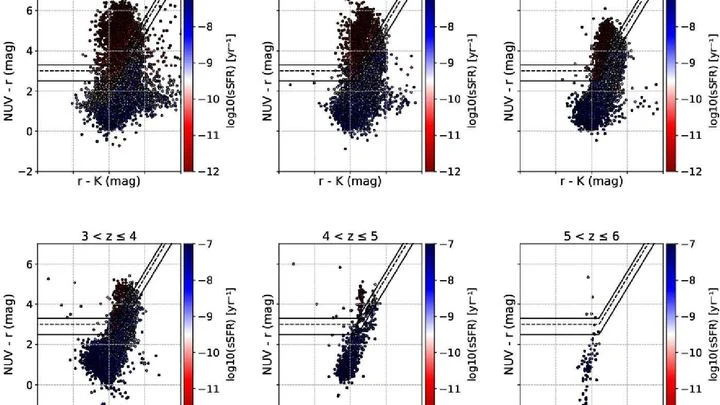
The Mystery of 'Impossible' Galaxies: How Outer Color Maps Are Rescuing Cosmology

Using NIRCam on JWST, astronomers studied four supermassive quiescent galaxies whose light has been traveling to us for over 11 billion years. It turns out that in three of them, the color shifts smoothly from center to outskirts: red old cores surrounded by bluer, younger regions. This color map re
arXiv:2606.02698v1 · 2026-06-01

Cosmic Detective: Two Independent Clues Against the Main Cosmological Debate

The Hubble constant — the expansion rate of the universe — has become a bone of contention: data from the cosmic microwave background and the distance ladder diverge by 6 sigma. Astrophysicists have proposed a new arbitration by cross-breeding 142 gravitational-wave events from the GWTC-4 catalog wi
arXiv:2606.03634v1 · 2026-06-02

Echoes of Black Holes: How Gravitational Sirens Reveal the Curvature of the Universe

Gravitational waves from mergers of black holes and neutron stars are not just ripples of curved spacetime but precise 'standard sirens' for measuring distances. A new study demonstrates that the Cosmic Explorer and Einstein Telescope detectors will be able to determine curvature Ω_k with an error o
arXiv:2606.04216v1 · 2026-06-02

Vacuum Tide: How Cosmic Emptiness Conducts the Universe

Standard cosmology stumbles over a 120-order abyss: by quantum calculations, vacuum energy should incinerate the universe, yet we see only a smoldering ember. The Running Vacuum Model (RVM) bridges the gap: it teaches spacetime to “remember” the expansion rate. In curved geometry, quantum fluctuatio
arXiv:2606.05352v2 · 2026-06-03

Dark Start: How Vacuum Decay Birthed the Big Bang

Imagine: after inflation, the Universe didn't ignite right away — it plunged into darkness. Nearly all the energy went into a dark sector, while ordinary matter got stuck in a false vacuum — a supercooled state, like liquid glass on the verge of crystallizing. Then a quantum nudge spawned bubbles of
arXiv:2606.06587v1 · 2026-06-04

The Cosmic Hump: How a New Spectrum Creates Massive Galaxies at the Dawn of Time

Observations by the James Webb Space Telescope have shown that in the early Universe, there are tens to hundreds of times more massive galaxies than standard cosmology allowed. A new model offers a paradoxically simple solution: a tiny 'hump'—a local enhancement—in the spectrum of primordial perturb
arXiv:2606.07357v1 · 2026-06-05

The Universe Isn't Getting Younger: Ancient Stars Rule Out "Early" Solutions

Astronomers led by Indranil Banik analyzed 155,600 subgiants from the LAMOST and Gaia catalogs. Bayesian age reconstruction revealed the oldest star at 13.73 billion years. Adding 0.2 billion years for the formation of the first stars gives a Universe age of about 13.93 billion years—a perfect match
arXiv:2607.00764v1 · 2026-07-01

The Hourglass of an Ancient Galaxy: JWST Spots Maturity That Arrived Too Soon

Analysis of images from JWST and Hubble with NIRSpec spectroscopy has revealed details of a distant disk galaxy at z=0.92. Multi-component modeling showed that an X-shaped bulge 4.5 kpc long and a bar of about 12 kpc were already present when the Universe was only 6.2 billion years old. A total stel
arXiv:2607.00982v1 · 2026-07-01

Dim Architects of Dawn: How Invisible Galaxies Lit Up the Universe

Analysis of ultra-deep images of the Abell S1063 cluster, boosted by nature's own gravitational telescope, has for the first time peered into the population of ultra-faint galaxies at redshifts 6 to 11. It turns out that even under the most conservative suppression of star formation, these tiny obje
arXiv:2607.01129v1 · 2026-07-01

A Universe Without Funhouse Mirrors: How a Ruler Error Spawned Cosmic Monsters

Recent sensational claims of giant inhomogeneities in galaxy distribution, supposedly contradicting the standard model, turned out to be due to a systematic error. Comparing DESI survey data with the FLAMINGO simulation showed that, when properly converting redshifts to distances, the observed large
arXiv:2607.01172v1 · 2026-07-01

Dark Energy: When the Constant Stops Being Constant

A team of astrophysicists conducted a systematic examination of extensions to the standard ΛCDM cosmological model, using data from telescopes like Planck, DESI, Pantheon+, and others. They added dynamic dark energy, spatial curvature, massive neutrinos, and additional inflationary parameters. It tu
arXiv:2607.01226v1 · 2026-07-01

The Conductor's Baton: How a Phase Transition Creates Axion Dark Matter

Lattice simulations showed that a first-order cosmic phase transition — like a sudden sweep of a conductor's baton — causes the axion field to switch on abruptly rather than smoothly. This gives rise to two regimes: a fast transition enhances the axion abundance due to delayed oscillations, while a
arXiv:2607.01333v1 · 2026-07-01

A Five-Dimensional Trace in the Cosmic Microwave Background

What lies beyond three dimensions? Theories with extra spatial dimensions predict the birth of massive particles in the young Universe. Using the cosmic microwave background as a kind of 'spectrograph,' scientists analyzed data from the Planck satellite looking for imprints of Kaluza–Klein gravitons
arXiv:2607.02651v1 · 2026-07-02

Cosmic Jazz: Three Finales of an Encounter with a Black Hole

How does a primordial black hole, a dark matter candidate, alter the fate of a planetary system? Simulations of the TOI-2796 system revealed three dramatic outcomes: planet ejection, formation of a stable triple system, and capture of the planet into an eternal journey with the black hole. The rare
arXiv:2607.03724v1 · 2026-07-04

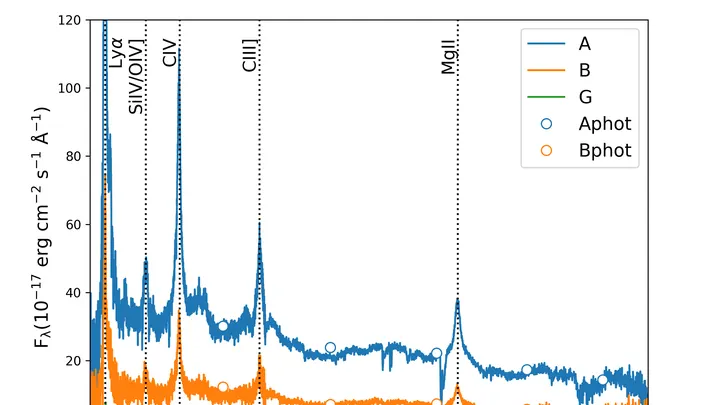
Fragrances of Cosmic Noon: How PAHs Survive the Hell of a Double Quasar

In the era of cosmic noon, 3 billion years after the Big Bang, two supermassive black holes are drawing close in galaxy J0749+2255. The MIRI infrared spectrograph on JWST captured emission from polycyclic aromatic hydrocarbons (PAHs) — organic molecules — not only in the cores but far beyond them. T
arXiv:2607.03913v1 · 2026-07-04

Cosmic Symphony: Algorithm Hears the Reverse Rhythm of the Early Universe

Analysis of data from the Planck satellite and ground-based telescopes using symbolic regression has revealed oscillations of the form cos(B/k) in the primordial perturbation spectrum. This inverse pattern is weakly preferred over standard alternatives and could be a remnant of a period of ultra-fas
arXiv:2607.04925v1 · 2026-07-06

The Quantum Wave That Gives Birth to the Universe

A physicist found that interpreting a motionless quantum wave as a probability distribution for a particle’s internal clock naturally yields the math of an expanding universe. Gravity becomes unnecessary—spacetime bends purely from statistical chances. This offers a route to merging quantum physics
arXiv:2607.05020 · 2026-07-06

Symphony of Dark Energy: From Heavy Adagio to Explosive Allegro

In the standard cosmological model, two epochs of the Universe speak different languages: the temperature of the cosmic microwave background demands one expansion rate, while supernova explosions demand another. The discrepancy has surpassed the five-sigma threshold, becoming a true crisis. The ECDM
arXiv:2607.05044v1 · 2026-07-06

Catching the Neutrino Wind: Why the Faintest Breeze in the Universe Demands the Impossible

The cosmic neutrino background is a ghostly echo of the Big Bang, billions of neutrinos permeating every cubic centimeter of space. Scientists have been hunting for its direct detection for years, but new work shows that measuring its anisotropy—the 'neutrino wind'—is a task orders of magnitude hard
arXiv:2607.05221v1 · 2026-07-06

Symphony of Shadows: Neutrino Telescopes Catch the Whisper of Dark Matter

Using 13 years of data from the ANTARES telescope, scientists have set stringent limits on the interaction of dark matter with ordinary matter across mass scales from keV to GeV. Collisions of cosmic rays with dark matter particles in the Galactic Ridge produce neutrinos that are detected by deep-se
arXiv:2607.05335v1 · 2026-07-06

The Mystery of Fragile Satellites: Dark Matter Under Tidal Assault

Elena Asencio and her colleagues showed that, contrary to standard cosmology, the Milky Way’s classical satellites suffer strong tidal deformations. In MOND (modified Newtonian dynamics) these disruptions are natural, while cold dark matter predicts they should be almost completely shielded by massi
arXiv:2607.05502v1 · 2026-07-06

Cosmic Tuning Fork: KLT-Net Neural Network Rewrites the Distance Ladder

Using 1701 Type Ia supernovae, the KLT-Net neural network reconstructs distance modulus for the first time without relying on cosmological models. The harmony of three architectures—KAN, LSTM, and Transformer—captures both local nuances and the global rhythm of expansion. The result: Hubble constant
arXiv:2607.06959 · 2026-07-08

Anchor in the Shallows: Why DESI Data Misses the Universe's Acceleration

Is the Universe accelerating its expansion—or not? The latest DESI survey, combined with Planck cosmic microwave background data, yields no clear answer for the current epoch, unlike older SDSS data. Researchers have shown that the root of the discrepancy is DESI's lack of measurements at low redshi
arXiv:2607.07348 · 2026-07-08