Phenomenology of early universe, cosmic microwave background, cosmological parameters, primordial element abundances, extragalactic distance scale, large-scale structure of the universe.
Scientists used a Bose–Einstein condensate (Bose and Einstein) — a state where atoms move as a single wave — to simulate the first moments after the Big Bang. By tuning interactions, they made it mimic the behavior of spacetime at the tiniest scales. This allowed them to observe “Planckian damping”
Scientists tested hundreds of galaxies against the rule 'every twist in light matches a twist in spin.' While the dwarf NGC 1560 followed suit, the overall sample showed 'extra' motions that don't match the visible pattern, complicating both dark matter models and alternative theories.
The universe is expanding, but measurements of its speed give conflicting numbers. This puzzle is called the Hubble tension. A new model suggests that in the early universe, a phase transition occurred in a hidden dark sector. It’s like the sudden freezing of supercooled water: a burst of energy was
The James Webb Space Telescope has for the first time captured light from stars consisting solely of hydrogen and helium — exactly what the very first stars after the Big Bang were probably made of. A cosmic magnifying glass helped: a galaxy cluster whose gravity amplified the faint shine of the dis
The merger of two unusually heavy black holes — GW231123 — suggests they might have originated from primordial seeds. Over billions of years, they sucked in matter, gaining mass and spinning up. Future observations will test this hypothesis and perhaps reveal the nature of dark matter.
The DESI survey examined the motion of galaxies and supernovae, testing the constancy of dark energy. Faint signals point to its evolution, and the Mirage model gave the best but not definitive result. If the energy is indeed growing, the Universe could face a tearing apart of matter.
Physicists have found that in the extreme gravity of neutron stars and black holes, a Bose–Einstein condensate emerges — a quantum state where particles merge into a single whole, like droplets of mercury. If dark matter consists of ultra-light axions, it naturally turns into a cosmic glue that keep
Scientists have found a mechanism for the birth of primordial black holes from magnetic vortices in the early Universe. These invisible objects may make up dark matter, and their formation created gravitational waves detectable by future detectors.
Physicists have proposed a way to test the hypothesis of a fifth dimension the size of a bacterium. If right-handed neutrinos live in it, then by measuring the energy of electrons in KATRIN, we will see sharp steps — one or more. Their number and position will reveal the properties of the hidden wor
Two cosmic mysteries—the excess of radio waves in the sky (ARCADE2) and the anomalously weak signal from the earliest hydrogen (EDGES)—have received a common explanation. The culprit could be axions, ultralight dark matter particles. In primordial magnetic fields, axions turn into radio waves, creat
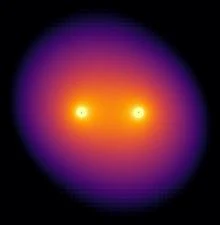
Simulations show that a cloud of dark matter around two stars takes the shape of a molecule. The elongated orbits of the stars knock particles out of the cloud, causing their trajectories to round out. This process could leave a noticeable imprint in the gravitational-wave background, helping to rev
A new study used only pulsating Cepheid stars to calculate the expansion rate of the Universe. The resulting value of 71.1 (km/s)/Mpc turned out to be lower than the previous 'gold standard' and even further from the Planck satellite data. This sharpens the 'Hubble tension' and suggests our knowledg
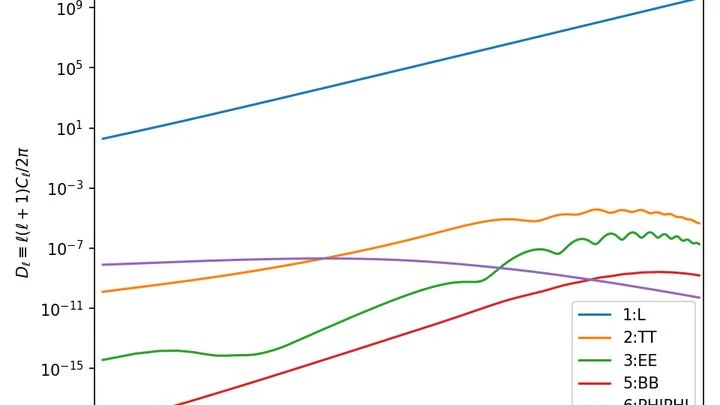
Astronomers found that the cosmic microwave background — the afterglow of the Big Bang — has slightly changed its polarization angle over billions of years. This twist may be caused by interaction with dark matter or dark energy. Data from the ACT telescope backs earlier hints from WMAP and Planck.
Scientists have created a detector that catches axions—candidates for dark matter. The device, made of layered material in a magnetic field, turns axions into light particles. Resonance, like that of a musical instrument, amplifies the faint signal, and tilting instead of moving parts lets you tune
New theoretical research reveals how the weak interaction—normally imperceptible—gets massively amplified during crystal growth. The amplification depends on a critical number of atoms in the seed of the new phase. This mechanism might have played a decisive role in the early universe, turning a mic
Analysis of years-long records of Earth's magnetic field has set the tightest limits on dark photons — dark matter particle candidates. Using the ionosphere as a giant resonator, scientists amplified faint magnetic fluctuations hundreds of times, but no direct signal has been found yet.
Recent observations of supernovae, galaxy distribution, and the Big Bang afterglow show that dark energy density is not constant. This challenges the standard cosmological model and promises a revision of the Universe's evolution.
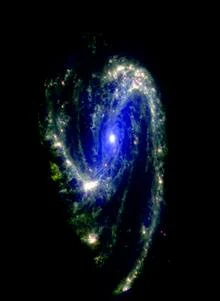
A very long and narrow trail of gas and dust has been discovered in the galaxy NGC 3627. It stretches for 26,000 light-years but is only 650 light-years wide. This wake was left by a massive black hole or the core of a dwarf galaxy that plunged through the galactic disk. The discovery offers a new m
ArgoLOOM is an AI-based program that builds a bridge between calculations from cosmology, particle physics, and nuclear science. It combines different computational methods into a single platform, enabling scientists to construct a unified picture of fundamental forces. Early tests suggest that this
Using a network of radio telescopes, astronomers spotted a tiny flaw in a thin arc of a distant galaxy. It revealed an invisible object with a mass of about a million Suns — a hundred times lighter than anything previously weighed at such distances. The discovery proves that gravitational lensing ca
In data from the Swift telescope, 34 gamma-ray bursts with a clear rhythm were discovered. These bursts are born when a dying star collapses into a black hole, and its superheated gas swirls into a rapidly rotating disk. The rhythmic pulsations reveal the dance of matter around the hole: perhaps thi
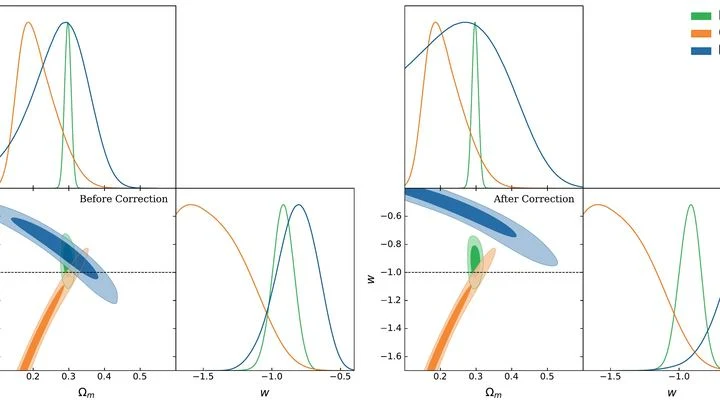
It was previously thought that Type Ia supernovae were reliable 'standard candles' for measuring distances, their brightness independent of age. New research shows: old stars produce dimmer explosions. This distorts the cosmic ruler. Correcting for age removes the discrepancy, and the data leans tow
Scientists have proposed a model where the universe didn’t explode from a point but first contracted and then bounced. Quantum effects during the bounce smooth out any distortions, making space uniform and the same in all directions. This is a natural explanation for the cosmos’s smoothness, requiri
Analysis of galaxy maps, quasar light, and supernovae shows that the simple model of constant dark energy is losing to a version with a smoothly changing force. This needs verification, but it's intriguing.
By turning Earth into a gravitational lens, scientists found a way to focus dark matter particles into a single point. There, a laser makes them instantly convert into light, which is then caught by detectors. The method promises to detect even ultralight particles from thousands of light-years away
Dark matter—the universe's invisible mass—might be a swarm of primordial black holes. Scientists have found a way to spot them: a hole with the mass of an asteroid would disrupt the precise ticking of pulsars; a more massive one, crashing into an icy body beyond Pluto, would light up like a searchli
Astronomers used a method where the program learns to find patterns without pre-labeled examples. It sifted through thousands of spectra and picked out groups, including rare objects. This will accelerate the analysis of future massive sky surveys.
Dark stars, shining from collisions of dark matter particles, became the progenitors of the largest black holes in the Universe. They grew to millions of solar masses, then collapsed, leaving behind seeds for future giants.
Scientists examined how dark matter affects black hole mergers. If its particles interact, they slow down the giants' plunge toward each other. Analyzing just 70 events with LISA will reveal whether dark matter collides. A new method paves the way to decipher the nature of invisible mass.
JWST data on massive galaxies at the dawn of time threatened to overturn dark matter theory. But new work shows the reason: systematic errors when converting brightness to mass. With those accounted for, 'impossible' galaxies vanish.
The Universe arranged a race of light beams. Fast radio bursts from distant galaxies made it possible to test: if the photon had mass, blue light would arrive later than red. In reality, the delay is explained only by gas. New mass limit: 5×10⁻⁵¹ kg – light is practically weightless.
The evaporation of primordial black holes may not have just destroyed them but also spawned new ones — like a spark igniting a forest fire. This self-sustaining reaction left behind a characteristic gravitational-wave hum with a sharp low-frequency cutoff. Future observatories like LISA could captur
Astrophysicists have shown that hypothetical boson stars—clumps of the lightest particles—can act as gravitational lenses with their own rhythm. The breathing lens oscillates its focus, and any light source caught in it begins to blink rhythmically. This can be tested with modern telescopes, offerin
The James Webb Space Telescope discovered massive galaxies that formed just a few hundred million years after the Big Bang. Existing models couldn’t explain such rapid growth. To solve the mystery, scientists considered that galaxies not only recede from each other but also have their own motions du
Physicists have proposed a hypothesis: once, dark matter particles paired up and abruptly cooled, like vapor turning into ice. This scenario explains the coldness of modern matter and predicts a distinct pattern that can be compared with the afterglow map of the Big Bang and the panorama of galaxies
Scientists have built a dark matter detector out of sponge-like porous crystals. When an invisible particle flies into such a sponge, it creates a twisted sound wave with magnetic properties. This faint signal is picked up by a built-in magnetic sensor. A nice surprise: the sensitivity barely depend
The collapse of boson stars triggers the formation of true vacuum bubbles that expand at light speed, altering the properties of all space. This new mechanism shows that even a stable vacuum is vulnerable to astrophysical catastrophes.
A hidden dimension in the shape of a Klein bottle inherently breaks the mirror symmetry that keeps matter and antimatter in balance. As our 3D universe slips through a layer of virtual particles in this dimension, real matter is born.
Observations show that dark energy in the early Universe behaved unusually, as if gaining strength. The KMIX model explains this as a visual trick, eliminating the 'Big Rip' scenario. A fast machine learning method helped compare the theory with data — and the result is encouraging.
By comparing supernova 'twins', astronomers eliminated the effect of cosmic dust and arrived at a more precise expansion rate. It turned out higher than what observations of the early universe suggest. The 'Hubble tension'—as this discrepancy is called—has been confirmed, meaning our picture of the
Computer simulations show: if dark matter is a frictionless fluid condensate, vortex lattices arise in galaxies. Light passing through them bends, creating a characteristic geometric pattern detectable by telescopes.
Invisible dark matter could have fueled the first stars. As its particles collided, they released heat and ignited giant luminaries that later collapsed into black holes. Calculations show their collective gamma-ray glow should be noticeable, opening a new way to hunt for dark matter.
A runaway supermassive black hole leaves a superheated gas tail visible from Earth. The James Webb Space Telescope clocked its escape velocity at 954 km/s, revealing that such giants can be flung from their galaxies.
New research shows that tiny black holes don't explode; instead, like a cooling kettle, their own radiation creates a 'blanket' and slows the process. This heat should have warmed ancient hydrogen, altering its 21-cm radio signal. But observations say the signal is colder. So black holes can't be da
Astronomers noticed that the light of quasars flickers like a candle flame. By analyzing the flickering pattern, they can determine the quasar's true brightness and calculate its distance. This allowed them to peer into the Universe's past and see that dark energy may not have been constant over tim
A fraction of a second after the Big Bang, the entire cosmos resembled a fizzy drink: bubbles of new vacuum swelled and rapidly expanded everywhere. Their collisions, racing to nearly the speed of light, unleashed energy that no laboratory device can achieve. In this cosmic crucible, super-heavy par
In the hot early Universe, much like bubbles in boiling water, regions of a new state of space emerged. Some of them possessed an enormous number of microscopic states, rendering them quantum-entangled. The merger of such bubbles generates gravitational waves that carry information about their quant
The model shows: the chef black hole heats galactic gas, preventing stars from igniting, and ejects metal-rich material while pulling in fresh gas. This explains the near-total lack of heavy elements in galaxy Abell 2744-QSO1 and the unusual ratio of the hole's mass to stars.
The expansion rate of the Universe — the Hubble constant — is key to the age and fate of the cosmos. The 'peak siren' method compared distances from galaxy light and gravitational waves. A match was found with 5.9 sigma confidence: H₀ = 67 km/s/Mpc. This is a new way to measure without relying on tr
A new hypothesis: dark matter acted like a sound amplifier. Its rhythmic oscillations, like microphone feedback on stage, turned faint magnetic seeds into the fields that shrouded galaxies. This explains the origin of cosmic magnetism without exotic additions.
Future gravitational wave detectors will see millions of black hole mergers. Sometimes the signal won’t arrive just once—massive invisible objects, like mountains, will create echoes. By measuring the delays between repeats, scientists will determine what fraction of dark matter is made up of primor
Scientists created modified gravity conditions (MOND) for a quantum fog and saw that the cloud expands and oscillates according to simple mathematical rules. This opens the door to lab-based tests of gravity theories that replace dark matter.
Scientists analyzed cosmological data and found that dark matter might have a subtle negative pressure. This contradicts the standard model, which treats it as completely inert. The result doesn’t depend on the dark energy model used. The discovery points to new physics, but leaves unsolved the myst
Different ways to measure the expansion rate, the properties of dark matter and energy, yield contradictions. Before changing physics, scientists are checking if their instruments are off. But increasingly it seems: the yeast is alive, and the recipe of the cosmos is not eternal.
Analysis of star motions in 23 dwarf galaxies showed that emergent gravity — a theory explaining attraction through the information capacity of space — is more accurate than modified Newtonian dynamics. The result with a confidence of 5.2σ casts doubt on the existence of dark matter.
New research explains dark energy as a loss of spatial equilibrium. A tiny dilaton field, born from that event, drives the repulsive push. It resolves the conflict in expansion rate measurements and hints at the cosmos's future trajectory.
The stretching cosmos can conjure particles from nothing. But new simulations find that if those particles tug on each other, they slam the door on further creation—challenging the idea that more expansion means more particles. The early universe may have been far less crowded than we thought.
In the first moments after the Big Bang, the universe boiled, spawning bubbles of a new reality. Their collisions accelerated particles more powerfully than any collider. This is how super-heavy neutrinos were born – particles that explain both dark matter and the mysterious excess of matter, and th
The cosmic lens effect offered a peek inside an invisible object with the mass of a million Suns. Its structure contradicts established theory: the density is uniform throughout, and a black hole likely hides at the center. Perhaps dark matter particles can collide.
Researchers found: the thicker the disk around a black hole, the rarer objects collide. Magnetic fields puffing up the disk can cut merger rates by billions of times. Astrophysicists must rethink gravitational wave forecasts.
Eight models of interaction between dark energy and dark matter fit observations better than the standard theory. Surprisingly, in the past, dark energy density could have been negative—like an energy debt in the dance. The finding refines the history of the expansion of the universe.
Scientists have shown how sterile neutrinos were born in the hot young Universe. This explains why we don't see their X-ray glow and turns dark matter into a tool for measuring the temperature of the early cosmos.
Analysis of 137 black hole mergers revealed three favorite masses: around 10, 18, and 33 solar masses. A flexible analysis, like a tuner, picked out these 'notes' more precisely than previous methods. As a result, the expansion rate of the universe was refined by 21%. This shows that the better we h
The accelerated expansion of the universe is usually explained by dark energy, but its nature is unknown. Perhaps it doesn’t exist, and gravity on cosmic scales deviates from Einstein’s law. Using maps of weak lensing—subtle distortions in the shapes of galaxies—scientists tested modified gravity th
In the early universe, giant black holes were born at a dizzying pace. The key lies in a dance of invisible fields: the trembling of the axion field and dark photons created vortex mixers that prevented matter clouds from fragmenting and whisked away their spin. Thus, quantum crumbs sculpted the see
Самую далёкую сверхновую SN Eos подтвердили, разложив её свет в спектр. Взрыв произошёл в среде, почти лишённой тяжёлых элементов, — прямое доказательство рождения массивных звёзд в ранней Вселенной. Открытие стало возможным только благодаря гравитационному линзированию и поможет уточнить темп рожде
This approach rewrites gravity's rules where it's barely felt—at the edges of galaxies. Under normal conditions, it aligns with Einstein's theory, but for weak fields, it adds a tweak. The solution needs no new particles and explains why galaxies spin faster than their visible mass permits.
Cosmology saw neutrinos as lighter than fluff, while lab experiments demanded noticeable weight. Decay into light invisibles resolves the conflict: some of the mass simply vanishes over time. Ordinary neutrinos, however, aren't fit for such a trick.
Physicists are hunting axions—light particles that might make up dark matter. They built a device with a levitating magnetized rod that should tremble if axions fly through it. In a new experiment, the rod stayed still, but the scientists set record constraints on how strongly axions interact with o
Generalized equations of the early Universe with a minimal correction better describe the 'quiet' large-scale patterns in ancient light maps, without disturbing the finely tuned small-scale picture. This hints at a gap in the standard inflation model.
By combining gravitational waves from merging neutron stars with galaxy surveys, scientists refined the universe’s expansion rate to 67.9 km/s per megaparsec (6.4% uncertainty), bridging a long-standing debate.
A computer simulation of the early universe revealed: supermassive black holes are born from plump seeds with a million solar masses and grow into giants in mere hundreds of millions of years, explaining the mysterious 'little red dots' seen by the Webb telescope.
Scientists have proposed that dark energy affects the mass of dark matter particles. This energy exchange accurately reproduces the observed expansion of the Universe and alters the growth of galaxy clusters by 10% — a difference that new telescopes will test. If the connection is confirmed, our und
Dark matter may consist of invisible particles that clump into clouds. Once such a cloud finds itself in a magnetic field, it lights up with ordinary light — like a firefly in the night. This effect offers a new way to detect the mysterious substance that makes up 85% of the Universe.
Supernova PTF12dam changed its appearance right as it was brightening. This prompted astronomers to think: the entire diversity of superluminous supernovae could be explained by the temperature of the ejected material at peak brightness. It turned out that the slower the light rises, the weaker the
A new model shows that dark matter and dark energy can transform into each other like a reversible chemical reaction. Observational tests confirmed that this process is almost impossible — only a few thousand transformations have occurred in the entire history of the Universe.
Cosmic 'boiling' in the early universe spawned bubbles of new vacuum and gravitational waves. Previous calculations of these waves were flawed due to their dependence on the frame of reference. A new method, borrowed from neutrino physics, eliminates this arbitrariness and promises a clearer picture
A new model shows how dark matter—a dust-like, invisible substance—could have emerged from the geometry of space during the rapid expansion. The mechanism works without fine-tuning: the right amount of matter automatically results from the expansion rate. After matter came to dominate over radiation
Scientists have shown that atom-sized black holes might be dark matter. With their gravity, they rip apart hydrogen atoms, leaving flashes. These traces can be found in ancient radio waves and chemical anomalies — that's how the invisible mass will be discovered.
After the Big Bang, sound waves left a rhythmic pattern in the distribution of galaxies — a 'standard ruler.' But over time, gravity blurs the sharp peak on the distance graph. Scientists discovered that the point of steepest slope on this graph hardly changes and serves as a more reliable tool. Ver
In giant cosmic voids, galaxies spin like a single ensemble. Their dance creates a barely noticeable difference in glow from different sides. It turns out that this effect is the most accurate indicator of how uniformly matter was foamed up at the moment of inflation. It is enough to measure it to f
Analysis of DESI data showed that adding a tiny negative fraction to dark energy improves agreement with observations, making it almost perfectly constant. Like a pinch of salt in dough, this addition brings harmony to the universe's expansion.
Scientists have built a model where dark energy loses its push. Instead of a shredding tear or a crunch into a point, the Universe’s expansion smoothly tapers off. The end result — a flat, table-smooth, empty space. Observations back this up.
A new study suggests dark matter isn't particles but a swarm of minuscule black holes. Born right after the Big Bang, like heavy dumplings in a cosmic soup, they quickly stirred up the surrounding matter, creating swift galaxy flows. The lightest of them evaporate, adding energy to the early Univers
Scientists have long debated: is dark energy constant or does it change? Fresh measurements point to a third path — it is conversing with dark matter. This turns a lone cosmic force into a duet of invisible interlocutors.
After rapid expansion (inflation), spacetime quickly restructures, triggering instability in the dark matter field. This kicks off an avalanche of particle creation — a purely gravitational mechanism. Calculations and computer simulations confirm that this can explain the observed density of dark ma
Future detectors will catch the hum from mergers of tiny black holes. New work shows how to distinguish this hum from other sources by its volume and frequency, and peer into the first second after the Big Bang.
Like a fussy chef, dark matter can only 'cook' the Universe using certain particles. New work shows how strongly it prefers quarks (the building blocks of atomic nuclei) over leptons (electrons and their kin). Using the idea of culinary symmetries and their violations, scientists estimated how far o
The James Webb Space Telescope has spotted enormous black holes in the young universe that couldn't have grown in the usual way. Their secret might be primordial black holes—tiny objects from the universe's first moments. Playing the role of dark matter, they rapidly merged at the centers of galaxie
Astronomers tested a model where dark energy is not a constant force, but a spring gradually losing its tension. The most surprising part: that same spring also explains dark matter, and all properties are set by fundamental theory without a single free parameter. Data from the DESI, Planck, and sup
In the first moments after the Big Bang, the Universe expanded at an enormous speed. If the expansion briefly paused, it generated powerful gravitational waves. Future detectors on Earth will be able to catch them, opening a window into an era hidden from any telescopes.
Data from the James Webb Telescope showed: mysterious red dots in the early universe are growing black holes. They emerged directly from gas clouds, without forming stars, and are now devouring matter at an incredible rate. This explains how supermassive black holes managed to grow so quickly.
Some theories suggest dark matter interacts with ordinary matter in a special way. If this interaction is strong enough, Earth's atmosphere acts as a shield, limiting the signal in labs. Orbital experiments, like those with quantum clocks, could detect changes in fundamental constants caused by dark
Scientists have found a new explanation for why measurements of the universe's expansion rate don't match: a tiny fraction of information may be 'erased' from its visible edge. This shortage creates extra energy that slightly accelerates expansion in the last few billion years, without affecting the
The universe is expanding, but two measurement methods give different speeds—this puzzle was called the Hubble tension. Scientists have proposed a model in which dark matter and dark energy are not strangers but interact, like dance partners. This simple assumption smooths out the contradiction. Tes
Astronomers used infrared light to peer into the core of galaxy IRAS 07251-0248. They found benzene, acetylene, methane, and other hydrocarbons in amounts inexplicable by ordinary gas chemistry. The key clue is cosmic dust: intense radiation, like a jackhammer, shatters dust grains, releasing comple
New research shows that small temperature fluctuations acted like well-timed pushes on a swing, amplifying the production of axions many times over. As a result, the likely mass of dark matter particles shifts into a region where they haven't been searched for yet. This changes the search strategy.
Tiny black holes, born in ever-expanding pockets of the universe, may make up all dark matter. This scenario not only explains its abundance but also predicts a detectable hum of gravitational waves.
Many explain the galaxies' recession with dark energy — a mysterious force that does not change over time. But there's an idea to replace it with the heat of emptiness itself. The cosmic horizon — the boundary of what we see — is slightly heated. This heat pushes the Universe apart. This approach re
Astronomers measured the motion of Centaurus A and M83 and found that the galaxies are gravitationally bound and impossibly drifting closer. Together, they pack about 6 trillion solar masses. This dance mirrors the future scenario of the Milky Way meeting Andromeda, helping us understand galaxy evol
Dark photons are light relatives of ordinary light, which could explain dark matter. A spherical mirror transformed them into radio waves, and 221 chilled sensors tried to catch that signal. In 1480 minutes, not a single photon was found, but it set a new limit on how strongly they interact with mat
Gravitational wave detectors caught the merger of two objects with a total mass less than the Sun's. Such black holes aren't born from stars—they could be primordial black holes, formed in the era described by the Standard Model of physics. Perhaps they actually make up dark matter. Calculations sug
Supermassive black holes heavier than a trillion Suns have an unexpected property: their shadow doesn't shrink with distance—it grows. This helps astronomers set strict limits: black holes with masses over a hundred million billion Suns simply cannot hide in the observable Universe.
When many gravitational waves overlap, special zones appear—like ripples on water freezing into predictable patterns. These structures aren’t random; they’re a regular feature of the cosmic background. By studying them, we can measure waves more accurately and glimpse the era of the universe’s birth
Astrophysicists have shown: the merger of two non-spinning black holes always produces an object with maximally chaotic movement of light rays at the horizon. The discovery helps better decode gravitational waves and test general relativity.
The 'late-waking' dark energy model: the mysterious force lay dormant for the first few billion years, then suddenly kicked in later. Telescope data allow for such a scenario, and in some combinations, it’s even more likely than the standard one. Yet the biggest puzzle—the discrepancy in measuring t
Researchers have shown: if the Universe first contracted and then expanded, the gravitational waves from both events mixed, like a double echo, creating a unique rhythmic pattern. Unlike the standard Big Bang, where the waves are chaotic, a clear pulsation emerges here. The signal is strong enough t
Scientists have discovered how rapidly spinning black holes produce the lightest particles—axions. These particles accumulate and vibrate, emitting gravitational waves at a single constant frequency. The hum from millions of such holes in our Galaxy can already be 'heard' by existing detectors, open
Three dwarf galaxies in the constellation Cetus lack dark matter. Velocity measurements in DF9 showed: stars crawl like pedestrians, instead of racing as usual. This pace indicates mass from visible stars only. Likely, all three arose when a galaxy collision filtered gas from dark matter, like a kit
Near the galaxy GN-z11, seen just 400 million years after the Big Bang, the James Webb Space Telescope spotted a bright spot. It glows with hot helium — such radiation can only come from very massive stars devoid of heavy elements, that is, the first generation. If confirmed, we are seeing for the f
The invisible substance that makes up most of the cosmos might reveal itself through the faintest nudges. A new method uses a levitating superconductor that picks up the slightest influences. Analysis shows that the magnetic response will be especially bright – this opens the door to a laboratory se
The faint light diffused throughout galaxy clusters turns out to be a precise impression of dark matter. Stars ripped from galaxies fill its gravitational scaffold like plaster into a mold. This discovery gives astronomers a direct way to study the hidden structure of the Universe, without resorting
A method for direct detection of axions — dark matter candidates — is proposed. The system, consisting of a layered resonator, a cloud of supersensitive atoms, and a superconducting nanowire, can catch single photons born from axions. This opens up a previously unexplored frequency range for dark ma
The universe began expanding faster only after large clumps of matter appeared. Dark energy wasn't always there — it switched on like a pump when dark matter gathered into galaxies. Calculations match observations, linking two major cosmic phenomena to a single cause.
If dark energy is not constant but evolves, it accumulates around black holes as a 'cosmic hair'. This hair alters the black hole's ringdown pattern after a collision. Observing these shifts with gravitational wave detectors like LIGO and LISA offers a powerful new way to measure dark energy's prope
Adding a second type of early dark energy helps resolve a stubborn mismatch: the universe's expansion rate measured today versus the rate inferred from the Big Bang's afterglow. The two-ingredient model narrows the gap and fits the afterglow's fine details, hinting that the early universe was more i
A recently caught ultra-high-energy particle may have been born not in distant space, but right after the Universe became transparent. This hypothesis resolves discrepancies with other experiments and predicts a barely perceptible trace in the afterglow of the Big Bang. The discovery forces a fresh
By watching pairs of galaxies draw closer, scientists have ‘weighed’ neutrinos – those almost intangible ghost particles. It turns out the combined mass of the three neutrino types doesn’t exceed 0.24 electronvolts (two million times lighter than an electron). The detected skew favoring neutrinos ov
Scientists have discovered that in the expanding universe, primordial black holes are born rhythmically: their mass grows not smoothly, but in jumps, forming a repeating pattern. Previously, this behavior was only observed in models without expansion. The discovery suggests that the mass distributio
Scientists have shown that different speeds of dark and ordinary matter create a gravitational resonance. Like a bow on a string, it amplifies sound waves in ordinary matter, explaining the longevity of spiral arms and gas heating. This makes it possible to 'hear' dark matter by its seismic imprint.
When invisible black holes pass through the Oort Cloud, they leave a trail: comets fly off in all directions, some even falling toward Earth. By comparing the actual frequency of comet appearances with calculations, scientists found that black holes a thousand times the mass of the Sun make up only
Scientists explored theories with extra heavy particles. In the early Universe, these particles briefly lowered the pressure of matter, facilitating the formation of black holes. This gave rise to objects with asteroid masses that could fully explain dark matter. Standard theories without such parti
The quintessential inflation model based on α-attractors describes inflation and modern dark energy as different roles of a single scalar field. Its key prediction is a kination stage, which amplifies high-frequency gravitational waves and leaves an imprint on the cosmic microwave background and pri
New data on the cosmic microwave background challenged the accepted inflation models. The solution was 'friction' in the equations of the field that drove the expansion. This move not only saves the theory but also promises to reveal a distinctive gravitational-wave background detectable by future i
The Universe resembles a sponge with huge pores—voids. Almost devoid of stars, these voids, as astronomers discovered, still harbor a thin gas. Using fast radio bursts, scientists managed to 'weigh' this invisible substance. It turned out to be about one and a half times less than the cosmic average
Astronomers used pulsars — ultra-precise cosmic lighthouses — to search for elusive dark matter. If it were made of ultralight wave-particles, they would distort the flawless rhythm of these stars. Years of observations showed no disturbances, but for the first time set bounds for two hypothetical f
Ripples of space, born at the moment of the Big Bang, still influence how galaxies gather billions of years later. Invisible waves from the universe's infancy clump together unseen mass, especially strongly for distant objects, altering their distribution by up to a factor of two. This discovery tur
What if the cosmic ocean expands unevenly? Using 1701 supernovae from Pantheon+, astrophysicists checked this and found a disturbing ripple — a dipole anisotropy in q0. But once they accounted for galaxies' peculiar velocities, the illusion almost dissolved. It's an artifact of our own drift, not ex
Primordial black holes are the key to two puzzles. They may make up dark matter (an idea by Vera Rubin and Fritz Zwicky), help black holes grow by generating a gravitational hum, and explain the giant black holes in early galaxies spotted by the Webb telescope.
Black holes are not eternal: they slowly lose energy, a process first described by Stephen Hawking. New research shows that when a hole almost disappears, a tiny reverse object remains — a white hole. Like a dying ember, it slowly releases the captured information. This resolves the long-standing pa
It turns out: the birth of black holes in the first moments doesn’t disrupt the harmony of the large-scale structure. Small and large processes in the Universe are separated, like basses and flutes. Thus primordial black holes become legitimate candidates for dark matter.
A new leptogenesis scenario shows: heavy Majorana neutrinos, born from the vacuum by post-inflation expansion, gave rise to the entire baryon asymmetry. Their mass almost mystically matches the inflation scale — and it's no accident: the amplitude of primordial gravitational waves becomes a direct e
Researchers modified the classic Bousso–Polchinski model, representing vacuum energy as the difference of contributions in flux space. As a result, small values of the cosmological constant form not spheres, but the thinnest 'waffles' — hyperdisks. Analysis of a database of 532 million Calabi–Yau ma
Using Cosmicflows-4++, scientists directly estimated relativistic corrections and found that curvature contributes about 10% to the expansion dynamics on scales up to 300 Mpc/h, while kinematic backreaction is negligible. This challenges the globality of ΛCDM and threatens systematic errors in cosmo
Simulating black hole images against different dark matter profiles revealed a frightening flexibility: a cored-NFW-type flattened halo noticeably inflates the bright ring, shifts its center, and amplifies asymmetry — almost exactly replicating real Event Horizon Telescope data. The Einasto profile,
A new study proposes a simple observational test: any binary system with a negative-mass component must either produce an anomalous signal with a falling frequency or instantly fly apart. Not a single such 'note' has been found in the LIGO, Virgo, and KAGRA archives. The silence shuts down an entire
Early galaxies let through far more ultraviolet light than expected. The reason is dust from supernova explosions, which stays almost as clear as glass but slowly clogs over time, explaining the differences between young and mature galaxies.
For a long time, dark energy was thought to be an unchanging force accelerating cosmic expansion. But the DESI instrument, by studying galaxy distributions, found that its influence has weakened by about 10% over billions of years. This undermines the foundations of the standard picture and paves th
Hundreds of scientists answered questions about the deepest mysteries of the Universe. The results showed that topics which seem settled in textbooks actually provoke fierce debate. Science is not a set of dogmas but a living dialogue, and this research confirms it.
The cosmic microwave background not only brings a map of the early universe but also a subtle twist in polarization—just a few thousandths of a radian. For a long time, it was attributed to ultralight axions, but they clash with experiments. A new explanation is more elegant: the rotation arises whe
Dark matter is invisible, but its gravity gives it away. It might consist of axions—light particles that can turn into radio waves inside a magnet. The new detector acts like a full-band receiver: it scans a vast range of axion 'frequencies,' filtering out noise, and promises to catch their signal h
Hydrogen in space acts as a network of natural antennas that pick up gravitational waves. By comparing the observed brightness of the glow with the theoretical value, scientists determine how much energy went into gravity. This makes it possible to create a gravitational map of the Universe.
Primordial black holes (PBHs)—candidates for dark matter—were long thought impossible to produce during phase transitions due to the gauge dependence of density contrast. However, new research shows that slow reheating after the transition creates a matter-dominated era where even weak perturbations
Just after the Big Bang, the universe was a hot particle soup. Neutrinos, escaping from it, were supposed to cool down to 1.96 degrees above absolute zero. New research shows that tiny clumps in that plasma, as they faded, cooled the neutrino background a bit more. The PTOLEMY experiment will try, f
Astrophysicists have proposed a new method for hunting dark matter — not searching for the black holes themselves, but listening to the quantum echo of gravity. In regions of ionized hydrogen, tidal forces from primordial black holes split the atomic level 2P₃/₂, turning a single 9.9 GHz absorption
Cosmology allows for a terrifying scenario of phantom dark energy, where the universe's expansion accelerates so violently that it tears apart galaxies, stars, and atoms. Deep-space detectors can't spot a sudden shift to this state: light from distant supernovae has traveled billions of years. So Ro
Quantum gravity eludes experiments due to the Planck scale. But the 2026 Gravity Research Foundation award-winning work points to a natural super-amplifier: superradiant axion clouds around rotating black holes. This cosmic mechanism generates squeezed states with up to 10⁷ correlated gravitons, cre
The Universe is expanding, but measurements of the rate from early times and today disagree — this puzzle is called the Hubble tension. A new model introduces an invisible chameleon field that recently began nudging expansion further and adds invisible mass that holds galaxies together. Near Earth,
In a new cosmological model, the source of accelerated expansion is not a mysterious cosmological constant but the process of absorbing other universes. The merger intensity is set by a single constant g, calibrated by the local value of the Hubble constant. The computed evolution of the dark energy
A mechanism is proposed in which gravitational waves from bubble collisions during phase transitions and domain wall annihilation induce second-order scalar inhomogeneities. These inhomogeneities can collapse into primordial black holes of asteroid masses, fully accounting for dark matter. Model-ind
An analysis of black hole mergers over the past year of observations reveals: almost all signals come from ordinary black holes of stellar origin. Primordial black holes, if they exist at all, make up only a tiny fraction of dark matter.
Scientists studied how dark matter and dark energy influence each other. Using gravitational lenses—massive galaxy clusters that bend light—they found that dark energy slowly transforms into dark matter. This explains why the universe's expansion began accelerating earlier than expected.
The moving lens effect bends the oldest light, revealing how galaxies and dark matter glide across the sky. Combined with other signals, it will build a 3D map of cosmic flows, testing gravity and the growth of structure.
The universe is full of black holes, but middleweights long eluded detection. Now distortions in radio signals have given them away, as if invisible masses altered the voice of distant bursts. These could be Big Bang relics hiding in dark matter.
Scientists analyzed the universe's ancient light—the afterglow of the Big Bang—and found imprints of extra dimensions curled into microscopic rings. A new way to test string theory through observation.
Dark energy, which makes the Universe expand ever faster, twice briefly crossed stable boundaries — DESI observations revealed this. The model explains such behavior by interaction with dark matter particles: their coupling creates an illusion of violation, but the system remains stable. The theory
Scientists have proposed a model of the early universe resembling a traffic jam followed by sudden acceleration. This shift in rhythm naturally smooths out large irregularities in the microwave background—the very ancient light that captured the newborn cosmos. It explains Planck satellite data with
In the dark universe, two types of particles are connected. When a massive particle oscillates, it makes a light particle vibrate, which changes light's properties. This cascade resonance could betray dark matter. Plot twist: the mechanism doesn't distinguish the direction of light's wobble — left a
Inflation—the Universe’s rapid ballooning—could act as a detector for special neutrinos. A special interaction, like a filter, amplifies their signal in the ancient light. This could explain the mystery of neutrino mass and point to new physics.
By simulating Euclid telescope observations, scientists showed that combining two analysis methods—coarse ripple measurement and fine asymmetry detection—nearly doubles accuracy. This will help test theories of the Universe's birth and likely spot traces of quantum jitters.
The evaporation of primordial black holes was supposed to generate gravitational waves. But because of their inevitable mass spread, a loud signal becomes mere noise, restoring these objects' chance to be dark matter.
Researchers trained a neural network on computer twins of star clusters to guess the main black hole. Comparison with real objects showed: giants are rare in globular clusters, while central clusters of galaxies might harbor middleweights. Unexpected twist: many black holes get a kick from the merge
Scientists have for the first time combined a rotating black hole and the expansion of the Universe in a mathematical model. It turns out that in the inflating cosmos, its point of no return and the twisted region of space gradually shrink — even though the hole's mass remains unchanged. And mysteri
Astronomers cracked the flare pattern of a distant galaxy. A tiny orbiting object repeatedly punches through a gas cloud — the remains of a torn-apart star. The cloud is bent, so some bursts shine brighter, others dimmer. This on-off rhythm unveils the central black hole's spin. In a few decades, th
Gravitational waves aren't just the hum of space. They have polarization, a direction of oscillation that has been ignored until now. A new approach, like polarized sunglasses, filters out glare from bright black hole mergers and reveals the background's true pattern for the first time.
Thanks to the discoveries of Edwin Hubble and Vera Rubin, we know that the Universe is expanding and contains invisible mass—dark matter. Astronomers have developed a new method: they create computer simulations to guess the Universe's properties without complex formulas. Combining maps of galaxies
Astrophysicists have shown: dark matter around a black hole barely distorts images of distant galaxies, but it alters the delay between the distorted images. For giant holes like M87*, the difference in light arrival time can be measured—a path to solving the dark matter puzzle.
Comparing two models: the standard one requires invisible dark energy, the alternative plays fair. Data with 92% probability support the simpler option.
Physicists suggest that invisible dark matter is the 'salt' left behind after primordial black holes evaporated. Calculations show that if there were too many such holes, their remnants would have overfilled the cosmos. But black holes weighing about a ton naturally account for the observed amount o
A new study models dark matter as a superfluid near a black hole. Physicists found two types of stable structures: a dense core and a rotating vortex. It turns out the vortex is stable if dark matter particles attract each other weakly; strong attraction makes it collapse. This discovery suggests th
In the early Universe, black holes sprang directly from clumps of dark matter. But collapse only kicked in where the matter formed broad, gently sloping hills, not sharp peaks. These primordial holes became the seeds of the giants at the centers of galaxies — allowing them to grow huge in a short ti
Researchers have proposed a model where cosmic history repeats exactly. Due to quantum cyclicity, the Universe returns to the Big Bang without having time to spawn hordes of phantom consciousnesses. This explains why we observe an orderly world rather than fleeting flashes of intelligence in the voi
Pulsars are cosmic lighthouses beaming radio pulses with the precision of atomic clocks. A passing gravitational wave disrupts this rhythm. Instead of searching for familiar patterns, the new technique listens to all the noise and picks out any signal, decomposing it into frequencies and applying a
Two key methods for measuring the expansion rate of the Universe — the cosmic microwave background and supernovae — yield values differing by 5 sigma. A hybrid model adds to the cosmological redshift a contribution from quantum conversion of photons into hidden mass. Analysis of the Pantheon+SH0ES c
A new study offers a bold explanation: the accelerating expansion of the Universe isn't the result of mysterious dark energy, but a consequence of quantum boundary conditions imposed from the distant future. In a radiation-dominated model with zero cosmological constant, a final state in the form of
Observations by the JWST have revealed a population of compact, anomalously red and bright sources in the early Universe — the so-called 'little red dots' (LRDs). Their nature remains a mystery: standard models of stars or active galactic nuclei cannot explain their spectra. One candidate is quasi-s
These objects are one of the biggest mysteries and a possible key to dark matter. New modeling has revealed a rare but spectacular scenario with two outcomes for capture by a binary system. Without an accretion disk, the star fades unnoticed; with a disk, it is torn apart by relativistic jets in min
The first two-dimensional radiation-hydrodynamic simulations prove that the radiation pressure in the Lyman-alpha (Lyα) line can exceed the direct stellar light force by up to 16 times and serve as the main feedback mechanism even before the explosion of supernovae in environments poor in dust. This
The classical light cone is a crystal-clear boundary between what can be causally connected and what remains forever separated. But quantum field theory in curved spacetime paints a different picture: gravitons, the quanta of the gravitational field, tremble even in vacuum, causing spacetime itself
In the early Universe, the Big Bang could have spawned cosmic strings—one-dimensional defects whose enormous energy can still shake spacetime. Their decay through quantum tunneling dictates the gravitational signal that detectors will pick up. New lattice modeling has shown: the string's finite thic
The primordial lithium-7 problem is one of the main contradictions in standard cosmology: Big Bang nucleosynthesis theory predicts three times more lithium-7 than observed in old stars. An elegant solution proposes using neutrons from the evaporation of primordial black holes. Neutron capture turns
Astronomers are increasingly finding giant black holes in the early universe, with masses reaching a billion suns. Ordinary gas accretion can't 'fatten' them up fast enough. A new hypothesis introduces an extra dimension: our brane-universe and an invisible donor brane intersect at a shared horizon.
The Hubble constant — the expansion rate of the universe — has become a bone of contention: data from the cosmic microwave background and the distance ladder diverge by 6 sigma. Astrophysicists have proposed a new arbitration by cross-breeding 142 gravitational-wave events from the GWTC-4 catalog wi
Gravitational waves from mergers of black holes and neutron stars are not just ripples of curved spacetime but precise 'standard sirens' for measuring distances. A new study demonstrates that the Cosmic Explorer and Einstein Telescope detectors will be able to determine curvature Ω_k with an error o
Recent observations suggest that dark energy, the force accelerating the universe’s expansion, is not constant. Around 6 billion years ago, it crossed a critical threshold, making its behavior even more puzzling. Scientists came up with a simple idea: the dark energy field experiences a tiny amount
Researchers combined a two-fluid model of neutron stars with fermionic dark matter and results from the search for continuous gravitational waves by the LIGO detectors. An anisotropic distribution of dark matter can create 'dark mountains' — quadrupole deformations that amplify emission. Comparison
Stretching around NGC 1052 is a chain of ultra-diffuse dwarfs — galaxies almost devoid of dark matter. According to the 'bullet dwarf' hypothesis, they were born from a head-on collision of gas clouds: dark matter slipped through, while the stars lined up in a row. Skeptics saw a projection illusion
The JWST peered into the hearts of gravitational lenses — and found not a single smudge expected from lightweight dark matter particles. New data shut down many warm dark matter models and bolster the standard cold scenario. Limits on the half-mode mass and thermal relic mass are among the tightest
Dark matter is physics' greatest intrigue. Paleodetection opens a new chapter: million-year-old minerals, like laurionite (PbClOH), preserve traces of dark particles. Thanks to massive lead nuclei and exceptional purity, crystals can detect the Higgsino — the superpartner of the Higgs boson, whose s
Two unrelated puzzles of the Standard Model — the flavor hierarchy and the strong CP problem — find a common solution in a model with flavor gauge symmetry and an axion. Born in the early Universe, two types of cosmic strings after the QCD phase transition become efficient sources of gravitational w
Standard cosmology stumbles over a 120-order abyss: by quantum calculations, vacuum energy should incinerate the universe, yet we see only a smoldering ember. The Running Vacuum Model (RVM) bridges the gap: it teaches spacetime to “remember” the expansion rate. In curved geometry, quantum fluctuatio
The DESI instrument, mapping millions of galaxies, has picked up signs of dark energy evolution. This discovery rewrites the rules for measuring the Universe's expansion rate: the local Hubble constant might drop by several km/s/Mpc. The drama of the Hubble tension — the discrepancy between the earl
The recent short gravitational-wave transients GW190521 and GW231123 have caused puzzlement: their parameters — extreme masses and spins — challenge the standard black hole merger scenarios. Scientists tested an exotic hypothesis: perhaps these bursts are not generated by cosmic catastrophes, but by
Imagine: after inflation, the Universe didn't ignite right away — it plunged into darkness. Nearly all the energy went into a dark sector, while ordinary matter got stuck in a false vacuum — a supercooled state, like liquid glass on the verge of crystallizing. Then a quantum nudge spawned bubbles of
An international team led by Marco Giunto analyzed nearly a thousand Type Ia supernovae from the ZTF survey and showed that the differences in their color and brightness are almost entirely caused by dust in their host galaxies, not by the physics of the explosions themselves. This settles a long-st
What if dark matter isn’t just passive, but can actually ignite stars? New research simulates white dwarf explosions triggered by the passage of a primordial black hole—a candidate for dark matter. Hydrodynamic simulations and nucleosynthesis calculations of 495 isotopes show that such Type Ia super
Radio telescopes CHIME and FAST can detect high-frequency gravitational waves that, passing through magnetic fields, turn into radio signals. This method enables the detection of mergers of microscopic black holes and even clouds of invisible particles around black holes, paving the way to solving t
The Ph-ΛsCDM model describes the behavior of a special field that smoothly transitions from an attractive to a repulsive force. This resolves contradictions between different measurements of the expansion rate and predicts a stable future without the 'Big Rip'.
A new method will allow catching particles with a microscopic charge, born in supernova explosions. They arrive after neutrinos, like a delayed wave. Perhaps dark matter is made of exactly such particles.
The universe is expanding at an accelerating rate. Usually this is blamed on dark energy. But a new explanation is post-selection, a quantum trick where the future selects scenarios that suit it. This removes the mystery and explains why the acceleration started just now.
Galaxy clusters in recent epochs have been growing more slowly than expected. The culprit could be dark matter decaying into lightweight particles that create a cosmic 'wind,' hindering clumping. This new model leaves a telltale signature that future sky surveys could detect.
Planets on the outskirts of star systems prove to be perfect scales for invisible matter. A drifting clump of dark matter nudges their orbit just enough— a shift we can now measure. This method could uncover the primordial invisible structures lingering from the Big Bang and let us chart the dark un
Scientists from the XENONnT collaboration have shown that ultrasensitive detectors built to hunt dark matter can spot neutrinos born from thermal motion in the Sun's core. The energy of these particles is like a dust speck tossed by the wind, once thought nearly invisible. The method lets us study t
Astronomers added a short-lived dark energy to the standard model, which appeared right after the Big Bang. This idea reconciled two methods of measuring cosmic expansion that previously gave different speeds—like two different thermometers. This approach strengthens the model without a major overha
The 'dark bubble' model explains why the Universe is expanding faster and faster. It suggests a hidden dimension about a micron thick. At such distances, gravity should weaken dramatically, linking the microcosm to cosmology and providing testable predictions.
Scientists described how magnetic fields in the early universe, like an invisible spoon, stirred spacetime, creating eddies that condensed into black holes. These holes could be a major component of dark matter.
The Webb telescope spotted red dots that look like galactic cores with enormous black holes. But a fresh analysis suggests they might be modest-sized objects wrapped in a dense gas cocoon. Just as fog makes a lantern seem like a huge red ball, the gas distorts our estimates. Inside, there may not be
Astronomers led by Indranil Banik analyzed 155,600 subgiants from the LAMOST and Gaia catalogs. Bayesian age reconstruction revealed the oldest star at 13.73 billion years. Adding 0.2 billion years for the formation of the first stars gives a Universe age of about 13.93 billion years—a perfect match
In pursuit of elusive dark energy, scientists have found a workaround: using pairs of independent gravitational lenses with nearly identical deflectors. Simulations for the LSST survey show that such 'pseudo-double' systems allow measuring the cosmological equation of state with unprecedented statis
Using a flexible mixed population model, scientists discovered a striking coincidence: the mass distribution of high-spin black holes exactly matches the distribution of remnant masses from the low-spin subpopulation. This ‘smoking gun’ proves that rapidly spinning black holes arose from hierarchica
Recent sensational claims of giant inhomogeneities in galaxy distribution, supposedly contradicting the standard model, turned out to be due to a systematic error. Comparing DESI survey data with the FLAMINGO simulation showed that, when properly converting redshifts to distances, the observed large
A team of astrophysicists conducted a systematic examination of extensions to the standard ΛCDM cosmological model, using data from telescopes like Planck, DESI, Pantheon+, and others. They added dynamic dark energy, spatial curvature, massive neutrinos, and additional inflationary parameters. It tu
Lattice simulations showed that a first-order cosmic phase transition — like a sudden sweep of a conductor's baton — causes the axion field to switch on abruptly rather than smoothly. This gives rise to two regimes: a fast transition enhances the axion abundance due to delayed oscillations, while a
The formation of primordial black holes requires extreme amplification of primordial curvature perturbations, which generates two types of gravitational waves: a low-frequency background (SIGW) from the perturbations themselves and a high-frequency signal from the mergers of the resulting binary sys
Recently, pulsar timing array collaborations detected a stochastic background of nanohertz gravitational waves. Scientists investigated whether a first-order phase transition in the simplest dark sector — an Abelian Higgs model — could have produced it. Precision thermodynamic analysis using dimensi
What lies beyond three dimensions? Theories with extra spatial dimensions predict the birth of massive particles in the young Universe. Using the cosmic microwave background as a kind of 'spectrograph,' scientists analyzed data from the Planck satellite looking for imprints of Kaluza–Klein gravitons
The hunt for dark matter demands the ability to read the subtlest distortions of light. In a new study, astrophysicists transformed the curved arcs of gravitational lenses into straight lines using a polar transform — and the neural network started noticing previously invisible subhalos. On simulate
Black holes store more information than the infalling matter provides. This excess 'information load' shifts the frequency of gravitational waves during mergers, revealing their origin—stellar or quantum.
Analysis of 3455 fast radio bursts from the CHIME telescope has mapped electron density fluctuations in the cosmic web. The statistically significant signal at >3σ confirms that residual dispersion measures are not random, but reflect real baryon clumping. The method, which does not require precise
Astrophysicists have proposed a method to search for ultralight axions — dark matter candidate particles — using high-precision polarimetric observations of close binary stars. In such systems, light reflected from the companion star's atmosphere creates a weak linear polarization strictly tied to t
Scientists have constructed a rigorous quantum-kinetic theory of gravitational instability for the fuzzy dark matter model—ultralight bosons with a mass on the order of 10⁻²² eV. By applying the Wigner equation and the Landau method, they derived a dispersion relation that revealed a sharp crossover
Analysis of data from the Planck satellite and ground-based telescopes using symbolic regression has revealed oscillations of the form cos(B/k) in the primordial perturbation spectrum. This inverse pattern is weakly preferred over standard alternatives and could be a remnant of a period of ultra-fas
In the standard cosmological model, two epochs of the Universe speak different languages: the temperature of the cosmic microwave background demands one expansion rate, while supernova explosions demand another. The discrepancy has surpassed the five-sigma threshold, becoming a true crisis. The ECDM
The cosmic neutrino background is a ghostly echo of the Big Bang, billions of neutrinos permeating every cubic centimeter of space. Scientists have been hunting for its direct detection for years, but new work shows that measuring its anisotropy—the 'neutrino wind'—is a task orders of magnitude hard
Using 1701 Type Ia supernovae, the KLT-Net neural network reconstructs distance modulus for the first time without relying on cosmological models. The harmony of three architectures—KAN, LSTM, and Transformer—captures both local nuances and the global rhythm of expansion. The result: Hubble constant
Is the Universe accelerating its expansion—or not? The latest DESI survey, combined with Planck cosmic microwave background data, yields no clear answer for the current epoch, unlike older SDSS data. Researchers have shown that the root of the discrepancy is DESI's lack of measurements at low redshi
The mysterious force accelerating the universe turns out to be fickle. In a new model, dark energy is like steam that partially condenses into 'droplets' when cooled. Massive galaxy clusters act as refrigerators, their gravity creating pressure differences. This solves recent anomalies in supernova
Researchers assessed the capability of the space-based gravitational-wave observatory LISA (launch in 2035) to detect ultralight dark matter interacting with Standard Model fields via quadratic coupling—a common mechanism in axion and dilaton models. Through this interaction, the signal emerges on t