Roots from the Abyss: The Secret Growth of Supermassive Black Holes ✛ ✦
The expansion of the universe, discovered by Edwin Hubble, gave us a picture of the young cosmos, but along with it — difficult questions. JWST peers into the era of the first galaxies and finds something incredible there: black holes with a billion solar masses shine as quasars, even though they simply didn't have time to gather that much mass. Standard gas feeding is hopelessly slow. Physics demands a different source of nourishment.
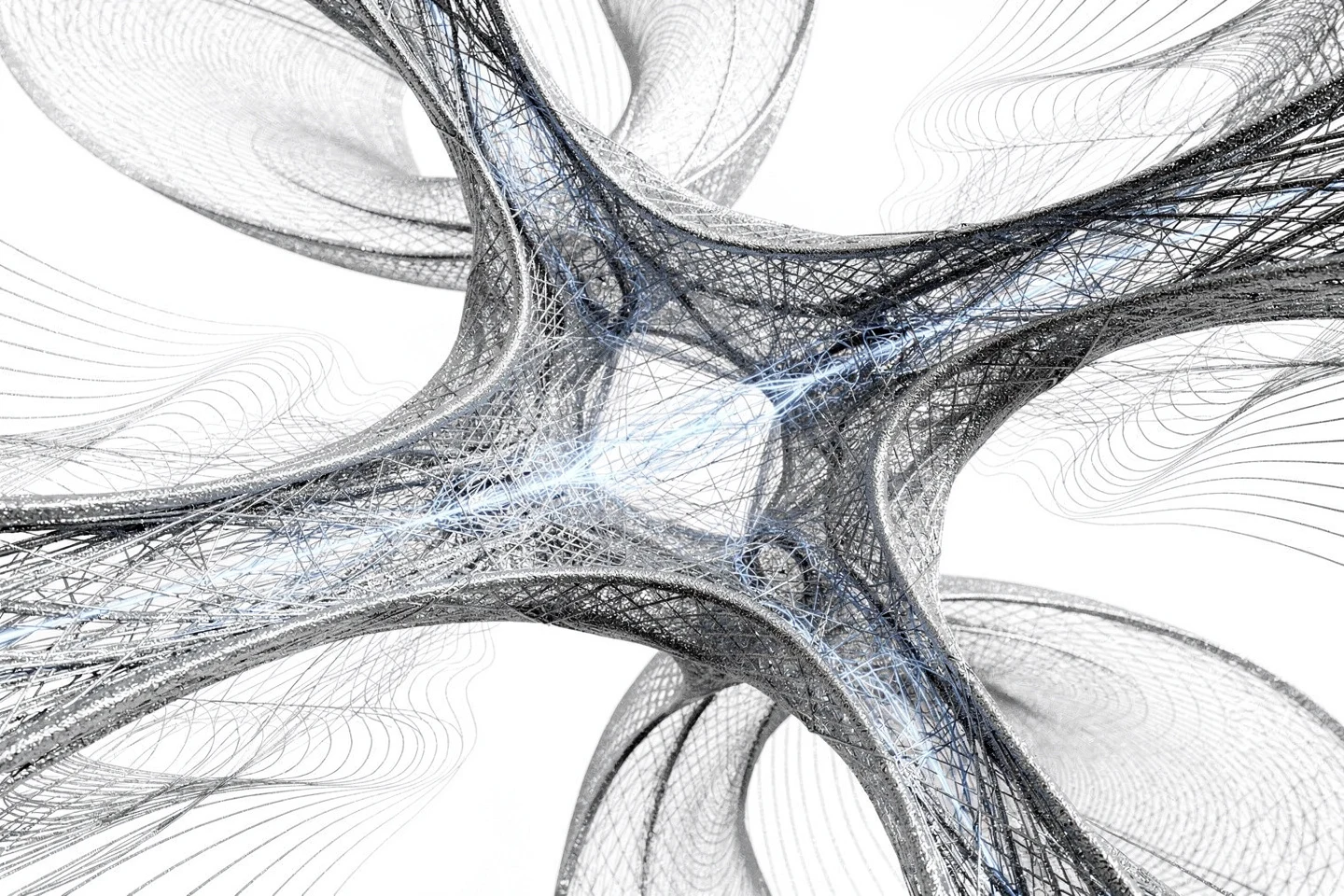
Here the metaphor of a giant tree comes into play. The visible crown is the mass of the black hole in our brane, its horizon, conventionally described by Karl Schwarzschild's metric. But the roots that feed this growth go down into an invisible substrate — a parallel brane. In a model with an extra dimension, the overall curved geometry appears as a five-dimensional black string. It pierces both branes and possesses a single horizon. Matter falling onto the hidden side increases the area of the shared horizon, and hence the mass we attribute to the object in our world.
The key growth law relates the accretion rates on the two branes: \(\frac{dM_A}{dT_A} = e^{-2d/\ell} \frac{dM_B}{dT_B}\). Here \(d\) is the microscopic distance between the branes, and \(\ell\) is the curvature scale of the extra dimension. This is like the efficiency of a root system: the thinner the layer between worlds, the more abundant the invisible moisture that flows to the cosmic tree. Numerically: with a gap less than a tenth of a millimeter, the hidden donor can grow a black hole to supermassive size without visible gas flows.
The main advantage of the model is that it creates seeds for black holes without extreme density perturbations, which would have left traces in the cosmic microwave background. The hidden growth channel bypasses these constraints, and the predicted signal from mergers of such objects promises to be loud. The LISA detector, being built with the participation of Nobel laureate Rainer Weiss, will tune into the low-frequency gravitational-wave noise from mergers of heavy seeds at high redshifts. Characteristic frequency: \(f_{\text{ISCO}} \approx 4\) mHz for a mass of \(10^5 M_\odot\) at \(z=11\). This is literally the music of invisible roots, resounding from the depths of spacetime.
Thus nature may have divided one horizon into two worlds, leaving us a chance to hear its multidimensional harmony. Perhaps we are already seeing these crowns in telescope images, giant black holes, without realizing that their true power is fed from invisible dimensions. In the future, a complete picture of the black hole population, testing the extra-dimension hypothesis, and maybe unraveling the dark sector, whose invisible threads intertwine with the most spectacular force of gravity.
Some of these hollow black holes could be so massive that their event horizon wouldn't fit inside Pluto's orbit.