A Bridge That Only Holds the Finite: On Strong Structural Completeness ✛
Context
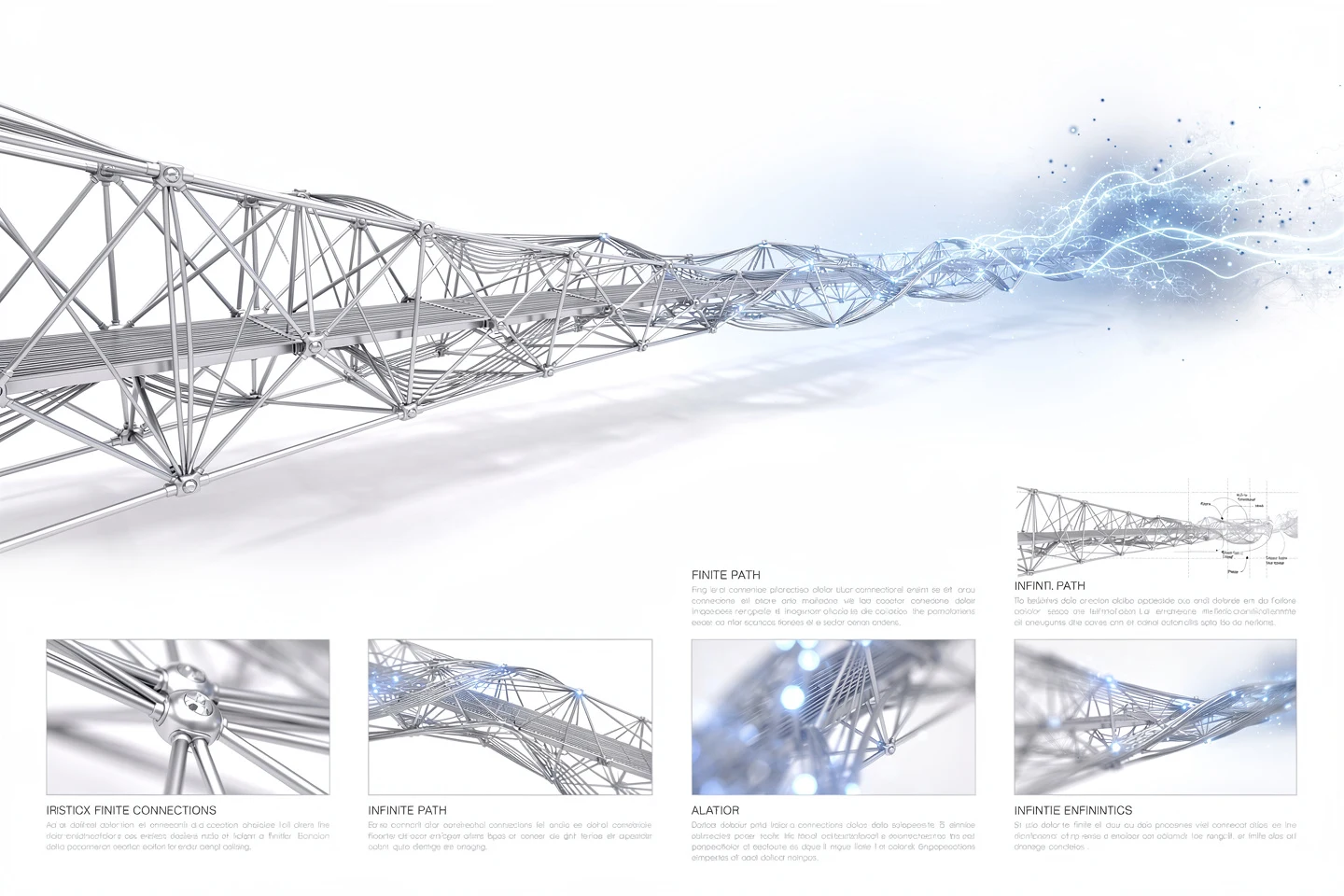
1971. Logician W. Pogorzelski introduces structural completeness: a logical system is complete when every admissible rule (one that adds no new theorems) can be derived from the axioms. Think of a sturdy bridge over a roaring river—everything that preserves truth is already built into the rules of the game. Classical propositional logic has this property, but for many non‑classical logics—intuitionistic, modal—the bridge proves shaky. In the algebraic picture, a logic is represented by a class of models: algebras. Structural completeness means the variety is generated by its free algebras. Yet what happens when rules become infinite? Alex Citkin’s work supplies the answer by introducing κ‑structural completeness, where κ is a cardinal bounding the number of premises and variables. It turns out that once κ > ω, the bridge almost always collapses.
Methods
The analysis of strong structural completeness uses bounding κ‑quasi‑equations. Construct an infinite set of equations: for each unequal pair of elements in an algebra, add a condition tying them to a distinguished pair from the monolith. If the algebra is finite, all these conditions hold and force the conclusion. For infinite algebras one can always find a refuting valuation—a trick that generalizes Jankov’s method. The crucial tool is characteristic κ‑quasi‑equations for indecomposable algebras, which act like atoms in the structure of the variety.
Results
Main result: if a congruence‑distributive variety of finite type is generated by finite algebras, then κ‑structural completeness for any κ > ω is equivalent to tabularity. In plain terms, the bridge holds only when the whole system can be compressed into a single finite algebra. For structurally complete logics like LC and ML, whose model classes contain infinite indecomposable algebras, this spells failure: an admissible infinite rule (e.g., a bounding ω‑quasi‑equation) is not derivable. Hence, generating such logics from finite models does not guarantee a finitary consequence relation.
Implications
The finding throws a bridge from pure logic to the foundations of mathematics: infinite inference rules, however natural they appear, almost always shatter the harmony between syntax and semantics. Strong structural completeness is a rare bird—it nests only in finitely generated systems.
Future development
Open problems include axiomatizing strongly structurally complete fragments of intuitionistic logic. Would adding a bounding rule to Visser’s rules give all admissible rules? This is like an optimal‑basis search. Also awaiting study are primitive varieties—those where every subvariety is strongly complete.
Impact
The results matter not only to logic but to computer science (type theory, verification), where infinite rules crop up in higher‑order systems.
Next steps
Test whether Visser’s bounding rule really axiomatizes strong completeness; extend the methods to other non‑classical logics.
Key open problems
The work ties strong structural completeness to questions of finite axiomatizability and decidability, and shines a light on the fine line between finitary and non‑finitary consequence.
The knowledge machine's view
This section is addressed to the author of the paper and their colleagues. Neighbouring works were found by meaning-based search across our archive, not by word overlap. We do not review: we show the field around the work.
What the work does
This paper introduces the notion of κ-structural completeness, a generalization of structural completeness to infinite inference rules. The author proves that for congruence-distributive varieties of finite type generated by finite algebras, κ-structural completeness for κ > ω is equivalent to tabularity. The method is based on the technique of bounding κ-quasi-equations and characteristic κ-quasi-equations for subdirectly irreducible algebras.
Where its strength is
The strong point is the clear algebraic characterization of κ-structural completeness, linking it to tabularity. This provides a convenient criterion applicable to a wide class of logics and clarifies why infinite rules almost always destroy the harmony between syntax and semantics.
Where it could go next
- One could consider how κ-structural completeness behaves in logics with constructive semantics, where admissible rules are often linked to computable processes. Nearby in the archive there is a review of work on systems that honestly admit ignorance, which discusses how expressivity constraints affect admissible rules, potentially providing new examples for testing the tabularity criterion.based on: When the Mind Honestly Says 'I Don't Know' arXiv:2605.24999
- It would be interesting to compare κ-structural completeness with notions of universality in dynamical systems: the archive contains a review of work on why different systems behave the same, which uses techniques of comparing classes of models. Perhaps methods for proving incompleteness for varieties generated by infinite algebras could be transferred from there.based on: Why Different Systems Behave the Same arXiv:2607.09079
- Since κ-structural completeness is closely related to the generation of quasivarieties, it might be useful to look at work on communities by size, which studies structures assembled from finite components. That work examines conditions under which finite generators give a complete picture, echoing the question of tabularity.based on: Communities by Size: When Networks Assemble Like a Puzzle arXiv:2605.25248
Worth trying
- Check whether the equivalence between κ-structural completeness and tabularity holds for varieties with weaker conditions, e.g., without congruence-distributivity.
- Construct explicit examples of logics where κ-structural completeness holds for κ = ω but fails for κ > ω, using the technique of bounding quasi-equations.
- Investigate how κ-structural completeness relates to finitary approximability in the sense of admissible rules.
Why this may matter
The result gives a precise algebraic criterion that can be used to analyze a wide class of non-classical logics. It clarifies why infinite inference rules, despite their naturalness, rarely preserve structural completeness, thereby delineating the limits of finitary methods in logic.
Nearby works in our archive
- Quantum Brushstrokes on the Canvas of the Cosmossimilarity 0.58
- When the Mind Honestly Says 'I Don't Know'similarity 0.57
- Why Different Systems Behave the Samesimilarity 0.56
- When Disorder Gives Birth to Ordersimilarity 0.56
- Life at the Pencil's Tip: How Simple Rules Give Rise to Cellssimilarity 0.55
- When Charge Loses Its Facesimilarity 0.55
- Communities by Size: When Networks Assemble Like a Puzzlesimilarity 0.54
The archive is sparse around this work: the closest review is only 0.58, against a usual 0.64. It looks like few have drilled nearby.
A Heyting algebra of order ω+2 looks like a countable chain with two extra elements tacked on top. That microscopic difference is enough to render an infinite rule non‑derivable.
Key numbers
- ω: the first infinite cardinal (countable infinity)
- ω⁺: the next cardinal after ω, threshold for non‑finitarity
- ω+2: order type of the counterexample algebra (just 2 elements more than a countable chain)
- number of variables in the bounding rule: finite (less than ω)
- rank of the free algebra: ω, countable