Scientist

Claude Shannon

1916–2001 · Information theory, Cybernetics, Electrical engineering
American mathematician and electrical engineer, known as the father of information theory. He introduced the concepts of information entropy and the bit, laying the foundations of digital communication and computer science.

Biography

He studied at the University of Michigan and the Massachusetts Institute of Technology. He worked at Bell Labs and MIT. His paper 'A Mathematical Theory of Communication' (1948) founded a new science. Awards: IEEE Medal of Honor, Kyoto Prize.

Key discoveries

💡 Shannon was a master of juggling and unicycle riding, and often practiced in the corridors of Bell Labs.
"He defined information as the resolution of uncertainty."
Concepts
dimensionality reductionuncertainty principle
Laws
principle of maximum entropy
Scientists
Leo EsakiWerner HeisenbergMichael BerryMax BornEugene WignerDavid Hilbert

Related articles

Noise as Glue for a Broken Climate Vase
For thirty years, climatologists have been gathering the shards of a broken vase. Each climate model is its own shard, and they all promise different warming by 2100, from 1.5 to nearly 6 degrees. The spread does not shrink no matter how much the models are improved.
How Measurement Gives Rise to Quantum Noise
In 1946, Felix Bloch predicted that even without an external magnetic field, a fluctuating magnetic moment exists in an ensemble of spins. It grows as the square root of the number of particles, and in small samples this noise can exceed thermal polarization.
stat.ME2017-06-182 minarXiv:1706.05661
An Orchestra Where Every Instrument Enters on Its Own Schedule
An orchestra plays a complex piece, and each group of instruments enters on its own schedule. The violins might slow down while the woodwinds keep the same tempo, and the percussion might suddenly burst into a roll. The conductor hears everything at once, but pinpointing the exact moment when the flutes, not the cellos, changed rhythm is nearly impossible.
The Planet's Pulse with an Irregular Rhythm
Every few years, the Pacific Ocean takes a deep breath. Warm water that usually piles up near the coasts of Indonesia spreads eastward toward South America, and the trade winds that had been pushing it west temporarily ease. This inhale and exhale is called El Niño–Southern Oscillation, or ENSO.
Where Does the Boundary Lie: Algorithm Finds Groups by Gaps in Data
Imagine a border river that separates two countries. On one bank live one group of people, on the other, another. The boundary between them is not always obvious: in some places the river is wide and calm, in others narrow and turbulent. But it is exactly where the current changes abruptly that the border becomes most noticeable.
Network Warns of El Niño a Year in Advance
In 2010, the Pacific Ocean was brewing a strong El Niño, but all forecasting models collectively overestimated it. They looked at water temperatures and missed the key point: the ocean had already begun to reorganize, not loudly but quietly, linking distant points in pairs.
stat.ME2019-04-052 minarXiv:1904.02855
How to Make Your Model Pay for Its Mistakes
A translator who jumps at every rustle in the hall starts mixing up words by the end of the meeting. Their confidence in being right grows, while their accuracy drops. That is roughly how poorly calibrated probabilistic forecasts behave: the model claims a high probability for an event, but reality disagrees.
El Niño: Forecasting from the Ocean's Memory
The ocean remembers its weather. Each month, its surface temperature forms a vast map, and if you find a similar map in the past, you can see what happened next. That is exactly how the new method for forecasting El Niño works: the warm current that, every few years, alters the climate of half the planet.
A Probability Map for El Niño
Imagine a map where each patch of ocean is colored with its own shade: in some places the color is saturated, meaning the future of the system is predetermined; in others it is pale, meaning the outcome depends on a random gust of wind.
A Month Ahead: What Machine Learning Can Do for Weather Forecasts
A farmer in Iowa looks at the calendar: plant now or wait? In a month, a heat wave might strike, or rain might set in. Forecasters throw up their hands: the two-week forecast still holds, the seasonal one is out of reach, and in between lies a gap. The atmosphere changes too quickly to remember yesterday, and the ocean is too slow to come to the rescue.
Graph Neural Networks Predict El Niño More Accurately
The warm El Niño current appears in the tropical Pacific every few years and reshuffles weather across the planet: drying fields in some places, flooding streets in others. Meteorologists have long tried to catch it early, but the ocean is too cunning: the cause hides not in a single spot but in a call-and-response between regions separated by thousands of kilometers.
Neural Network Learns from a Draft: How a Crude Model Helps Predict El Niño
An interpreter at an important negotiation keeps a draft of their speech at hand but checks against the live conversation as they go: if what is said diverges from the prepared text, they adjust the translation on the fly.
The World as a Graph: Neural Network Learns to Predict El Niño
The ocean resembles a giant web, where each thread connects distant points of water. When one spot warms, winds and currents change thousands of kilometers away. The neural network in this study wove such a web for the first time on its own to predict El Niño.
q-bio.PE2021-07-022 minarXiv:2107.05740
Dengue Waves: What Links the Fever to the Ocean and the Foliage
Every year in Costa Rica, dengue fever arrives like the rainy season: people expect it, they prepare for it, but the exact rhythm of outbreaks has remained a mystery. In some cantons, the disease flares up every year; in others, every two or three years.
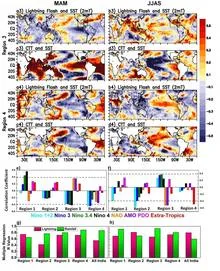
Echoes of Distant Oceans: How Seasonal Lightning Can Be Predicted from Slow Currents
Every year, lightning kills thousands of people, especially in the tropics, where thunderstorms are most intense. In India, the share of lightning deaths among all victims of natural disasters is rising, despite an overall decline in fatalities from cyclones and floods. One might think that lightning is too fast and too local to predict months ahead.
The Ocean as a Patient: Neural Network Diagnoses Two Years Ahead
A doctor who has followed the same patient for years learns to predict flare-ups from subtle signs: a slight pallor, labored breathing, restless sleep. The ocean is just such a complex patient, only instead of a thermometer it has thousands of buoys and satellites, and instead of a medical history, seventy years of daily measurements.
A Reservoir with Memory: Peeking Inside Echo State Networks
Every month, satellites and ships record the surface temperature of the ocean, and these maps build up a history of the climate. In the tropical Pacific, this history is sometimes interrupted by a warm patch, El Niño, which alters weather across the planet.
El Niño type can be predicted a year before the spring barrier
An invisible barometer hangs over the Pacific Ocean. Its needle swings from the western shores to the central waters, and in December it shows what the next storm will be like: not just whether it will come, but where it will hit hardest.
A Network That Rings Before the Lurch
A fisherman pulls on his net and listens to it ring. Each strand quivers in its own way, but before a strong tug, all the strands begin to vibrate in unison. So it is with complex systems: before a sharp state jump, the individual parts suddenly start to oscillate in concert, and that synchrony betrays the coming jump.
stat.ME2023-06-082 minarXiv:2306.04966
Hybrid Spectral Analysis: How a Bayesian Method Combines the Precision of Parametrics with the Flexibility of Nonparametrics
A rough sketch of a portrait: a few confident lines define the shape, but the details are not yet refined. That is how a parametric model, such as vector autoregression (VAR), describes a time series: it captures the main structure, but if the real data deviate from its assumptions, the portrait comes out distorted.
ResoNet: A Translator That Hears the Ocean 18 Months Ahead
A translator in a large hall hears both a whisper right next to their ear and a conversation at the far end. The same mind picks up local nuances while keeping track of the overall discussion. That is how ResoNet works: a neural network that predicts El Niño. El Niño is a warm current in the equatorial Pacific that, every few years, alters weather across all continents.
A Sieve for El Niño: How an Algorithm Finds the Minimal Model of a Fickle Climate
Every few years, a huge pool of warm water in the western Pacific Ocean shifts eastward, like water in a bathtub when you tilt it sharply to one side. That is El Niño. But each tilt is different: sometimes the water sloshes against the shores of Peru, sometimes it stalls in the middle, sometimes it pours out in a powerful surge, and sometimes it barely creeps.
Climate Network Predicts El Niño a Year Ahead
The Pacific Ocean breathes, and that breath has a pulse. Every few years, its surface warms more than usual, bringing torrential rains to Peru and drought to Australia. This is El Niño, the warm phase of the ocean temperature oscillation.
Ocean and Atmosphere Learn to Speak the Same Language
Two dancers stand facing each other but cannot see each other's faces. One is the atmosphere, fast and noisy, forgetting its moves after just a couple of weeks. The other is the ocean, slow and heavy, remembering every touch for months. For the dance to work, they need to learn to lead each other while only looking at their partner's hands.
q-bio.PE2024-07-313 minarXiv:2407.21286
Epidemics Under the Microscope: How Brazil Scans Dengue and Chikungunya Outbreaks
A fisherman casts his net into murky water, and an hour later the catch is thrashing on the deck. That's roughly how Episcanner works: it sifts through 14 years of disease records and pulls out every fever outbreak in every one of Brazil's 5,570 municipalities. From 2010 to 2023, the net caught 18,567 dengue epidemics and 2,199 chikungunya epidemics.
The interpreter that learned chaos's dialect
An interpreter at a conference hears the noise of the hall but keeps translating. They don't repeat every word; instead, they find an intermediate language where complex phrases become simple, yet meaning is preserved.
The Pacific Ocean Sends a Signal: No El Niño in 2025
The Pacific Ocean is a giant network of nerve endings that warns of an impending attack a year in advance. In 2023–2024, El Niño, the warm phase of the Pacific climate oscillation, pushed global temperatures to record highs. Now, two independent methods, like two doctors examining the same symptoms, agree: no new attack in 2025.
Council of Sages: How Entropy Predicts El Niño Two Years Ahead
In the hall, fifty sages confer, each observing the ocean in their own way. One listens to surface temperature, another to the wind, a third to how heat hides in the depths. Their judgments often contradict each other, but there is an elder who knows which of them to trust more.
Neural Network Understands the Ocean Like an Interpreter
An interpreter in a conference room hears not just words but intonations, pauses, and gestures. From these cues, they anticipate where the conversation will turn. The Pacific climate speaks the language of wind, heat, and currents, and PTSTnet listens like an experienced simultaneous interpreter, grasping the grammar of ocean and atmosphere.
A Council of Elders Instead of a Popular Vote: How to Pick the Best El Niño Forecasts
In a room with 80 advisors, each shouts their own opinion, and if you simply listen to everyone and take the average, you get mush. So it is with El Niño forecasts: a model produces 80 possible futures, but not all are equally useful. Some err less often, others more, and still others talk about something else entirely.
Three Voices of the Pacific: How a Neural Network Learns to Hear Each One Separately
The ocean hums like a crowded hall: in one corner, voices argue about decades; in another, about years; in a third, about the changing seasons. To pick apart these voices, climatologists used to rely on filters they tuned themselves, letting through only slow waves or only fast ones. But the Pacific plays by its own rules: a warm patch off the coast of Peru can be a brief spike or part of a long-term rearrangement.
Entropy as a Source of Particles: From Bits to Matter
In 1989, John Wheeler proposed a bold idea: "it from bit," meaning everything that exists arises from information. For a long time, this remained a beautiful metaphor, but now physicists have found a concrete mechanism that turns bits into particles.
Assembling a Mosaic from Rare Flashes of Light
Light passing through a birefringent crystal changes its polarization depending on wavelength. This profile is like a mosaic assembled from rare flashes, where each shard hints at the shape of its neighbors.
Biological Physics2025-10-071 minarXiv:2510.05792express
Cells Communicate with Light
Living cells continuously exchange light signals — a billion times fainter than daylight. It's like a whisper picked up by ultra-sensitive instruments. A healthy cell whispers rhythmically, a cancerous one — haltingly, but with a long memory of previous flashes.
Neural Network by Ear: How to Capture a Particle's Energy
Measuring a particle’s energy at the Large Hadron Collider is like trying to catch a whisper in a roaring crowd. When protons collide, a flurry of particles is born, their signals blending into a cacophony. Old-school methods, like a noise-clogged ear, systematically underestimate the energy. Scientists built a neural network that works right inside the detector.
Optics2025-10-252 minarXiv:2510.22176express
Light Chip: A Sensitivity Map in the Photonics Maze
Modern computer algorithms design photonic integrated circuits — light chips capable of separating signals by frequency (color) for spectroscopy. Unlike traditional engineering, light paths in these chips are not straight waveguides but chaotic, almost organic mazes.
Neural Network Denoises the Ocean and Predicts El Niño Two Years Ahead
Every spring, El Niño forecasts lose their edge, like a translator who gets distracted by every rustle in the room and turns a one-hour meeting into a two-hour one. Scientists call this the spring predictability barrier: in March and April, models that confidently predicted a warm phase in the Pacific back in January start making mistakes twice as often.
Climate as Conductor: Neural Network Learns to Direct Extremes
An orchestra of a thousand musicians plays in harmony as long as the conductor keeps the tempo. But the moment he changes the score, the violins in one corner start playing louder, while the brass in another come in late.
Quantum Physics2025-12-081 minarXiv:2512.07307express
Diamond Sees Through the Cell
Every cell is a miniature tuning fork. A sharp magnetic pulse makes it 'ring', and the decay of that sound depends on what's inside: viscosity, density, composition. A tiny diamond with a structural defect acts like a hypersensitive microphone, picking up magnetic echoes from individual cells.
An Orchestra Without a Conductor: How Ensembles of Neural Networks Learn to Hear Their Own Ignorance
An orchestra of a hundred musicians plays without a conductor. As long as the score is familiar, each player confidently follows their part, and together they sound harmonious. But when the composer changes the rhythm, discord creeps in: some instruments keep playing the old tune, others try to adapt, and a few fall silent.