Fragrances of Cosmic Noon: How PAHs Survive the Hell of a Double Quasar
Original: "Widespread Detection of Aromatic and Aliphatic Emission in the Dual Quasar J0749+2255 at Cosmic Noon"
Using the James Webb Space Telescope, astronomers have found that aromatic hydrocarbons not only survive but thrive in a system of two merging quasars at redshift 2.17.
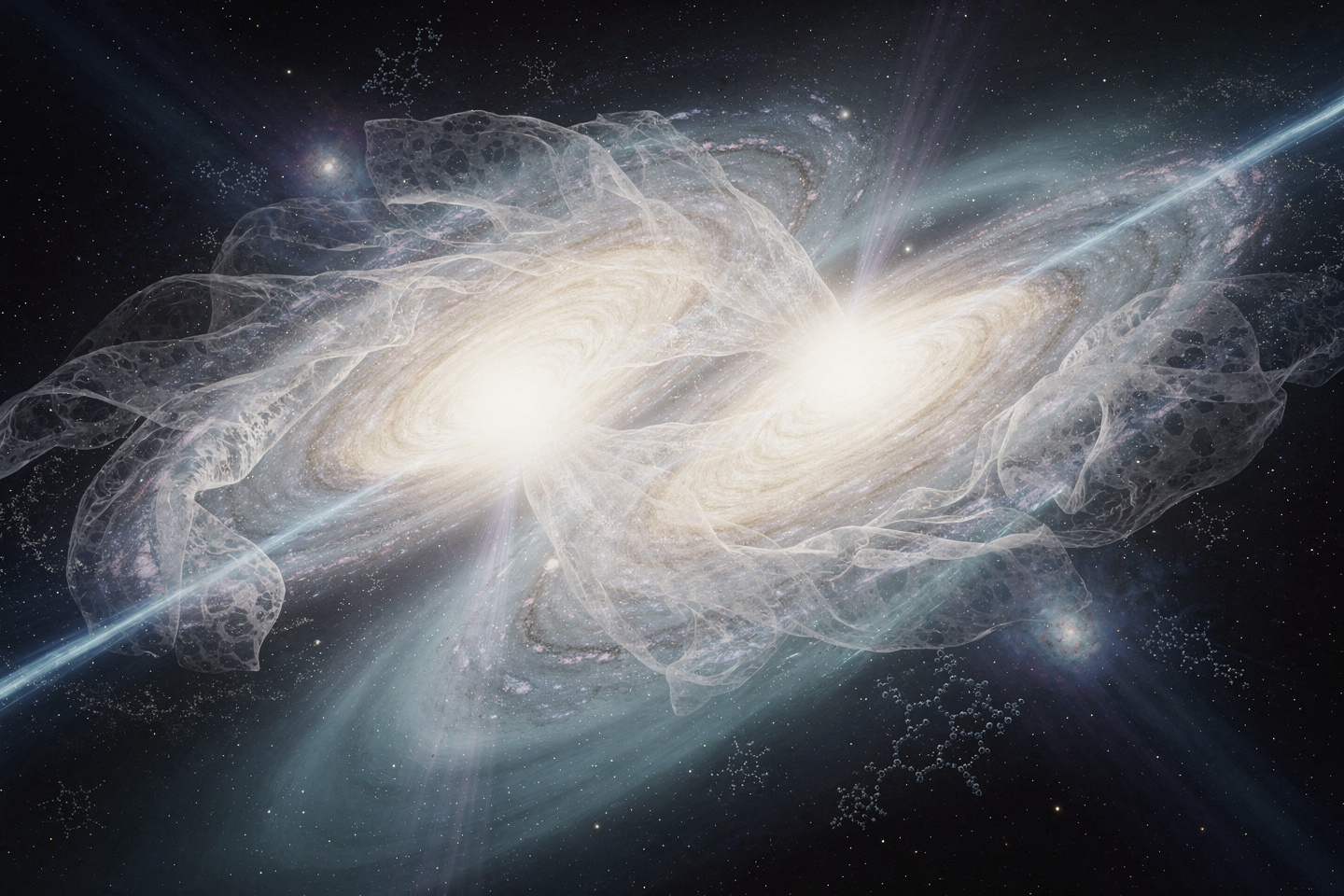
Links in the knowledge graph 1
Three billion years ago, two black holes whirled in a gravitational waltz, spraying aromatic molecules around. JWST caught this trail — and surprised us: the molecules don't die near the monsters but thrive. We are on the verge of merger chemistry: we will discover what the birth of galaxies smells like.
🎯 Polycyclic aromatic hydrocarbons are not just cosmic exotica, but also familiar earthly grime. They form during incomplete combustion of organic matter and are found in exhaust gases and soot. Some PAHs have recognizable odors: for instance, naphthalene smells like mothballs.
N_{\rm C,ali} / N_{\rm C,aro} \approx \frac{1}{6.40} \left( \frac{P_{3.4}}{P_{3.3}} \right)_{\rm obs}
This simple equation shows how, from the brightness of two infrared bands, one can estimate what fraction of carbon atoms is in aliphatic (side) groups rather than in aromatic rings.