Popular

Galaxies astro-ph.GA

171 articles

Phenomena pertaining to galaxies or the Milky Way. Star clusters, HII regions and planetary nebulae, the interstellar medium, atomic and molecular clouds, dust.

articles

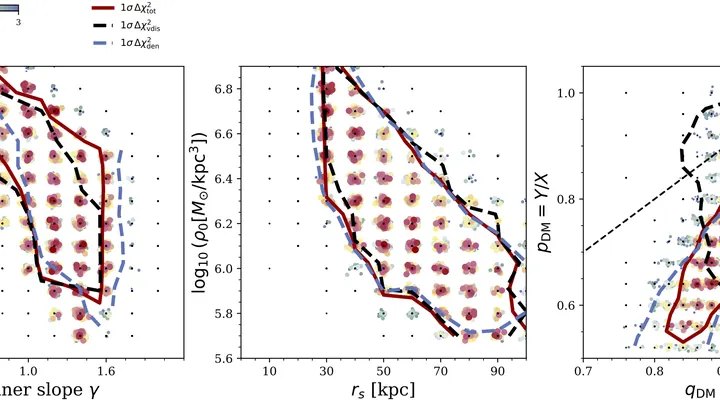
Fast stars reveal the Sun’s galactic path

Astronomers used 1,200 high-speed stars to compute the Sun's motion. By measuring their full 3D velocities, scientists refined the trajectory of our star and the gravity map of the Milky Way. This helped better understand the distribution of invisible dark matter in the outskirts.
arXiv:2501.12478 · 2025-01-21

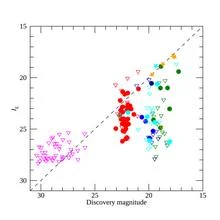
Euclid Accidentally Discovers 164 Cosmic Flashes

The Euclid space telescope, designed to study dark energy, accidentally detected 164 transient flashes. Astronomers measured brightness in different wavelengths to understand the nature of stellar explosions and discovered hidden galaxies.
arXiv:2503.15334 · 2025-03-19

Weighing the Invisible: A Black Hole in the Early Universe

A team of scientists used light from carbon ions in a distant galaxy to determine the rotation speed of gas around the central object. A sharp acceleration of the gas toward the center pointed to a black hole with a mass of about 6.3 billion Suns. This is the first dynamical weighing of a black hole
arXiv:2504.13409 · 2025-04-18

Dusty Black Hole in a Young Galaxy

Astronomers using the spectroscope aboard JWST have, for the first time, measured the amount of dust around a distant black hole. Dust, like fog, dims its light, but the main surprise is that the black hole fluoresces, revealing the secrets of its rapid growth.
arXiv:2507.20684 · 2025-07-28

Who's Lurking in the Radio Glow of Galaxies?

In three galaxies, like a city at night, radio astronomers counted 115 bright dots. Most are local streetlights: a supernova remnant, stellar nurseries, unknown warm spots. But nine turned out not to be residents at all – these are distant supermassive black holes whose radiation happens to pierce t
arXiv:2507.23332 · 2025-07-31

Caught by a Stellar Kick: Webb Finds a Neutron Star

Astronomers have searched for decades for the object left behind by supernova 1987A. Webb finally saw it: a neutron star that is accelerating gas and flying sideways. By measuring its displacement, scientists determined its speed — 500 km/s, as if someone gave it a stellar 'kick'.
arXiv:2508.03395 · 2025-08-05

How Galaxies Spin: A Simple Rule Failed

Scientists tested hundreds of galaxies against the rule 'every twist in light matches a twist in spin.' While the dwarf NGC 1560 followed suit, the overall sample showed 'extra' motions that don't match the visible pattern, complicating both dark matter models and alternative theories.
arXiv:2508.03569 · 2025-08-05

First Stars Found: Webb Peers into the Universe's Childhood

The James Webb Space Telescope has for the first time captured light from stars consisting solely of hydrogen and helium — exactly what the very first stars after the Big Bang were probably made of. A cosmic magnifying glass helped: a galaxy cluster whose gravity amplified the faint shine of the dis
arXiv:2508.03842 · 2025-08-05

The Dance of Three Bodies: New Orbits in Chaos

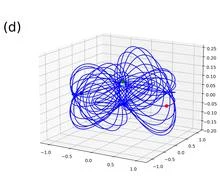
What the work is about: searching for periodic orbits in the three-body problem. What's new: over 10,000 three-dimensional orbits, many of them stable, including round dances and duets with a solo. Why it matters: these refined movements explain the stability of triple star systems and offer a glimp
arXiv:2508.08568 · 2025-08-12

Interstellar Visitor with Carbonated Breath

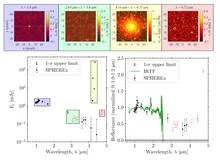
The SPHEREx telescope split the light of the interstellar wanderer 3I ATLAS into colors. It revealed that it's actively emitting carbon dioxide, while water ice absorbs some of the rays like tinted glass. All visible glow is a dusty shell, with the solid core inside being hundreds of times smaller.
arXiv:2508.15469 · 2025-08-21

An Invisible Intruder Smashed Into the Milky Way: The Impact Scar Found in Stars

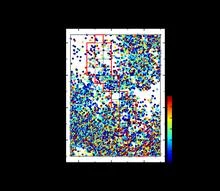
In the Milky Way's stellar disk, astronomers spotted a region where hundreds of stars suddenly changed their speed. Nearby, gas clouds are crumpled into a giant 'finger,' and at its tip, there's not a single star. It's a dwarf galaxy made of dark matter that rammed our disk millions of years ago, le
arXiv:2508.19643 · 2025-08-27

Red Dots Are Not Twins of Dusty Quasars

The Webb telescope spotted a multitude of tiny red galaxies in the early Universe. They were confused with dazzlingly bright galaxies where a black hole heats dust like a blast furnace. Though their color 'portraits' are similar, the red dots have cooler dust—meaning their 'engines' run more modestl
arXiv:2508.21678 · 2025-08-29

Seven Stars from One Dough

In the nebula NGC 6334I, a system of seven protostars was discovered in a common gas disk. The disk, like fragile dough, tore apart under its own weight into pieces, and each condensed into a star. Previously, such a mechanism was thought to be common only for binary stars. The discovery proves that
arXiv:2509.06787 · 2025-09-08

Cosmic Necklace Reveals Secrets of Galaxy Birth

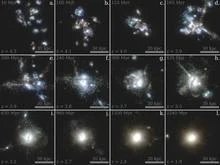
Astronomers peered into the early Universe and saw how three massive galaxies, merging, eject gas. This gas compresses into clumps resembling necklace beads and glows brightly. These cosmic 'jewelry' pieces are an important stage in the construction of the most massive galaxies.
arXiv:2509.08035 · 2025-09-09

Black Hole Wind Clears the Galactic Center

Astronomers found the 'breath' of the black hole at the center of the Milky Way. A huge cone of blown-out cold hydrogen, over three light-years long, proved that black holes not only devour matter but also clear space with powerful winds.
arXiv:2509.10615 · 2025-09-12

Einstein’s Cosmic Cross Unveils the Secrets of Dark Matter

Light from a distant galaxy, bent by a foreground cluster, creates four identical images in the sky. Ordinary matter alone wasn’t enough for such a trick—only by adding invisible dark matter did scientists achieve a match with observations. Now this cross serves as a natural telescope into the unive
arXiv:2509.14983 · 2025-09-18

The Cosmic Lighthouse Has Switched

The Ansky black hole in a distant galaxy has changed the rhythm of its X-ray flares: they are now half as frequent, but four times as powerful and longer lasting. Scientists link this to an object that might be making its final loops before falling into the hole, disturbing the disk of superheated g
arXiv:2509.16304 · 2025-09-19

Star Soup from an Ancient Cluster

In cluster M15, the first generation of stars shows a spread in heavy elements, while the second does not. This means the gas for the first stars was poorly mixed. This helps us understand where elements like gold are born: most likely in neutron star mergers, which happen quickly.
arXiv:2509.16840 · 2025-09-20

How Volunteers Help Unravel the Mysteries of Radio Galaxies

Volunteers and algorithms unite to sort millions of radio galaxies and build the most detailed map of the southern sky.
arXiv:2509.19787 · 2025-09-24

A Giant Black Hole's Wake in a Spiral Galaxy

A very long and narrow trail of gas and dust has been discovered in the galaxy NGC 3627. It stretches for 26,000 light-years but is only 650 light-years wide. This wake was left by a massive black hole or the core of a dwarf galaxy that plunged through the galactic disk. The discovery offers a new m
arXiv:2509.20832 · 2025-09-25

Black Holes Remember Everything: Memory Burden Alters Their Oscillations

Scientists have theoretically demonstrated that the information accumulated by a black hole (its “memory burden”) affects its oscillations under external perturbations. Two black holes of identical mass but with different information loads emit different gravitational wave spectra. This discovery pr
arXiv:2509.22540 · 2025-09-26

Black Hole Tugboat: Birth of a Stellar Core

It was thought black holes kick stars out of galactic centers, yet a third of giant galaxies host dense clusters snug against the hole. The clue? The hole's post-merger motion: like a cosmic tugboat, it can tow a whole swarm along.
arXiv:2509.25011 · 2025-09-29

Invisible Object Weighing a Million Suns: Gravity Acts as a Magnifying Glass

Using a network of radio telescopes, astronomers spotted a tiny flaw in a thin arc of a distant galaxy. It revealed an invisible object with a mass of about a million Suns — a hundred times lighter than anything previously weighed at such distances. The discovery proves that gravitational lensing ca
arXiv:2510.07382 · 2025-10-08

The Milky Way's Dark Halo is Flattened and Twisted

Using the motions of millions of stars, astronomers have built a 3D map of the dark halo. Its shape is not a sphere, but an elongated, flattened cloud. Surprisingly, the halo's long axis is almost perpendicular to the stellar disk. This orientation hints at a possible 'flip' of the disk in the past
arXiv:2510.08684 · 2025-10-09

Dark Matter: An Invisible Web Explains Three Mysteries

Simulations show that if dark matter could clump, its lumps would explain perturbations in the stellar stream GD-1, the mysterious object from the gravitational lens, and the origin of the Fornax 6 cluster.
arXiv:2510.11006 · 2025-10-13

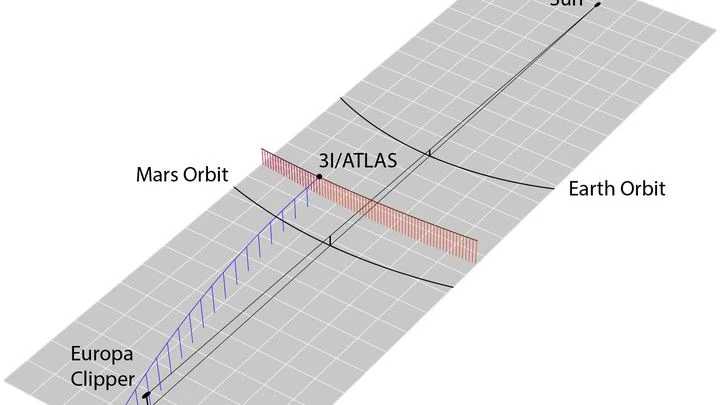
Two Probes Will Dive into the Tail of an Interstellar Comet

A comet from another star system will pass by two Earth spacecraft. In late October, they will spend several days in its tail—this is the first chance to directly study extrasolar material.
arXiv:2510.13222 · 2025-10-15

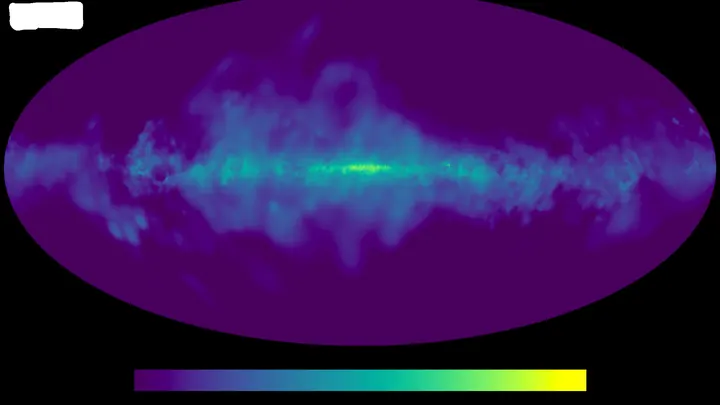
Stellar explosions puff up giant gamma-ray bubbles

A computer model revealed that the gamma-ray bubbles at the Galaxy’s center are not the result of a black hole, but of vigorous stellar life. Like a boiling pot, massive star explosions hurl out particles that shine in gamma rays. The finding explained the Fermi telescope’s riddle and showed where t
arXiv:2510.14908 · 2025-10-16

Warm Moons of Rogue Planets

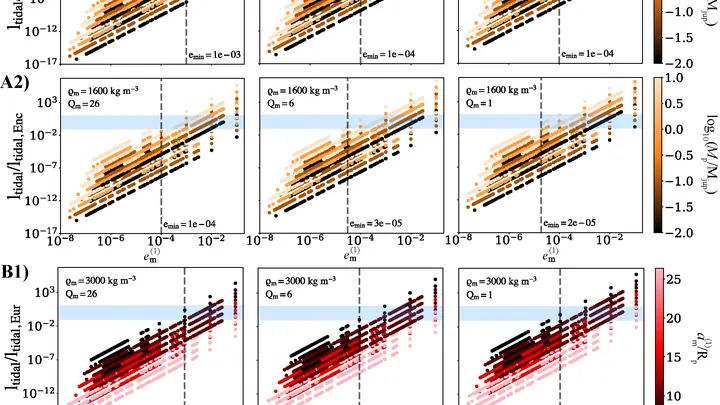
Simulations show that after a planet is ejected by a supernova explosion, all its moons are left on slightly elongated orbits. This triggers constant internal heating — as if the planet endlessly kneads its moons. In 12–15% of cases, the heat is enough for subsurface oceans, like those on Europa and
arXiv:2511.03392 · 2025-11-05

How Dark Matter Influences the Rhythm of Cosmic Collisions

Scientists examined how dark matter affects black hole mergers. If its particles interact, they slow down the giants' plunge toward each other. Analyzing just 70 events with LISA will reveal whether dark matter collides. A new method paves the way to decipher the nature of invisible mass.
arXiv:2511.13220 · 2025-11-17

Why 'impossible' galaxies don't break cosmology

JWST data on massive galaxies at the dawn of time threatened to overturn dark matter theory. But new work shows the reason: systematic errors when converting brightness to mass. With those accounted for, 'impossible' galaxies vanish.
arXiv:2511.13708 · 2025-11-17

Rusty Heart of an Interstellar Comet Makes It Shine

The second known interstellar object, comet 3I/ATLAS, is rich in water and metals. As it approaches the Sun, its ice melts and water triggers the corrosion of metallic dust. Chemical reactions create a luminous envelope unique in composition. Such visitors from other stars help us study the far reac
arXiv:2511.19112 · 2025-11-24

Ghost Stars as Precise Cosmic Clocks

Astrophysicists have shown that hypothetical boson stars—clumps of the lightest particles—can act as gravitational lenses with their own rhythm. The breathing lens oscillates its focus, and any light source caught in it begins to blink rhythmically. This can be tested with modern telescopes, offerin
arXiv:2511.19606 · 2025-11-24

How a Black Hole Splits Light by Polarization

A spinning black hole acts like a giant whirlpool: it twists the fabric of space and separates light rays by their twist. Left and right polarizations are focused at points spread trillions of kilometers apart — more than Earth’s diameter. Changing location on the planet causes the polarization to s
arXiv:2511.22276 · 2025-11-27

Universe's expansion rate refined using supernova 'twins'

By comparing supernova 'twins', astronomers eliminated the effect of cosmic dust and arrived at a more precise expansion rate. It turned out higher than what observations of the early universe suggest. The 'Hubble tension'—as this discrepancy is called—has been confirmed, meaning our picture of the
arXiv:2512.02391 · 2025-12-02

A Galaxy That Slept for Half a Billion Years

The 'Sleepy' galaxy in the early universe furiously gave birth to stars, but after 300 million years it fell asleep. A record-breaking hydrogen dip in its glow showed that not all bright early galaxies become giants—some doze off and turn into dwarfs.
arXiv:2512.03154 · 2025-12-02

Runaway Black Hole Leaves an Interstellar Trail

A runaway supermassive black hole leaves a superheated gas tail visible from Earth. The James Webb Space Telescope clocked its escape velocity at 954 km/s, revealing that such giants can be flung from their galaxies.
arXiv:2512.04166 · 2025-12-03

How a galaxy's shape reveals its history

Adding shape information to brightness, astronomers can forgo expensive spectrometers and solve the mysteries of cosmic dust. This method will speed up the study of millions of distant objects.
arXiv:2512.05078 · 2025-12-04

A Nearby Supernova: Recipe for Rocky Planets

Astronomers have found an elegant mechanism: the supernova doesn't destroy the planetary cradle but sends rays that create the necessary radioactive atoms right inside the disk. At a distance of one parsec, it works perfectly. This discovery makes rocky planets common.
arXiv:2512.09660 · 2025-12-10

The 'Chef' Black Hole That Prevents Star Birth

The model shows: the chef black hole heats galactic gas, preventing stars from igniting, and ejects metal-rich material while pulling in fresh gas. This explains the near-total lack of heavy elements in galaxy Abell 2744-QSO1 and the unusual ratio of the hole's mass to stars.
arXiv:2512.14066 · 2025-12-16

A New Record in the Search for Dark Matter

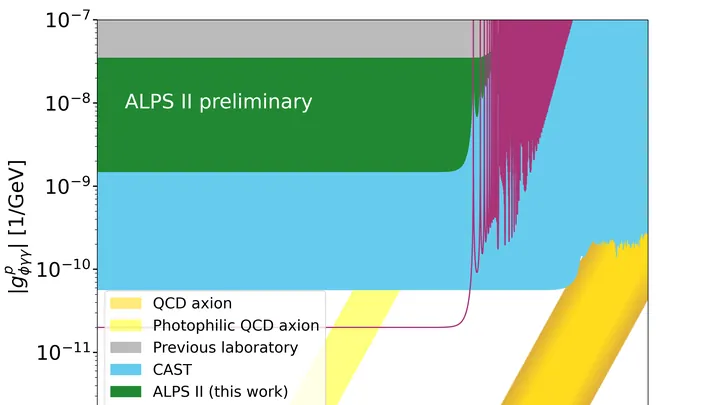
The first stage of ALPS II, a setup to search for axions—dark matter candidates—has concluded at DESY. No particles were detected, but the instrument's sensitivity proved 20 times better than previous records. The system is now being upgraded to boost accuracy another 100-fold.
arXiv:2512.14110 · 2025-12-16

A Middleweight Black Hole Exposed by a Torn Star

The flare AT2018cqh in a dwarf galaxy turned out to be the trail of a star torn apart by a middleweight black hole. These objects are the missing link between tiny and giant black holes, and they are extremely hard to find. This discovery offers a new way to hunt for the invisible.
arXiv:2512.16568 · 2025-12-18

How Galaxies 'Simmered' Metals in the Cosmic Noon Era

Astronomers studied 34 ancient galaxies with the James Webb Telescope. They precisely measured oxygen content and found that more massive galaxies are richer in heavy elements. This relationship turned out to be similar to the modern one, but computer models couldn't reproduce it. It seems the basic
arXiv:2512.16989 · 2025-12-18

Mysterious Red Dots: How Dark Matter Hides Growing Galaxies?

The James Webb Space Telescope has discovered mysterious “red dots”—distant sources glowing in hydrogen but nearly invisible in X-rays. A dense gas curtain conceals them. This may be a brief stage of galaxy growth when their dark matter cores are flooded with matter. The “light” dark matter hypothes
arXiv:2601.00044 · 2025-12-31

A Cosmic Wanderer Steps on the Scales for the First Time

Free-floating planets, untethered to stars, long remained a mystery: without an exact distance, their mass couldn't be measured. By combining telescopes on Earth and in space, scientists calculated the distance to object KMT-2024-BLG-0792 and found its mass—just 0.22 Jupiter masses. It turned out to
arXiv:2601.00057 · 2025-12-31

Rogue Planet Gave Itself Away with Warped Light

Astronomers spotted lone planet KMT-2024-BLG-0816 when, like a cosmic lens, it amplified the light of a background star. The planet passed so close to the line of sight that it was possible to see how the brightness of different edges of the stellar disk changed. They didn't find a host star nearby,
arXiv:2601.00325v1 · 2026-01-01

How quantum fog tests the laws of gravity

Scientists created modified gravity conditions (MOND) for a quantum fog and saw that the cloud expands and oscillates according to simple mathematical rules. This opens the door to lab-based tests of gravity theories that replace dark matter.
arXiv:2601.01039v1 · 2026-01-03

The first galaxies lived in tiny clouds of dark matter

Analysis of early galaxies clustering revealed that their invisible cocoons were tens of times lighter than modern ones. This sheds light on the joint growth of matter and dark matter.
arXiv:2601.01697v1 · 2026-01-05

Gravity Without Dark Matter: The Entropic Approach Triumphs

Analysis of star motions in 23 dwarf galaxies showed that emergent gravity — a theory explaining attraction through the information capacity of space — is more accurate than modified Newtonian dynamics. The result with a confidence of 5.2σ casts doubt on the existence of dark matter.
arXiv:2601.01715v1 · 2026-01-05

First Stars: Fireworks Seen by Webb

In the James Webb Space Telescope's images, bright dots thought to be distant galaxies might actually be explosions of the first stars — pair-instability supernovae. These cosmic fireworks happen when a massive star made of pure hydrogen and helium is torn apart as light transforms into matter and a
arXiv:2601.02469v2 · 2026-01-05

Why Magnetic Fields Make Black Holes Quiet

Researchers found: the thicker the disk around a black hole, the rarer objects collide. Magnetic fields puffing up the disk can cut merger rates by billions of times. Astrophysicists must rethink gravitational wave forecasts.
arXiv:2601.02487v2 · 2026-01-05

Catching an Interstellar Wanderer with a Solar Sling

Interstellar object 3I/ATLAS is racing away, and a regular rocket can't catch it. But if you dive toward the Sun and fire the engines at peak speed, gravity acts like a giant sling. This maneuver gives a chance to reach the target in a few decades, but the probe must survive hellish heat.
arXiv:2601.02533v2 · 2026-01-05

A Lunar Telescope Will Reveal the Shadows of Distant Black Holes

Combining antennas on Earth and the Moon will deliver incredible sharpness. Astronomers have selected six black holes in alien galaxies whose silhouettes will become visible. The real twist: to glimpse the thinnest ring of light around them, we'll need antennas floating in space between planets.
arXiv:2601.02812v2 · 2026-01-06

Thin Disks of Galaxies Already Existed in the Young Universe

Astronomers studied distant galaxies when the Universe was just a few billion years old. They developed a new way to more accurately measure the thickness of stellar disks, even if they are slightly tilted. It turns out that thin disks, similar to our Milky Way, had already formed by that early time
arXiv:2601.03339v2 · 2026-01-06

Сверхновая из детства Вселенной

Самую далёкую сверхновую SN Eos подтвердили, разложив её свет в спектр. Взрыв произошёл в среде, почти лишённой тяжёлых элементов, — прямое доказательство рождения массивных звёзд в ранней Вселенной. Открытие стало возможным только благодаря гравитационному линзированию и поможет уточнить темп рожде
arXiv:2601.04156v2 · 2026-01-07

How Weak Gravity Does Without Dark Matter

This approach rewrites gravity's rules where it's barely felt—at the edges of galaxies. Under normal conditions, it aligns with Einstein's theory, but for weak fields, it adds a tweak. The solution needs no new particles and explains why galaxies spin faster than their visible mass permits.
arXiv:2601.04290v1 · 2026-01-07

Galactic Bubbles: How Black Holes Paint the Cosmos

Simulations reveal that giant bubbles in the Circinus galaxy are sculpted by narrow black hole jets, not stellar winds. This unlocks the secret of how black holes govern galaxy growth.
arXiv:2601.04317v1 · 2026-01-07

How Giant Black Holes Are Born in the Early Universe

A computer simulation of the early universe revealed: supermassive black holes are born from plump seeds with a million solar masses and grow into giants in mere hundreds of millions of years, explaining the mysterious 'little red dots' seen by the Webb telescope.
arXiv:2601.04955v1 · 2026-01-08

Black Holes as Unexpected Beacons of the Early Universe

It turns out that black holes were 3–4 times brighter in ultraviolet light than scientists believed. This raises their contribution to the clearing of the universe to 20%, and possibly higher when dim nuclei are considered. A new model of active galactic nuclei changes the view of reionization.
arXiv:2601.05316v1 · 2026-01-08

The Quiet Death of a Star

In the Andromeda galaxy, a star faded away without a flash. James Webb and the Chandra telescope saw a dim object in a dust cocoon. This proves that a black hole can be born in the quiet collapse of a star, not just in the fire of a supernova.
arXiv:2601.05774v2 · 2026-01-09

Red Eyes: Cosmic Lens Reveals a Pair of Black Holes

Using a gravitational lens — a massive cluster of galaxies bending light — the James Webb Space Telescope detected two red dots in a distant galaxy. These are intermediate-mass black holes, located not in the center but on the outskirts. The discovery suggests such invisible objects might be widespr
arXiv:2601.06015v1 · 2026-01-09

Galaxy Rotation in Voids Tests Inflation

In giant cosmic voids, galaxies spin like a single ensemble. Their dance creates a barely noticeable difference in glow from different sides. It turns out that this effect is the most accurate indicator of how uniformly matter was foamed up at the moment of inflation. It is enough to measure it to f
arXiv:2601.06589v1 · 2026-01-10

Icy Visitor from Another System

ISO 3I/ATLAS is the second known interstellar object. As it approached the Sun, it bared its interior: its icy shell evaporated, revealing a mix of water, carbon dioxide, and carbon compounds. These findings help us understand the chemical makeup of other planetary systems.
arXiv:2601.06759v2 · 2026-01-11

Space is Colder Than We Hoped

Scientists analyzed infrared data from the WISE telescope to detect possible Dyson spheres or other technologies that reprocess starlight. After excluding ordinary hot objects, they set an upper limit: only one in 6,500 galaxies could emit such excess heat. The probability of encountering an advance
arXiv:2601.07297v2 · 2026-01-12

Why Black Holes Can't Merge Without Gas

Astrophysicists discovered that stars alone aren't enough for supermassive black holes to merge — gas plays the decisive role. It not only brings the pair together but also makes them shine, revealing the merger long before the finale.
arXiv:2601.07762v1 · 2026-01-12

When the Sun Dived into a Cloud

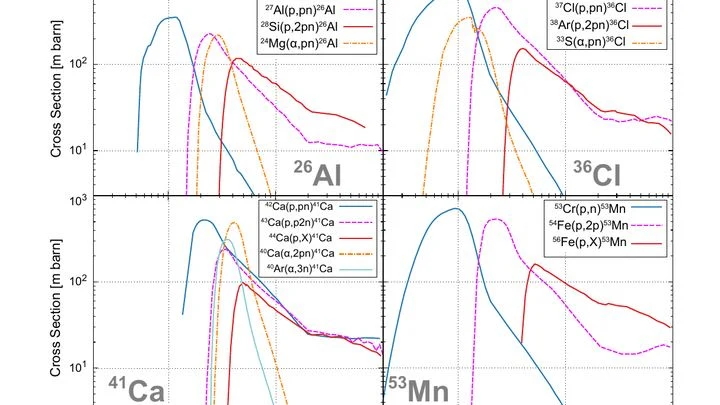
When the Solar System enters dense interstellar clouds, the Sun's protective bubble shrinks. The intensified flow of cosmic rays spawns beryllium-10 in the atmosphere, which settles in ocean sediments and ice. Studying these layers uncovers when and which clouds the Earth encountered, letting us rea
arXiv:2601.07983v2 · 2026-01-12

The Mystery of Cosmic Dust: Weighing a Galaxy

Astronomers refined the mass of three extremely distant galaxies using Webb, and it turned out: invisible dust can distort our estimates more than we imagined, but even with corrections, two galaxies remain monstrously massive for their young age.
arXiv:2601.08693v2 · 2026-01-13

A Spinning Top at the Galaxy’s Core Snuffs Out Stars

Scientists studied the galaxy VV 340a, where the jet from its central black hole wobbles with a period of about 800,000 years. It sweeps away gas—roughly 19 solar masses per year. The superheated gas leaves the galaxy, and star formation shuts down.
arXiv:2601.08791v1 · 2026-01-13

Hidden Gas Clumps Trick Astronomers in Early Galaxies

JWST studied three distant galaxies and found tiny, dense gas clumps dominate certain light signals. This makes standard methods underestimate elements like oxygen and nitrogen. New computer models that treat gas more realistically fix these errors, helping us understand galaxy formation.
arXiv:2601.08939v1 · 2026-01-13

Echo of a Silenced Black Hole

Astronomers measured the polarization of light from GSN 069—the direction in which its waves oscillate. The farther from the center, the more ordered the light became. This pointed to an extinguished active nucleus: the black hole once blazed brightly, and distant clouds still reflect its former bri
arXiv:2601.08940v1 · 2026-01-13

Stellar Bakeries: Two Suns, One Organic Recipe

The ALMA radio telescope peered into the triple system HOPS-288, where three stars are being born. Around two of them, a chemical kitchen is bubbling: warm clouds where complex molecules assemble from icy dust. Astonishingly, the list of these molecules is almost identical for both stars — as if pre
arXiv:2601.08948v1 · 2026-01-13

Red Dots in Space Turned Out to Be Growing Black Holes

Data from the James Webb Telescope showed: mysterious red dots in the early universe are growing black holes. They emerged directly from gas clouds, without forming stars, and are now devouring matter at an incredible rate. This explains how supermassive black holes managed to grow so quickly.
arXiv:2601.14368 · 2026-01-20

Black Hole with Double Flashes

Five years after ripping a star apart, a black hole in a distant galaxy is emitting regular X-ray emissions: every 12 hours, a powerful flare, and on its crest, micro-bursts. Astronomers explain this by oscillations in the gas disk, churned up by an unseen companion, and in the future, such systems
arXiv:2602.03932 · 2026-02-03

Webb Reveals the Chemical Secret of a Distant Galaxy

Astronomers used infrared light to peer into the core of galaxy IRAS 07251-0248. They found benzene, acetylene, methane, and other hydrocarbons in amounts inexplicable by ordinary gas chemistry. The key clue is cosmic dust: intense radiation, like a jackhammer, shatters dust grains, releasing comple
arXiv:2602.04967 · 2026-02-04

How a Dwarf Galaxy Shook the Milky Way

About five billion years ago, the Sagittarius galaxy began falling into the Milky Way, repeatedly slicing through its disk. Scientists simulated a billion-year-old impact: it nicely reproduced the spiral arms and the warp, but not all the wave patterns in stellar motion. So other jolts must have hap
arXiv:2602.05296 · 2026-02-05

Cold Water Trail in the Red Dots of Space

The James Webb Telescope discovered that the mysterious red dots are not hot disks around black holes, but dense clouds of water vapor with temperatures around 2000–4000 °C. This reduced the mass estimates of black holes by an order of magnitude.
arXiv:2602.06024 · 2026-02-05

Lithium Dip Found in Unexpectedly Young Stars

In the 35-million-year-old 'Serpens' star cluster, astronomers discovered a 'lithium dip' — a sharp shortage of lithium in stars. It was previously thought that this only occurs after 150 million years. Fast rotation, like a blender, speeds up the destruction of primordial lithium, forcing a rethink
arXiv:2602.07367 · 2026-02-07

Invisible Black Hole Shreds Star in a Galactic Suburb

Normally, black holes rip stars apart in the centers of galaxies. A new discovery shows that some black holes lurk in the outskirts. Astronomers spotted a flare tens of thousands of light-years from the center of a large galaxy. A computer algorithm trained on similar events helped identify it. Soon
arXiv:2602.10180 · 2026-02-10

Two Giant Galaxies Spin in a Cosmic Waltz

Astronomers measured the motion of Centaurus A and M83 and found that the galaxies are gravitationally bound and impossibly drifting closer. Together, they pack about 6 trillion solar masses. This dance mirrors the future scenario of the Milky Way meeting Andromeda, helping us understand galaxy evol
arXiv:2602.11268 · 2026-02-11

Icy Surprise from a Dying Star: JWST Finds CO2 Crystals

Astronomers using the James Webb Space Telescope have found carbon dioxide ice for the first time in the planetary nebula NGC 6302. A dust ring, like a mitten, protects the crystals from ultraviolet radiation. The discovery rewrites chemical models of dying stars.
arXiv:2602.22366 · 2026-02-25

A Flashlight Wrapped in Red Tape: Why Active Cores Change Color

Scientists have explained the mystery of "red dots" in the early Universe: it's all about the viewing angle. If an active core is seen edge-on, dust makes it dim and red; face-on — bright and blue. Like a flashlight wrapped in red tape: straight on, the light is white; from the side, it's red.
arXiv:2602.22386 · 2026-02-25

Dyson Spheres Around White and Red Dwarfs: Calculating the Search

A Dyson sphere is a cosmic blanket that captures all of a star's energy. Scientists have figured out how such a blanket glows around white and red dwarfs: the bigger it is, the cooler it gets. Surprisingly, the hottest blanket comes from the dimmest star. These clues will aid telescopes in the hunt
arXiv:2602.23270 · 2026-02-26

Two massive black holes swept clean the center of a galaxy

Telescope images revealed a region in a distant galaxy where billions of stars had disappeared. The void was caused by a pair of supermassive black holes whose combined mass is an absolute record. The discovery helps understand the growth of giant galaxies.
arXiv:2603.10104 · 2026-03-10

Cosmic Neon Sign: Gas Glows Brighter Than Stars

In a distant galaxy, almost all light comes not from stars, but from clouds of hot gas. This discovery helps understand what the Universe looked like shortly after the Big Bang. Perhaps the gas is heated by remnants of the first stars, which consisted only of hydrogen and helium. This explains why t
arXiv:2603.13471 · 2026-03-13

DF9: The Third Galaxy Without Dark Matter

Three dwarf galaxies in the constellation Cetus lack dark matter. Velocity measurements in DF9 showed: stars crawl like pedestrians, instead of racing as usual. This pace indicates mass from visible stars only. Likely, all three arose when a galaxy collision filtered gas from dark matter, like a kit
arXiv:2603.15860 · 2026-03-16

Light from the Universe’s First Stars Captured

Near the galaxy GN-z11, seen just 400 million years after the Big Bang, the James Webb Space Telescope spotted a bright spot. It glows with hot helium — such radiation can only come from very massive stars devoid of heavy elements, that is, the first generation. If confirmed, we are seeing for the f
arXiv:2603.20362 · 2026-03-20

Interstellar Comet: Water 14 Times Heavier Than Earth's

Spectroscopic analysis of comet 3I/ATLAS by Webb revealed an anomalously high deuterium content. This chemical marker suggests the comet was born in the bitter cold of a distant star system.
arXiv:2603.20445 · 2026-03-20

Quasi-stars: Cocoons with a Black Hole Inside

Astronomers have modeled quasi-stars—objects where a black hole hides inside a gas cocoon. When accreting matter rapidly, such a cocoon shines tens of thousands of times brighter than the Sun and lives for millions of years. Comparisons with telescopes show that these cosmic giants may be lurking in
arXiv:2603.21714 · 2026-03-23

Milky Way and Andromeda: A 90% Likely Merger

A new study based on precise Gaia measurements has reduced uncertainty: Andromeda is heading almost straight for us. In 6.5 billion years, the two galaxies will merge into a vast star system. The influence of satellites—the Magellanic Clouds and the Triangulum Galaxy—further nudges them together.
arXiv:2603.22863 · 2026-03-24

Faint Light Reveals the Shape of Invisible Dark Matter

The faint light diffused throughout galaxy clusters turns out to be a precise impression of dark matter. Stars ripped from galaxies fill its gravitational scaffold like plaster into a mold. This discovery gives astronomers a direct way to study the hidden structure of the Universe, without resorting
arXiv:2603.23158 · 2026-03-24

Star Furnaces Don't Incinerate Life

Astronomers have seen glycolamide in a hot protostellar cocoon for the first time. Its abundance and ratios with related compounds exactly mirror those in a cold interstellar cloud. Complex carbon molecules don't perish during star formation but are passed on like a recipe through the fire.
arXiv:2603.23170 · 2026-03-24

Stars Are Not Made from a Single Mold: The Gaia Discovery

The Gaia telescope studied stellar nurseries and discovered that the ratio of giant stars to dwarfs differs from one gas-and-dust cloud to another. It depends on the density and temperature of the ‘crib’, meaning there is no single cosmic recipe for star formation.
arXiv:2603.23594 · 2026-03-24

Mysterious Blue Flashes: What Their Host Galaxies Hide

Astronomers have found that mysterious blue flashes prefer dwarf galaxies but avoid regions of new star formation. This indicates their nature: a merger of a dead neutron star with a massive dying star — not an explosion, but a collision.
arXiv:2603.23597 · 2026-03-24

Supernova Exhaled Carbon Monoxide

62 days after supernova SN 2024rbc exploded, its debris revealed an infrared signal from carbon monoxide—a first. It helps explain how cosmic dust is born in the Universe.
arXiv:2603.23877 · 2026-03-25

Dark Matter May Be Less Abundant Due to Galaxy Shape

Standard mass estimates assumed galaxies are spheres. But galaxies resemble pancakes. A new model that accounts for their true shape slashes the need for mysterious dark matter by a third. Some of the invisible mass may have been just an artifact of oversimplified geometry.
arXiv:2604.06917 · 2026-04-08

The Galactic Family Tree: How Star Chemistry Tells the Story

Scientists built stellar family trees based on chemical composition, much like biologists trace species ancestry. In the galactic center, star birth was turbulent and clustered, while on the outskirts, it proceeded slowly and steadily. A new key to decoding the past of galaxies.
arXiv:2604.11974 · 2026-04-13

Caught: The Light That Lit Up the Young Universe

Telescopes have for the first time captured light that knocks electrons out of atoms, coming from distant galaxies about a billion years old. The intergalactic medium allowed nearly 80% of ultraviolet light to pass through—far more transparent than expected. This changes our understanding of how the
arXiv:2604.13267 · 2026-04-14

Civilizations' energy growth isn't what we thought

Sixty years of data debunk a popular theory: energy consumption grows twice as fast as predicted, yet even that won't let humanity become a supercivilization. A new approach accounts for not just energy but also information processing, explaining why we still see no alien megastructures.
arXiv:2604.17516 · 2026-04-19

How Chaos Governs the Chemistry of Giants

At the crucial moment of the reaction, when hydrogen ions overcome the barrier, chaos freezes, enhancing tunneling. Scientists have calculated which vibrations bring chaos back and slow down the process — this will allow more accurate modeling of distant planets' atmospheres.
arXiv:2604.21005 · 2026-04-22

Webb Found Giants That Turned Darkness into Light

The Webb telescope caught light from two galaxies from the era when the universe was 600 million years old. In that light, scientists recognized the signature of stellar giants: their powerful winds and ultraviolet heat. Comparison with models confirmed that such heavyweights, hundreds of times more
arXiv:2604.21493 · 2026-04-23

The Universe Sings: Resonance of Dark and Ordinary Matter

Scientists have shown that different speeds of dark and ordinary matter create a gravitational resonance. Like a bow on a string, it amplifies sound waves in ordinary matter, explaining the longevity of spiral arms and gas heating. This makes it possible to 'hear' dark matter by its seismic imprint.
arXiv:2604.22665 · 2026-04-24

Quasi-Stars: Black Holes Inside Giant Stars

In the dense star clusters observed by the JWST, supergiants were born. If a black hole fell inside, it began to grow, feeding on the star. Thus, a quasi-star formed — a translucent giant living for an astonishingly long time. These objects explain the red dots in the images and produce gravitationa
arXiv:2604.22924 · 2026-04-24

Self-propelled Pair of Black Holes

When two black holes orbit each other, they act like a boat with oars: they fling away passing stars and push themselves. This not only brings them closer but also causes the pair to shift, spin, and tilt. This explains why supermassive black holes are sometimes found far from the centers of galaxie
arXiv:2605.00976v1 · 2026-05-01

Cosmic voids are not quite empty

The Universe resembles a sponge with huge pores—voids. Almost devoid of stars, these voids, as astronomers discovered, still harbor a thin gas. Using fast radio bursts, scientists managed to 'weigh' this invisible substance. It turned out to be about one and a half times less than the cosmic average
arXiv:2605.01994 · 2026-05-03

How to Peer into the Heart of a Black Hole

Astronomers are turning scattered radio dishes across Earth into a single instrument, which, after an upgrade, will film black holes like a big-budget blockbuster—with unprecedented detail. This will let us witness the birth of giant jets of matter and check whether the law of universal gravitation
arXiv:2605.04133v1 · 2026-05-05

Interstellar Comets vs. Dark Matter

A huge number of unaccounted interstellar comets could overturn our understanding of the Galaxy’s mass, reducing the need for mysterious dark matter by almost half.
arXiv:2605.04801 · 2026-05-06

Amino Acid Relative Found in a Cosmic Cloud

Glycine, a basic protein building block, eluded astronomers for nearly half a century. Then they found its isomer, methyl carbamate, where the same atoms are arranged differently. The ALMA radio telescope picked up the molecule’s signal, letting them measure its abundance and temperature. The discov
arXiv:2605.07159 · 2026-05-08

The Secret of the Metallic Comet from Another Star System

After its close approach to the Sun, comet 3I/ATLAS ejected an abnormally large amount of nickel and iron into its tail. These metals hid deep inside as volatile compounds with carbon monoxide. When heat seeped beneath the surface, the compounds evaporated, freeing the atoms. This mechanism unveils
arXiv:2605.07652 · 2026-05-08

Weighing the invisible: how light reveals the secrets of black holes

By comparing the redshift and blueshift of light from two symmetric points in orbit, scientists can calculate the mass and distance to a black hole. Gravity distorts the color, but a pair of beams allows its influence to be isolated. The method works even if the system is moving.
arXiv:2605.08582 · 2026-05-09

Why Early Galaxies Shine So Bright: The Secret of Transparent Dust

Early galaxies let through far more ultraviolet light than expected. The reason is dust from supernova explosions, which stays almost as clear as glass but slowly clogs over time, explaining the differences between young and mature galaxies.
arXiv:2605.09829 · 2026-05-11

Dark Matter vs. Modified Gravity: Stars Deliver the Verdict

Data from the Gaia satellite allowed a double check of gravity: how stars rotate and how they oscillate up and down. No modified gravity variant could explain both motions at once. But the invisible dark matter cloud handled it effortlessly. This is a strong argument that dark matter is real, and Ei
arXiv:2605.10857 · 2026-05-11

Cosmic Hydrogen Catches Gravitational Waves

Hydrogen in space acts as a network of natural antennas that pick up gravitational waves. By comparing the observed brightness of the glow with the theoretical value, scientists determine how much energy went into gravity. This makes it possible to create a gravitational map of the Universe.
arXiv:2605.11278v3 · 2026-05-11

Ancient Black Hole Jet Left a Gamma Trail in the Center of the Galaxy

Mysterious gamma-ray glow in the center of the Milky Way has been attributed for 15 years to either dark matter or pulsars. New work links it to the echo of an ancient jet: the same black hole Sagittarius A* ejected particles millions of years ago and inflated giant bubbles. Collisions of these part
arXiv:2605.12448v2 · 2026-05-12

Gravitational Radio Forest: How a Hydrogen Quantum Detector Reveals Dark Matter

Astrophysicists have proposed a new method for hunting dark matter — not searching for the black holes themselves, but listening to the quantum echo of gravity. In regions of ionized hydrogen, tidal forces from primordial black holes split the atomic level 2P₃/₂, turning a single 9.9 GHz absorption
arXiv:2605.13042v1 · 2026-05-13

Where Do Intermediate-Mass Black Holes Hide?

Researchers trained a neural network on computer twins of star clusters to guess the main black hole. Comparison with real objects showed: giants are rare in globular clusters, while central clusters of galaxies might harbor middleweights. Unexpected twist: many black holes get a kick from the merge
arXiv:2605.21593 · 2026-05-20

Cosmic sieve: Gaia sifts through billions of celestial bodies

Astronomers passed billions of objects through a computer 'sieve'. The most distant ones slipped through, but the infrared telescope CatWISE2020 caught them, increasing the haul of distant galaxies and quasars by tens of percent — albeit with a small fraction of false positives.
arXiv:2605.23388 · 2026-05-22

The Black Hole's Record: Flare Rhythm Reveals Its Spin

Astronomers cracked the flare pattern of a distant galaxy. A tiny orbiting object repeatedly punches through a gas cloud — the remains of a torn-apart star. The cloud is bent, so some bursts shine brighter, others dimmer. This on-off rhythm unveils the central black hole's spin. In a few decades, th
arXiv:2605.24905 · 2026-05-24

Why Black Holes Dance Differently

Gravitational wave detectors have revealed three distinct black hole merger styles: a slow waltz, a chaotic disco, and a mixed dance. The difference points to their origin — either from binary stars or star clusters — and helps reconstruct the history of galaxies.
arXiv:2605.25980 · 2026-05-25

Dark Matter: Quantum Vortices Around Black Holes

A new study models dark matter as a superfluid near a black hole. Physicists found two types of stable structures: a dense core and a rotating vortex. It turns out the vortex is stable if dark matter particles attract each other weakly; strong attraction makes it collapse. This discovery suggests th
arXiv:2605.29069 · 2026-05-27

Dark Matter Sculpts Black Holes

In the early Universe, black holes sprang directly from clumps of dark matter. But collapse only kicked in where the matter formed broad, gently sloping hills, not sharp peaks. These primordial holes became the seeds of the giants at the centers of galaxies — allowing them to grow huge in a short ti
arXiv:2605.30145 · 2026-05-28

The Mystery of 'Impossible' Galaxies: How Outer Color Maps Are Rescuing Cosmology

Using NIRCam on JWST, astronomers studied four supermassive quiescent galaxies whose light has been traveling to us for over 11 billion years. It turns out that in three of them, the color shifts smoothly from center to outskirts: red old cores surrounded by bluer, younger regions. This color map re
arXiv:2606.02698v1 · 2026-06-01

Ghost Wind of the Cosmic Dawn: How Lyman-alpha Destroys Stellar Cradles

The first two-dimensional radiation-hydrodynamic simulations prove that the radiation pressure in the Lyman-alpha (Lyα) line can exceed the direct stellar light force by up to 16 times and serve as the main feedback mechanism even before the explosion of supernovae in environments poor in dust. This
arXiv:2606.02711v1 · 2026-06-01

Ruby Pupae: How Dark Matter Transforms the Face of Galaxies

The James Webb Space Telescope discovered a population of 'little red dots' (LRDs) — compact objects with disproportionately massive black holes that almost disappear at z<3. A study of 98 such sources showed that at z>4 they reside in sparse regions, but by z~3.5 their environment and dark halo mas
arXiv:2606.02773v1 · 2026-06-01

Erythrulose: The First Sugar Baked in an Interstellar Furnace

Spectral lines of erythrulose (C₄H₈O₄), caught by the Yebes 40m and IRAM 30m radio telescopes, betrayed the presence of this sugar in the cloud G+0.693. For the first time, we see how, in the interstellar medium, on the surface of icy dust grains, components of nucleic acids are born from glycolalde
arXiv:2606.03313v1 · 2026-06-02

Red Lanterns of the Cosmos: What Compact Objects from the Early Universe Conceal

Analysis of a hundred 'little red dots' (LRDs) with JWST has shown that their ultraviolet light is redder and more compact than that of ordinary galaxies. Spectral lines of carbon, helium, and hydrogen point to extreme conditions around a black hole, whose radiation seeps through a clumpy envelope.
arXiv:2606.03522v1 · 2026-06-02

Bees of Dark Clouds: How Ions Weave Carbon Rings in Space

In the PIRENEA ion trap, a cosmic dance was recreated: benzyl-type ions intertwine with alkylnaphthalenes, birthing a photostable acenaphthylene cation. This solves the mystery of cyanoacenaphthylene in the TMC-1 cloud and rewrites the rules for assembling aromatic compounds in the cold depths of sp
arXiv:2606.03575v1 · 2026-06-02

Interstellar Wanderer with a Polar Orbit

Analysis of the fireball that blazed on April 1, 2026 over the South Atlantic showed its heliocentric velocity was 51.73 km/s. That's 9.59 km/s above the threshold at which an object forever leaves the Solar System. Scientists accounted for gravitational acceleration, recalculated coordinates, and r
arXiv:2606.04379v1 · 2026-06-03

Gaia Sausage — A Palimpsest: Four Ancient Mergers that Rewrote the Galaxy's Heart

Like a restorer examining an ancient manuscript under different lights, astronomers used DESI spectroscopy and the GS3 Hunter algorithm to peer beneath the surface of the Gaia Sausage. They found not a monolith, but a palimpsest: four substructures aged 7 to 12 billion years, differing in chemical c
arXiv:2606.04462v1 · 2026-06-03

Scarlet Invisible Cores: How Hydrogen Fog Conceals Black Holes

Scientists spectroscopically studied 14 'little red dots' (LRD) — compact objects at high redshifts. They decomposed the hydrogen Balmer series lines and found that the anomalously high Balmer decrement values are not due to dust absorption, but to extreme gas density (above 10⁹ cm⁻³). This led to a
arXiv:2606.04711v1 · 2026-06-03

The Cosmic Pearl String: How Galaxies Lost Their Dark Matter

Stretching around NGC 1052 is a chain of ultra-diffuse dwarfs — galaxies almost devoid of dark matter. According to the 'bullet dwarf' hypothesis, they were born from a head-on collision of gas clouds: dark matter slipped through, while the stars lined up in a row. Skeptics saw a projection illusion
arXiv:2606.05144v2 · 2026-06-03

A Cosmic Sketch Without Smudges: JWST Confirms Cold Dark Matter

The JWST peered into the hearts of gravitational lenses — and found not a single smudge expected from lightweight dark matter particles. New data shut down many warm dark matter models and bolster the standard cold scenario. Limits on the half-mode mass and thermal relic mass are among the tightest
arXiv:2606.05277v1 · 2026-06-03

Lead Archives: Ancient Minerals vs. Higgsino

Dark matter is physics' greatest intrigue. Paleodetection opens a new chapter: million-year-old minerals, like laurionite (PbClOH), preserve traces of dark particles. Thanks to massive lead nuclei and exceptional purity, crystals can detect the Higgsino — the superpartner of the Higgs boson, whose s
arXiv:2606.05299v1 · 2026-06-03

Winds of Cosmic Noon: How Quasar WISSH13 Halts Star Formation

At the peak of star formation, 12 billion years ago, quasar WISSH13 was ejecting two streams of matter at near-light speeds. Analysis of XMM-Newton and NuSTAR data revealed a cold corona and powerful reflection—a sure sign of accretion at the Eddington limit. These ultrafast winds, with kinetic powe
arXiv:2606.05312v1 · 2026-06-03

Tiny Sparks That Ignited the Universe

A natural gravitational lens—the Abell 2744 cluster—boosted JWST's ultra-deep observations and allowed the selection of a population of compact galaxies with an equivalent width of [OIII]+Hβ >740 Å. NIRSpec spectroscopy confirmed: their metallicity is 10–100 times lower than solar, dust is almost ab
arXiv:2606.05323v1 · 2026-06-03

Speed Filter of the Skies: How Swift Visitors Elude Telescopes

Since 2017, only three interstellar bodies have been discovered — Oumuamua, Borisov, and ATLAS. New research reveals: rapid sky motion renders most such objects invisible. Analytical models and simulations show that faint visitors streak by faster than survey cameras can capture. This explains the p
arXiv:2606.05344v1 · 2026-06-03

Quiet Quasar: Ultraviolet Storm at a Third of Light Speed

The quasar SDSS J2318, pretending to be a quiet one with weak emission lines, concealed inside a furious wind accelerated to 0.3 the speed of light. This outflow is capable of sweeping the interstellar medium out of its host galaxy, forever halting star birth. The discovery, made through spectroscop
arXiv:2606.06226v1 · 2026-06-04

Quasi-stars: The Furnaces Where Supermassive Black Holes Are Born

The James Webb Space Telescope has spotted mysterious "Little Red Dots" in the early universe—compact objects that don't fit standard models. A new study suggests they may be quasi-stars: black holes shrouded in a dense gas cocoon that thermalizes radiation like a giant furnace. Calculations using t
arXiv:2606.06575v1 · 2026-06-04

Roots of the Cosmic Banyan: How Black Holes Feed

New data from the JWST telescope on galaxy NGC 4696 in the Centaurus cluster have for the first time traced the kinematic connection between large-scale filaments and a compact circumnuclear disk with a radius of about 120 parsecs. The S-shaped structure, familiar from Hubble images, turned out to b
arXiv:2606.06620v1 · 2026-06-04

Cosmic Prospector: Sifting Stars in Search of Life

Where to look for intelligent brothers? A new parametric filter of seven criteria rejects stars unable to support complex life. From Gaia DR3's 1.74 million stars, it eliminated 55.4%, retaining 777,835 priority targets — mostly G and K dwarfs. Key rejection factors: low metallicity and youth. Notab
arXiv:2606.06692v2 · 2026-06-04

The Cosmic Hump: How a New Spectrum Creates Massive Galaxies at the Dawn of Time

Observations by the James Webb Space Telescope have shown that in the early Universe, there are tens to hundreds of times more massive galaxies than standard cosmology allowed. A new model offers a paradoxically simple solution: a tiny 'hump'—a local enhancement—in the spectrum of primordial perturb
arXiv:2606.07357v1 · 2026-06-05

Cosmic Latte: Why X-rays Are Three Times Brighter Than Hydrogen

Why does the ratio of X-ray brightness to H-alpha line emission in diverse systems—from galactic winds to jellyfish—stubbornly hover around three? Astonishingly, H-alpha arises from cold gas (10,000 K), while X-rays come from plasma heated to millions of degrees. Three-dimensional simulations have c
arXiv:2606.07741v1 · 2026-06-05

The Color Key to the Ultraviolet Excess: Ghost Stars from Globular Clusters

The mystery of the ultraviolet 'hump' in the spectra of elliptical galaxies has found an unexpected solution: it's created not by natives, but by immigrant stars from destroyed globular clusters. Analysis of Hubble images in four filters revealed radial color gradients sensitive to helium and nitrog
arXiv:2606.07751v2 · 2026-06-05

Dark Matter Sways Distant Planets

Planets on the outskirts of star systems prove to be perfect scales for invisible matter. A drifting clump of dark matter nudges their orbit just enough— a shift we can now measure. This method could uncover the primordial invisible structures lingering from the Big Bang and let us chart the dark un
arXiv:2606.14827 · 2026-06-12

Early dark energy reconciles the different ‘thermometers’ of the Universe

Astronomers added a short-lived dark energy to the standard model, which appeared right after the Big Bang. This idea reconciled two methods of measuring cosmic expansion that previously gave different speeds—like two different thermometers. This approach strengthens the model without a major overha
arXiv:2606.19090 · 2026-06-17

Red Dots in the Early Universe Are Black Holes Viewed Edge-On

In the young universe, telescopes found many reddish dots. A new explanation: these are huge black holes that we see from the side. The gas disk around them blocks the most energetic radiation, allowing only dim red light and hydrogen glow. A similar object exists right in the Milky Way. If viewed f
arXiv:2606.21105 · 2026-06-19

Neutrino Secret: The Invisible Express in a Black Hole's Jet

Nearly invisible neutrino particles come from black holes, but their source remained a mystery: the jets seemed too slow. New analysis revealed that inside the jet hides a super-fast core, racing at near-light speed. This core is the neutrino generator, and the radio signal arrives years later, like
arXiv:2606.27430 · 2026-06-25

Fog Passes Off Tiny Black Holes as Giants

The Webb telescope spotted red dots that look like galactic cores with enormous black holes. But a fresh analysis suggests they might be modest-sized objects wrapped in a dense gas cocoon. Just as fog makes a lantern seem like a huge red ball, the gas distorts our estimates. Inside, there may not be
arXiv:2606.30711 · 2026-06-29

Can life travel between stars on icy comets?

Data from JWST and SPHEREx on comet 3I/ATLAS revealed that natural spread of life in ice is possible if microbes periodically thaw. But intentional sending of life by another civilization is nearly impossible — the impact would be too hot. The work proposes a method to search for life on such wander
arXiv:2607.00202 · 2026-06-30

The Universe Isn't Getting Younger: Ancient Stars Rule Out "Early" Solutions

Astronomers led by Indranil Banik analyzed 155,600 subgiants from the LAMOST and Gaia catalogs. Bayesian age reconstruction revealed the oldest star at 13.73 billion years. Adding 0.2 billion years for the formation of the first stars gives a Universe age of about 13.93 billion years—a perfect match
arXiv:2607.00764v1 · 2026-07-01

The Hourglass of an Ancient Galaxy: JWST Spots Maturity That Arrived Too Soon

Analysis of images from JWST and Hubble with NIRSpec spectroscopy has revealed details of a distant disk galaxy at z=0.92. Multi-component modeling showed that an X-shaped bulge 4.5 kpc long and a bar of about 12 kpc were already present when the Universe was only 6.2 billion years old. A total stel
arXiv:2607.00982v1 · 2026-07-01

The Smoking Gun of Hierarchy: Black Holes Betray Their Ancestors

Using a flexible mixed population model, scientists discovered a striking coincidence: the mass distribution of high-spin black holes exactly matches the distribution of remnant masses from the low-spin subpopulation. This ‘smoking gun’ proves that rapidly spinning black holes arose from hierarchica
arXiv:2607.01121v1 · 2026-07-01

Dim Architects of Dawn: How Invisible Galaxies Lit Up the Universe

Analysis of ultra-deep images of the Abell S1063 cluster, boosted by nature's own gravitational telescope, has for the first time peered into the population of ultra-faint galaxies at redshifts 6 to 11. It turns out that even under the most conservative suppression of star formation, these tiny obje
arXiv:2607.01129v1 · 2026-07-01

Cosmic Metamorphosis: How Quasars Shed Their Dust Cocoons

A study of rare quasars with powerful outflows and anomalously weak emission lines has shown that these objects are in a transitional phase of 'blowing off' their dust cocoons. Using spectroscopy and polarimetry, outflow velocities of up to 0.16c were measured, and a predominance of tiny dust grains
arXiv:2607.01330v1 · 2026-07-01

The Cosmic Club with Face Control: The Mystery of Quasar Broad Lines Solved

Broad emission lines are the hallmark of active galactic nuclei, but they mysteriously weaken both at low and critically high accretion rates. A new study proposes a unified mechanism: the filtering of ionizing radiation by dense inner disk structures plays the decisive role. The effective flux reac
arXiv:2607.01479v1 · 2026-07-01

The Silence of the Interstellar Wanderer: The Hunt for Radio Signals from 3I/ATLAS

Astronomers took advantage of the visit of the interstellar object 3I/ATLAS to conduct a unique radio reconnaissance. Using the 500-meter FAST telescope and the method of canonical polyadic decomposition, they analyzed the data, trying to extract periodic signals against the background of terrestria
arXiv:2607.01666v1 · 2026-07-02

Invisible Planet in Warped Light

For the first time, a planet has been detected in TESS data using gravitational microlensing. The event Gaia23bra, identified by the Gaia survey as an isolated lens, revealed sharp caustic-crossing peaks in the TESS light curve—an unmistakable sign of a binary system with a planetary companion. Join
arXiv:2607.01853v1 · 2026-07-02

Cosmic Kick: Warm Orphans Born from Stellar Death

Analytical estimates and numerical simulations show that kicks during white dwarf formation directly liberate only ~1% of known exoplanets, but in multi-planet systems they trigger dynamical instability in 40–47% of cases, leading to planet ejections. These free-floating planets are heated to up to
arXiv:2607.02653v1 · 2026-07-02

Polar Vision: How to Unfold a Gravitational Lens and Find Traces of Dark Matter

The hunt for dark matter demands the ability to read the subtlest distortions of light. In a new study, astrophysicists transformed the curved arcs of gravitational lenses into straight lines using a polar transform — and the neural network started noticing previously invisible subhalos. On simulate
arXiv:2607.02663v1 · 2026-07-02

Corkscrew Galaxy: How a Twisted Jet Reveals the Magnetic Signature of Clusters

The spiral radio jet of the 'Corkscrew Galaxy' served as a natural magnetometer: astronomers compared its bends with Faraday rotation measure and proved that RM oscillations are synchronous with its morphology. In the eastern part of the jet, rotation is generated by its own magnetic field, while in
arXiv:2607.02665v1 · 2026-07-02

Cosmic Cocoons: MEOW's Infrared Hunt Reveals the Secret Growth of Black Holes

In a new study presented in the MEOW survey, astronomers used the MIRI infrared camera on the James Webb Space Telescope to search for dust-obscured active galactic nuclei from an era when the Universe was less than a billion years old. Analyzing the emission from hot dust allowed them to identify 1
arXiv:2607.02666v1 · 2026-07-02

Cosmic Jazz: Three Finales of an Encounter with a Black Hole

How does a primordial black hole, a dark matter candidate, alter the fate of a planetary system? Simulations of the TOI-2796 system revealed three dramatic outcomes: planet ejection, formation of a stable triple system, and capture of the planet into an eternal journey with the black hole. The rare
arXiv:2607.03724v1 · 2026-07-04

Fragrances of Cosmic Noon: How PAHs Survive the Hell of a Double Quasar

In the era of cosmic noon, 3 billion years after the Big Bang, two supermassive black holes are drawing close in galaxy J0749+2255. The MIRI infrared spectrograph on JWST captured emission from polycyclic aromatic hydrocarbons (PAHs) — organic molecules — not only in the cores but far beyond them. T
arXiv:2607.03913v1 · 2026-07-04

Triple Black Hole Waltz: How Chaos Spawns Mergers

Astrophysicists embedded the behavior of three massive black holes directly into hydrodynamic simulations of galaxies. It turned out that even a slight tilt of the third body's orbit turns billions of years of waiting into a rapid merger. The chaotic dance of three gravitational wells not only solve
arXiv:2607.04121v1 · 2026-07-05

Quasi-interstellar objects: when the Solar System meets its own exiles

The discovery of 1I/‘Oumuamua made us wonder: could some interstellar wanderers actually be our own comets, ejected from the Oort cloud and returning millions of years later? Simulations show that such ‘quasi-interstellar objects’ are indeed possible, but they have unique characteristics: extremely
arXiv:2607.04216v1 · 2026-07-05

Stellar Nurseries in the Jet's Shadow: JWST Explores Centaurus A

Centaurus A is the nearest radio galaxy to us, where an active supermassive black hole lives at its center, shooting out a powerful jet, while a warped dusty disk whirls around it. For a long time, it remained a mystery whether stars could be born under such extreme conditions. New observations with
arXiv:2607.04942v1 · 2026-07-06

The Ocean of Spacetime: The Hum of Black Holes and the Precision of Simulations

Recently, pulsar timing arrays have for the first time picked up the low-frequency hum of gravitational waves — a cosmic analog of the noise from distant storms in the ocean of spacetime. Comparing NANOGrav data with the Fable simulation showed that the predicted signal from supermassive black hole
arXiv:2607.05208v1 · 2026-07-06

The Pulse of a Black Hole: Birth of a Jet in X-ray Echo

Years of observations with XMM-Newton, Swift, and VLA showed how the changing-look active galaxy 1ES 1927+654 underwent a dramatic transition from a wind regime to a jet. X-ray spectra revealed oxygen emission lines and a broad iron line, while ionized absorption faded. Synchronously, radio emission
arXiv:2607.05246v1 · 2026-07-06

The Forge of Black Holes: Stellar Mergers as a Source of Spin

In dense globular clusters, frequent collisions of massive stars lead to the formation of rapidly rotating blue supergiants. Simulations show that when the mass ratio of the components exceeds 0.3, the merger product does not expand into a red supergiant and retains its angular momentum. The collaps
arXiv:2607.05495v1 · 2026-07-06

The Mystery of Fragile Satellites: Dark Matter Under Tidal Assault

Elena Asencio and her colleagues showed that, contrary to standard cosmology, the Milky Way’s classical satellites suffer strong tidal deformations. In MOND (modified Newtonian dynamics) these disruptions are natural, while cold dark matter predicts they should be almost completely shielded by massi
arXiv:2607.05502v1 · 2026-07-06

Globular Clusters: A Palimpsest of Ancient Gas Clouds

For decades astronomers puzzled over mysterious anti-correlations of light elements in globular clusters. New research based on high-resolution cosmological simulations shows: the chemical anomalies could have arisen long before the birth of the cluster's first stars—in giant gas clouds. This scenar
arXiv:2607.05509v1 · 2026-07-06

Flattened Darkness: Stellar Streams Outline Invisible Halos

Using the STRRINGS catalog of 32 stellar streams, astronomers have for the first time measured the population distribution of dark matter halo shapes beyond the Local Group. Applying Bayesian analysis, they found that for the 17 most reliable streams, the median flattening is about 0.72 — meaning th
arXiv:2607.05510v1 · 2026-07-06

Why Nebulae Fool Astronomers

Astronomers have discovered that gas density in nebulae can't be described by a single number. Each measurement method only responds to the density range it is sensitive to. This resolves a long-standing contradiction and calls for recalculating masses and energies in star-forming regions.
arXiv:2607.07973 · 2026-07-08