Dancing Loops: How Defects Move in Irradiated Nickel ✛
A nickel crystal irradiated with ions resembles a hall where extra chairs are left after a concert. These chairs are atoms squeezed between lattice sites. At first they cluster together, then they line up into rings: some rings lie still on the floor, others roll across the hall like hoops. The question of why some roll and others don't has long puzzled materials scientists.
To figure this out, scientists built perfect nickel crystals in a computer and manually inserted extra atomic planes. Then they heated these crystals and watched how the rings changed shape and position. It turned out that a mobile ring does not move as a whole but in a relay fashion: each step involves only a subset of atomic rows, and the number of participants grows with ring size. Therefore, larger rings move more slowly, even though the energy barrier for motion is the same.
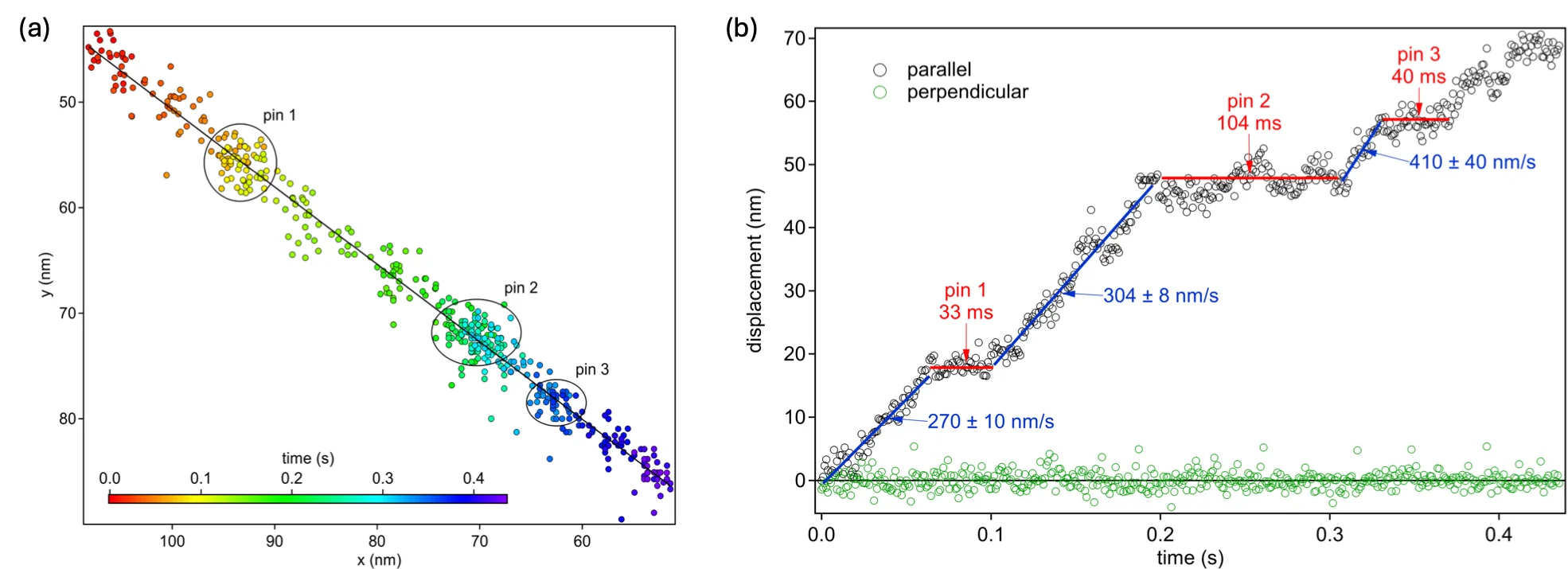
But in a real crystal, rings get stuck. In a thin nickel foil irradiated with gallium ions, rings hopped between traps about 5 nm apart. Their speed turned out to be millions of times lower than calculations predict for a free ring. This means impurities and local stresses play the main role, not the properties of the ring itself. Now, the motion parameters of rings can be used in models that predict how a metal will behave in a nuclear reactor.
Interstitial loops in nickel can move at speeds up to 4000 nm/s, equivalent to crossing the diameter of a human hair in a quarter of a second, but in a crystal with impurities they get stuck, only oscillating within a trap 5 nm wide.