Dancing Loops: How Interstitial Clusters Move in Irradiated Nickel ✛
Context
This work stands apart from neighboring studies on quantum vortices and diamond qubits, but thematically connects to carbon, optical microscopy, ion channels, and quantum information. There is little surrounding work, with the nearest neighbor at a distance of 0.547, so it fills a gap in understanding the early stages of radiation damage in metals. Previous studies of loops in nickel and copper provided scattered data on mobility and stability, and direct comparison with experiment on millisecond timescales was lacking.
Methods
The authors constructed perfect nickel crystals with up to 87,808 atoms and introduced a specified number of interstitial atoms (from 1 to 400). After relaxation and annealing at temperatures of 400–1200 K, they classified defects using Wigner–Seitz analysis and a dislocation extraction algorithm. To compare energies, Frank loops and prismatic loops were constructed manually by inserting an extra {111} atomic plane or ordered dumbbells. Mobility was assessed from the mean squared displacement of the cluster's center of mass, and the motion mechanism was identified from the trajectories of individual dumbbells. Experimentally, thin nickel foils, irradiated with gallium ions during preparation, were heated to 500 °C and imaged in a transmission electron microscope at 1100 frames per second.
Results
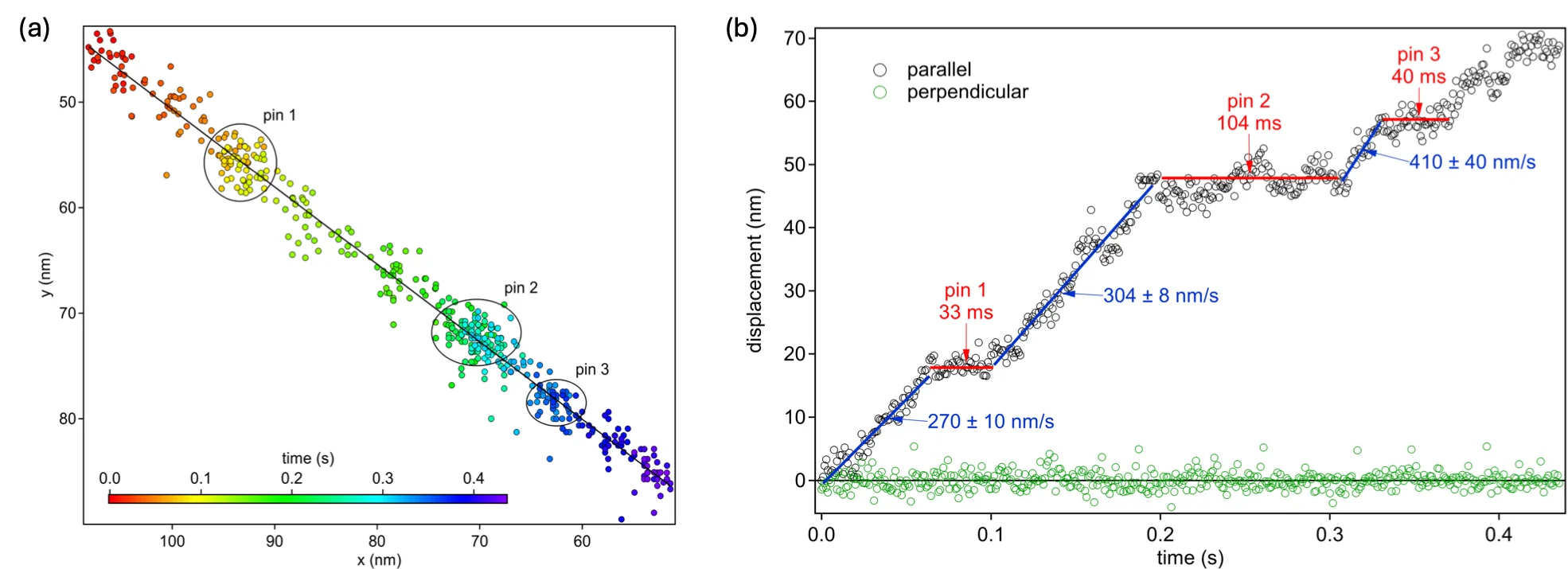
For cluster sizes from 14 interstitial atoms, prismatic loops become energetically favorable over Frank loops, and the difference grows with size due to the stacking fault penalty. However, Frank loops do not disappear instantly: barriers of 0.7–2 eV keep them as metastable states, and the transition was observed only at 1200 K. For prismatic loops, the migration activation energy was only 0.02 eV and independent of size, while the pre-exponential factor decreased following a power law with an exponent of about −0.5. Trajectory analysis showed that the loop does not move as a rigid body but via a relay: each step involves only a fraction of the dumbbell rows, and the number of participants grows as $N^0$.82. The experiment captured intermittent motion of loops with diameters of 6–20 nm at speeds of 270–4000 nm/s, orders of magnitude higher than previous measurements, but the effective diffusion was $10^5$–$10^9$ times lower than the molecular dynamics estimate for a free loop.
Implications
Unlike neighboring studies on quantum vortices or qubits, this research is the first to connect atomistic modeling with high-speed electron microscopy for the same material. This allowed not only refining the thermodynamics and kinetics of loops but also revealing a quantitative gap between ideal mobility and real behavior in irradiated foils. Such a gap indicates the dominant role of impurities and local stresses, which was previously only speculated.
Future development
The topic could evolve toward accounting for Cottrell impurity atmospheres and unresolved pinning on sub-millisecond timescales. Simulations with explicit gallium introduction and comparison with experiments at different temperatures would allow separating the contributions of trapping and drag. Also promising is the study of loop nucleation: which microscopic events determine whether a Frank loop or a prismatic loop forms.
Impact
The results will influence mesoscale models of radiation swelling and hardening in nickel alloys and austenitic steels. They provide physically based parameters for predicting defect structure evolution in nuclear reactors.
Next steps
The next step will be modeling loop motion in the presence of gallium impurities and comparing with microscopy trajectories at varying temperatures. It is also important to determine the nucleation barriers for different loop types from primary cascades.
Key open problems
For the materials science of irradiated metals, the connection between atomistic defect migration parameters and macroscopic swelling and creep remains unresolved. This work shows that without accounting for impurity drag and the heterogeneous energy landscape, quantitative prediction of loop kinetics is impossible, which is critical for the long-term stability of reactor materials.
The knowledge machine's view
This section is addressed to the author of the paper and their colleagues. Neighbouring works were found by meaning-based search across our archive, not by word overlap. We do not review: we show the field around the work.
What the work does
The authors combined molecular dynamics simulations with high-speed transmission electron microscopy to study the formation and movement of dislocation loops in irradiated nickel. They showed that prismatic loops are thermodynamically more favorable than Frank loops from a size of 14 interstitial atoms, but kinetic barriers make Frank loops metastable. The mobility of prismatic loops is almost independent of size in terms of activation energy, but it decreases due to a reduction in the pre-exponential factor, which is explained by a relay mechanism of atomic row movement. The experiment revealed intermittent loop motion with velocities higher than previously observed, but five orders of magnitude lower than predictions for an ideal crystal.
Where its strength is
This work is the first to combine atomistic modeling with high-speed electron microscopy for a single material, allowing direct comparison of defect dynamics on atomic and experimental timescales. The identified relay mechanism of prismatic loop motion is a concrete result that can serve as a basis for further studies of defect interactions with impurities and other obstacles.
Where it could go next
- It might be interesting to see how the relay mechanism of loop motion relates to the collective behavior of active particles: the study on active dumbbells examines how shape and interaction affect mobility in a dense medium, which resonates with loop motion in a crystal with impurities.based on: An Ellipse in a Crowd of Active Dumbbells arXiv:2608.30377v1
- Closely related is the work on how noise generates order and chaos in flows: it considers the influence of random fluctuations on filament dynamics, which could be useful for modeling intermittent loop motion under thermal fluctuations and random traps.based on: Threads in the Flow: How Noise Creates Order and Chaos arXiv:2601.00643
- In the archive there is an analysis of a droplet in active turbulence, where the trajectory of a single particle in a complex field is tracked: a similar approach to tracking individual loops in experiments could help quantitatively describe their interactions with defects and impurities.based on: Detective Droplet: How a Soft Particle Unveils the Secrets of Active Turbulence arXiv:2607.03737
Worth trying
- Test the trajectory analysis method from the droplet-in-turbulence study to identify regimes of intermittent loop motion in experimental videos.
- Use the active dumbbell model to describe the relay mechanism as collective motion of atomic rows with internal degrees of freedom.
- Apply the concept of noise effects from the filaments-in-flow study to model the influence of thermal fluctuations and random obstacles on the pre-exponential factor of loop diffusion.
Why this may matter
Understanding the early stages of radiation damage in metals is critical for predicting material behavior in nuclear reactors and during ion implantation. Connections to active matter research may provide new tools for analyzing defects in crystals.
Nearby works in our archive
- Threads in the Flow: How Noise Creates Order and Chaossimilarity 0.54
- How the Atomic Nucleus Becomes a Dance Floorsimilarity 0.53
- Detective Droplet: How a Soft Particle Unveils the Secrets of Active Turbulencesimilarity 0.53
- Electrons Freeze into a Patternsimilarity 0.53
- How Electrons Jostle Each Othersimilarity 0.53
- An Ellipse in a Crowd of Active Dumbbellssimilarity 0.52
The archive is sparse around this work: the closest review is only 0.54, against a usual 0.64. It looks like few have drilled nearby.
Interstitial loops in nickel can move at speeds up to 4000 nm/s, equivalent to crossing the diameter of a human hair in a quarter of a second, but in a crystal with impurities they get stuck, only oscillating within a trap 5 nm wide.
Key numbers
- migration activation energy of prismatic loop: 0.02 eV
- threshold size for thermodynamic advantage of prismatic loop: 14 interstitial atoms
- loop velocity in experiment: 270–4000 nm/s
- difference between experimental and calculated diffusion: 105–109 times
- trap width for pinned loop: 5 nm