Popular

Materials cond-mat.mtrl-sci

28 articles

Techniques, synthesis, characterization, structure. Structural phase transitions, mechanical properties, phonons. Defects, adsorbates, interfaces.

articles

A Magnetic Fridge with No Freon and No Compressor

Magnetic refrigerators cool by changing the magnetic field around a material: it alternately heats up and absorbs heat. Instead of expensive rare metals, an alloy of iron, nickel, and manganese has been proposed—cheap and effective. But when ground into nanopowder, carbon infiltrates the alloy, spoi
arXiv:2410.15776 · 2024-10-21

Where Electrons Hide: A Puzzle in a Crystal

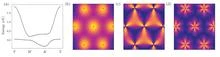
Using spectroscopy, like a probe feeling the electron clouds, physicists discovered: at one energy electrons sit on atoms, at another — in between. This means the internal structure of the material is more complex than a simple model, and such knowledge will help create quantum devices.
arXiv:2412.02813 · 2024-12-03

How a Part's Shape Deciphers Material Properties

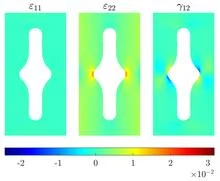
Now, instead of running many simple tests, you can use a single cleverly designed sample. When loaded, its bends reveal all the material’s elastic properties. Scientists have developed a computer method to calculate the ideal shape, ensuring accuracy even amidst noise.
arXiv:2501.12756 · 2025-01-22

Scientific Lego: Predicting Material Properties Without a Lab

MatGL is an open-source library for materials researchers. It uses graph neural networks (akin to social media algorithms) to predict properties from atomic structure. It comes with ready-made models, like construction kit parts: pick the one you need and quickly test new materials. The tool acceler
arXiv:2503.03837 · 2025-03-05

A Magnetic Metal for Future Electronics

A computer simulation showed that the compound of cobalt, iron, and germanium is magnetic and at the same time conducts current excellently — a rarity. The secret is that the intrinsic rotation of electrons (spin) aligns in one direction, reducing disorder. This opens the door to spintronics: from u
arXiv:2505.24836 · 2025-05-30

The Electron's Heel: What Dirac Knew and Pauli Missed

The simplified description of electrons in magnets misses a built-in curvature. Dirac's equation shows that every electron inherently has a property that slightly bends its path. This explains the anomalous Hall effect without extra assumptions. The discovery changes the foundations of magnet physic
arXiv:2506.01292v2 · 2025-06-02

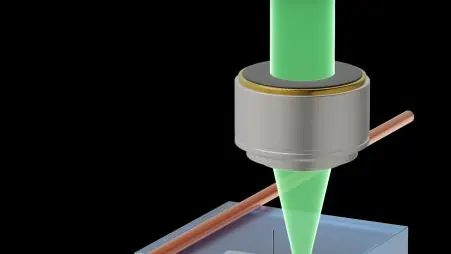
How Diamonds and Light Measure Immense Pressure

In a diamond anvil cell that compresses matter to pressures of the Earth's core, scientists placed diamond dust specks, which lit up under a laser like miniature sensor-bulbs. Analyzing their glow allowed them to build a detailed stress map, revealing dangerous 'hot spots.' The method paves the way
arXiv:2506.09058v2 · 2025-06-04

Resistance Paints the Secret Angles of a Magnetic Dance

In bismuth ferrite coated with platinum, the resistance twists unpredictably—each microscopic magnetic arrow inside seems to point in its own direction. This glitch, never observed before, hints at the complex life of magnetic domains. It could lead to new memory based on magnetization vortices.
arXiv:2510.15091 · 2025-10-16

Diamond spies peek at magnetic secrets under Earth's core pressure

Scientists have learned to create spy defects in diamond: swapping a carbon atom for nitrogen yields a sensor that responds to magnetic fields. For the first time, they've observed titanium under nearly two million atmospheres expel magnetic fields—a sure sign of superconductivity. This technology p
arXiv:2510.26605 · 2025-10-30

Chimeric Materials: Magnetic Expulsion Without Superconductivity

The discovery shows that the expulsion of a magnetic field, the hallmark of superconductors, can occur in ordinary conductors and even insulators. In such 'chimeric' materials, opposite properties coexist. Experiments on networks of superconducting switches promise practical magnetic shields.
arXiv:2511.00146 · 2025-10-31

Magnetic Ripples: How Relativity Plays with Spins

A magnetic material has been discovered where electron spins arrange into ripples due to relativistic effects. This brings spintronics — spin-based electronics — closer to reality.
arXiv:2511.01690 · 2025-11-03

Crystals that absorb light backward

Superfluorescence is a crystal's coordinated exhale of light. Now, scientists have caught its inhale: superabsorption. This light-gulping unison occurs in a tenth of a trillionth of a second—even at warm temperatures—because fleeting internal distortions act as a pacemaker. Adjusting the crystals' s
arXiv:2511.02678 · 2025-11-04

How a Nickel Impurity Turns a Superconductor into a Magnetic Tangle

Scientists placed nickel between the layers of superconducting niobium diselenide, and it completely killed the superconductivity. Instead, at extreme cold (–250 °C), a tangled magnetic pattern emerged — a chaotic tangle of magnetic "arrows." The reason: a shift in a critical point of the electronic
arXiv:2511.10160 · 2025-11-13

Thorium Nuclear Clocks: A New Frontier of Precision

In thorium-229 nuclear clocks, one 'tick' lasts 641 seconds — like a pendulum in syrup. The hardest part is eliminating interference from the crystal. If successful, the clocks will surpass everything created before and pave the way for testing fundamental theories.
arXiv:2511.13017 · 2025-11-17

Quantum Secrets of Plants and Birds

Plants and birds have mastered quantum tricks for survival: perfect photosynthesis and navigation without maps. Now engineers are copying these lessons for future technologies.
arXiv:2511.14363 · 2025-11-18

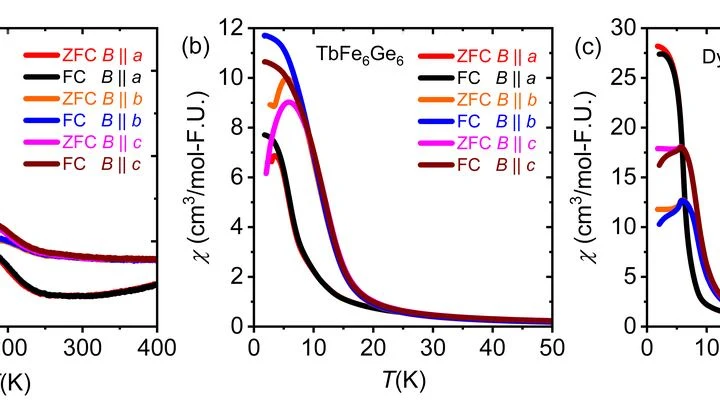
Magnetic Construction Set: Unexpected Flexibility of Atomic Layers

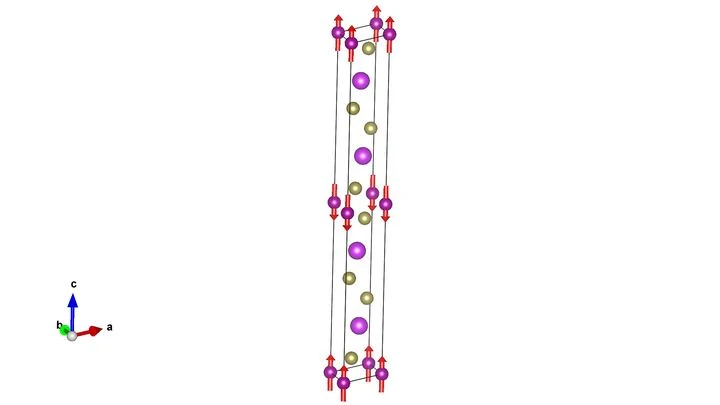
A magnetic material where layers are magnetized alternately, like a stack of pancakes. A tiny distortion of the triangular lattice (kagome) by germanium dumbbells makes flipping the whole layer energetically costly, while flipping a single chain is almost free. This opens the door to controlling mag
arXiv:2511.17398 · 2025-11-21

Nuclear Fusion in Metals: How the Medium Helps Nuclei Fuse

Palladium and titanium foil saturated with deuterium boosted the probability of nuclear fusion by a quintillion times. At low energies where the reaction should vanish, it unexpectedly plateaus. The discovery proves: the medium can control fusion just as well as stellar temperatures.
arXiv:2512.06212 · 2025-12-05

The Icy Magnets of Uranus and Neptune

Deep inside Uranus and Neptune, monstrous pressure transforms ice into a substance where an oxygen framework is threaded with flowing protons. Temperature differences within the planet set these protons in motion, generating electric current and a magnetic field. This explains the weird magnetospher
arXiv:2601.03659v2 · 2026-01-07

Why Some Metals Superconduct and Others Don't

Superconductivity arises when the electron 'sheet' in a metal is so soft that it ripples and nudges electrons along. All metals fall into three classes based on the stiffness of this sheet. For the first time, this new approach explains why gold and copper don't superconduct, and it promises a targe
arXiv:2601.14500 · 2026-01-20

How to Make Gold a Superconductor

Gold and silver don't superconduct—until you make them thousands of times thinner than a human hair. Quantum effects in a two-dimensional layer change electron behavior: calculations show that at a thickness of about half a nanometer, resistance vanishes. This could enable electronics that don't hea
arXiv:2602.07585 · 2026-02-07

A quantum simulator mimics a real magnet

A 256-atom simulator reproduced the properties of the frustrated magnet TmMgGaO₄ and showed that its behavior is governed by quantum jitters, not crystal defects. After a sudden jolt, the virtual material reached equilibrium in trillionths of a second—a process that ordinary computers cannot calcula
arXiv:2603.20372 · 2026-03-20

Entangled Photons: A New Way to See the Invisible

The new BELS technique tracks the synchrony of paired photons rather than their brightness. This allows it to distinguish between birefringence and Faraday rotation in a single measurement. The method opens the door to ultra-sensitive diagnostics for quantum devices.
arXiv:2603.22547 · 2026-03-23

Carbon nanotubes with calcium trap hydrogen

Hydrogen fuel is clean, but keeping it in a tank is tricky—molecules are too small and slip away. Scientists found a fix: put calcium atoms inside carbon tubes so they snag hydrogen like Velcro. This brings us closer to lightweight, safe hydrogen tanks for cars.
arXiv:2604.07110 · 2026-04-08

Hydrogen Made the Moon's Core Lighter

Scientists discovered that hydrogen seeps into molten iron, making it less dense. Under the conditions of the Moon's core, iron absorbs up to 1.2% hydrogen, reducing its density by 9% — exactly the amount needed to explain data about the Moon's oscillations. This finding overturns our understanding
arXiv:2604.12222 · 2026-04-14

Thorium Nuclear Clock Ticks with a Whisper of Light

The article describes a new way to excite the nucleus of thorium-229 using a very weak, steady laser beam. Instead of waiting for the nucleus to glow, the team detected the laser light absorbed by the crystal, making the signal faster and clearer. This opens the door to a solid-state nuclear clock t
arXiv:2604.16640 · 2026-04-17

Magnetic Walls — The Key to Quantum Computers

The boundaries between magnetized regions can be moved like a wave through a row of dominoes. These mobile walls are perfect candidates for quantum bits: they carry information while dodging interference and could lead to compact devices that don't need ultra-low temperatures.
arXiv:2604.19304 · 2026-04-21

Lone Molecule Bridges Spin and Light

New research has demonstrated for the first time a single molecule that works as a bridge between quantum spin and light. A carbene molecule embedded in a crystal shines brightly and preserves quantum information for milliseconds at -269°C. This is a breakthrough for building quantum networks, where
arXiv:2605.10077 · 2026-05-11

An Atom-Thick Magnet: Power in a Single Layer

A single-atom layer of iron chloride turns out to be a switchable magnet. Tiny defects within it quench the magnetic field fourfold, creating a natural nanopattern. This is a breakthrough for ultra-dense memory and spintronics.
arXiv:2605.22783 · 2026-05-21