A nuclear reactor is a device that initiates and controls sustained nuclear chain reactions, most commonly by using neutron-induced fission of heavy nuclei like uranium-235 or plutonium-239. In a chain reaction, a neutron strikes a fissile nucleus, causing it to split into lighter fragments and release energy plus additional neutrons; these neutrons then strike other nuclei, perpetuating the process. The reactor's design ensures that the reaction proceeds at a controlled rate, neither dying out nor escalating uncontrollably, and the released energy is extracted as heat for practical use.
History
The first artificial nuclear reactor, Chicago Pile-1, was built by Enrico Fermi's team and achieved criticality on December 2, 1942, at the University of Chicago. This demonstration paved the way for both military plutonium production and civilian nuclear power.
How it works
The core contains fuel rods with fissile material, a moderator (such as water or graphite) that slows neutrons to increase the chance of fission, and control rods made of neutron-absorbing materials like boron or cadmium. By adjusting the position of control rods, operators regulate the neutron population and thus the reaction rate. Coolant, often water or liquid metal, circulates through the core to carry away heat, which is then used to produce steam and drive turbines for electricity generation.
In practice
Nuclear reactors generate about 10% of the world's electricity, power naval vessels, and produce radioisotopes for medicine and industry; they also serve as neutron sources for scientific research.
Fun fact
Some reactor designs, like fast breeder reactors, can produce more fissile fuel than they consume by converting fertile isotopes such as uranium-238 into plutonium-239.
Atomic batteries powered by plutonium decay have been running pacemakers and space probes for over sixty years. But the raw material is scarce: worldwide, only a few kilograms of plutonium-238 are produced each year, barely enough for the most critical missions.
The atomic nucleus is usually pictured as a dense ball where protons and neutrons are mixed together. But in some isotopes, neutrons can stick out far beyond this ball, forming a diffuse shell — a neutron halo. This is especially common in nuclei with many more neutrons than protons.
In 1976, physicists predicted that an electron could do more than just fly past a nucleus: it could slam into it, transferring energy and making the nucleus 'shudder.' They called this effect NEEC — nuclear excitation by electron capture. But for nearly fifty years, no one has managed to observe it in an experiment.
The race for fusion energy is like trying to bottle a lightning bolt. For decades, physicists have struggled to recreate on Earth the processes that power the Sun. The main challenge is getting light nuclei to fuse despite their mutual repulsion, while extracting more energy than was spent heating and confining the plasma.
Empty space is not as empty as it seems. According to quantum theory, the vacuum is filled with particles that constantly pop in and out of existence. In 1976, physicist Bill Unruh showed that if an observer moves with acceleration, this 'quantum soup' turns into a genuinely warm bath for them — the Unruh effect.
Deep inside a neutron star, matter is squeezed so tightly that familiar protons and neutrons give way to new players. Hyperons are born there — particles that harbor a strange quark.
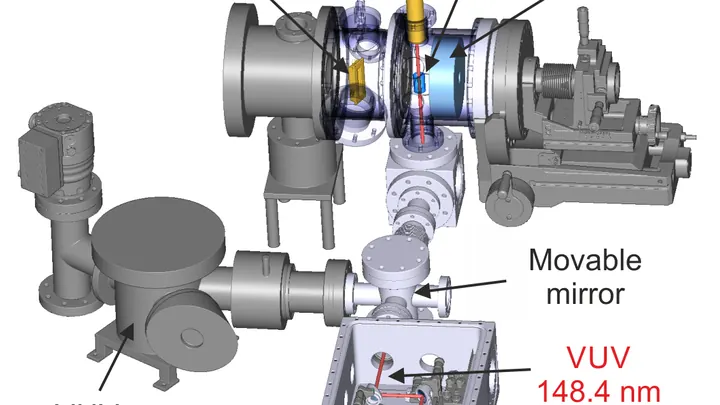
The world's most accurate pendulum isn't a steel rod: it's a tiny atomic nucleus. The isotope thorium-229 has a special excited state: to nudge the nucleus into it, you need surprisingly little energy — about what an ultraviolet laser delivers.
A pendulum that almost nothing can knock off balance (not shaking, not heat, not magnetic fields) because it is hidden in the very heart of the atom. That is the kind of pendulum physicists used when they first switched on a nuclear clock. Previously, the best clocks, optical ones, relied on electron transitions.
The most precise modern clocks count time by the oscillations of electrons in atoms. But their rhythm can be thrown off, like a mechanical watch's spring gets jolted by shaking. Physicists found a more reliable pendulum: the atomic nucleus.
Atomic nuclei are wrapped in fluffy electron coats — in such attire, they can't get close enough to embrace. But swap the light coat for a heavy one: a muon, a particle from the standard model, shrinks the cloud by nearly 200 times.
The atomic nucleus is a natural spring of colossal power. When the protons and neutrons inside it rearrange, it enters a special long-lived state — a nuclear isomer. It stores energy like a spring compressed to its limit.
The Standard Model is a set of rules for all known particles. But it says nothing about dark matter, which makes up a quarter of the Universe. To find it, you don't need to build city-sized colliders. Radioactive molecules act like sniffer dogs: their incredible 'scent' picks up the faintest traces of unknown forces that slip past giant machines.
A swing only gets going if you push it in rhythm. Miss the beat, and your effort is wasted. Light interacts with an atomic nucleus in much the same way: a photon is usually absorbed only when its energy exactly matches the gap between nuclear levels. But what if the photon's energy doesn't fit? The authors of a new study have found a workaround.
A laser hits a target of thin wires, and within tens of femtoseconds (billionths of a billionth of a second) knocks out a stream of protons. These protons fly into a converter made of lithium and deuterium, where neutrons are born.
The nucleus of a thorium-229 atom is like a taut guitar string: it vibrates at a strictly defined frequency. To 'pluck the string', a precise strike is needed — a laser beam of a very specific color.
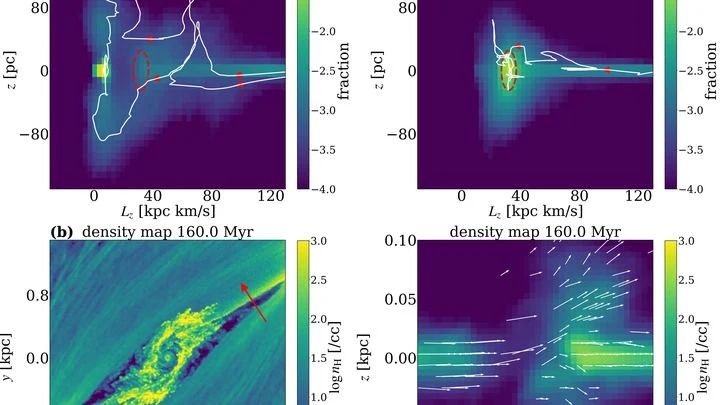
A river flows toward a whirlpool, but a dam with a notch blocks the way. Most water piles up before the dam, but some, gaining height, leaps over it and falls straight into the funnel. So it is with gas in a galaxy: it streams toward the center but hits a ring of stars and gas, like a dam. Usually, everything stops there, swirling into a dense vortex.
A laser beam as faint as a whisper of light has stirred a thorium-229 nucleus into a higher energy state. Most nuclei demand a blast of energy, but thorium-229 has such a tiny energy gap that even this gentle nudge works.
Neutrinos are tiny particles that pass through the planet's bulk like light through a windowpane. Every second, billions of them fly through your pinky fingernail, but catching even one is no easy feat. To do it, scientists dug a two-kilometer-deep mine in Canada and installed the SNO+ detector.
When heavy nuclei collide in accelerators, a multitude of particles is produced, and physicists want to understand how electric charge moves through this chaos. Two trains crash into each other: the passengers (quarks) scatter, but their luggage (charge) may end up far from the crash site.
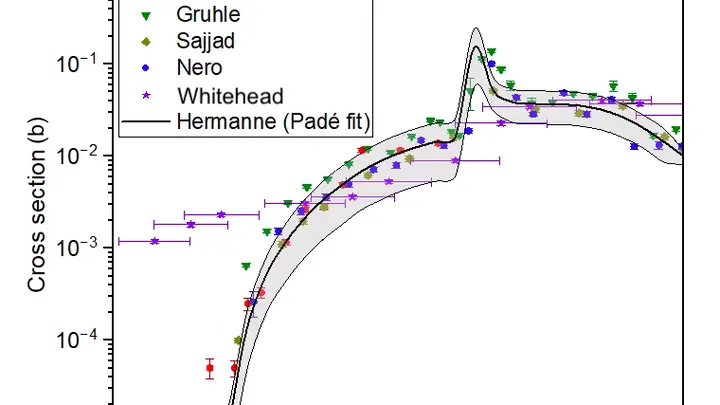
Inside the Sun, invisible nuclear transformations occur every second. One of them is the birth of boron-8: a beryllium-7 nucleus captures a passing proton and momentarily becomes a new element. This step kicks off a chain that ends with the emission of a neutrino — a particle capable of passing straight through Earth.
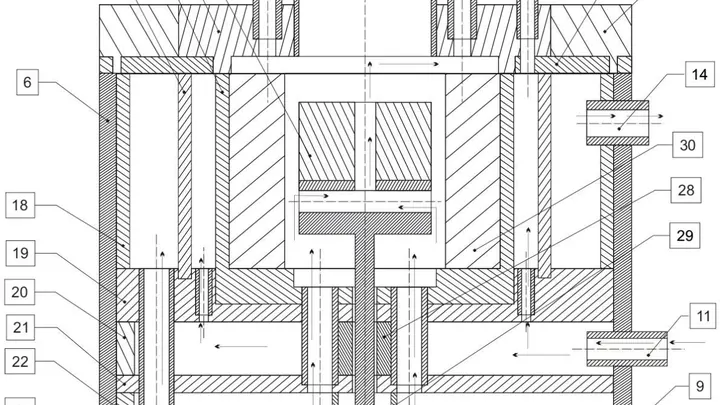
An ordinary nuclear reactor is like a boiler where fuel burns evenly throughout the volume. Here the picture is different: a fission wave, a narrow zone where atoms split and release heat, slowly creeps along a cylindrical rod of uranium carbide. Ahead of the wave, the fuel is untouched; behind, it is already spent. So fire runs along a candle wick, leaving wax behind.
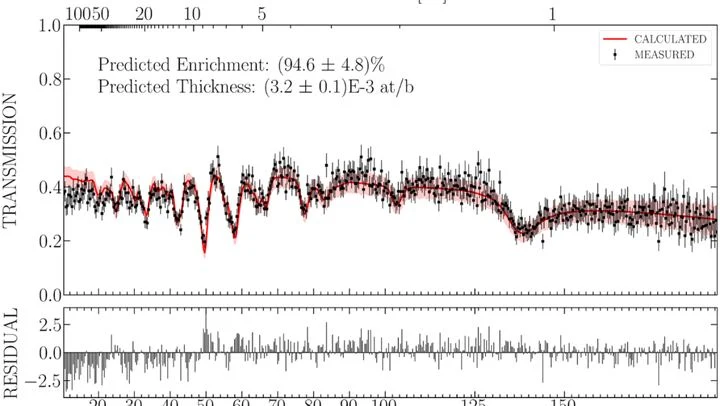
A customs officer can't take a suitcase apart to see what's inside. They shine X-rays through it and, from the shadows on the screen, tell: here's metal, here's organic matter. In much the same way, an inspector for future nuclear disarmament treaties should be able to check a warhead — without opening it or seeing its secret internals.
Neutrons are better suited for this than X-rays.
In a dark chamber where the temperature sits just four degrees above absolute zero, a sapphire crystal the size of a grain of rice lies waiting. When a neutrino, a ghostly particle that barely notices matter, flies through it, the crystal shudders and warms by a tiny fraction of a degree.
Deep inside a dying star, just before it goes supernova, nuclear reactions determine which chemical elements will be scattered across the cosmos. One such reaction is the collision of an oxygen nucleus with a proton, producing a nitrogen nucleus and an alpha particle (a helium nucleus).
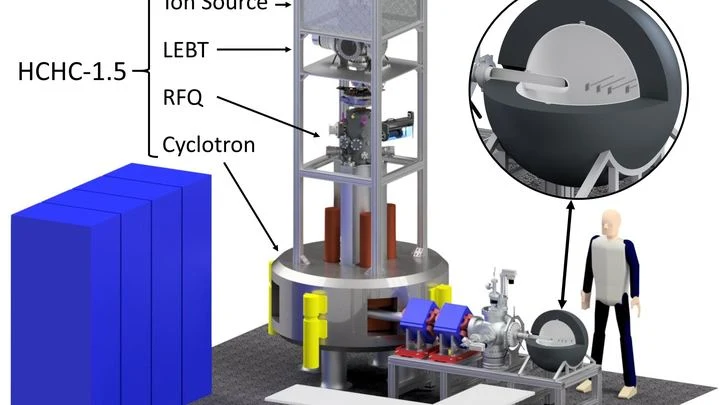
Every time deuterium and tritium fuse in a fusion reactor, a fast neutron flies out. It can turn one substance into another — for example, create valuable isotopes for medicine.
Today such neutrons cost a fortune, because there are few experimental facilities and they rarely operate.
Inside a future fusion reactor, a magnet weighing as much as a small car will float. It holds the superheated plasma like an invisible hand holding a cloud. Previously, such a magnet was considered unsuitable for deuterium-tritium fuel: neutron fluxes would quickly destroy it.
In April 2023, Japanese satellites detected a super-intense X-ray burst on the neutron star MAXI J1752–457. The star cooled down in 4 days — five times faster than usual. Like someone cracked open a cosmic window.
The antiproton is the proton's twin, only with a negative charge. When such a twin approaches a nucleus, it doesn't just bounce off: a whole dance of attraction and repulsion unfolds between them.
An atomic nucleus usually lives in a single energy state, like a ball resting on the floor. But thorium-229 has a rare exception: the nucleus can get stuck on a tiny step above the floor — the so-called isomeric state. This step is so low that it can be nudged by ordinary light, not just hard radiation.
Every year, in the United States alone, doctors perform more than 16 million scans using the radioactive isotope technetium-99m. It lights up the heart, bones, and lungs in images, helping to find tumors or check blood flow. But the isotope itself has a half-life of only six hours, so you can't stockpile it: you need a steady supply.
Igniting a miniature sun is a long-held dream of humanity. Typically, scientists try to confine scorching plasma (a gas of charged particles) at temperatures of hundreds of millions of degrees. But plasma tends to escape magnetic traps, and confinement comes at enormous cost.
A dying star is like a high-rise building collapsing in on itself. The core compresses to unimaginable density, while the outer layers fall onto it at speeds of tens of thousands of kilometers per second. At that moment, neutrinos are born — particles that barely notice ordinary matter and carry energy away.
Aluminum-26 is an isotope that doesn't live long by cosmic standards: only about a million years. When a massive star explodes as a supernova, it flings this aluminum into space. Later, it decays, emitting gamma rays that telescopes can catch.
The authors recalculated how much aluminum-26 a star with 20 solar masses should eject.
For two atomic nuclei to fuse, they must overcome their fierce electric repulsion — like trying to bring two angry bulls together. Normally, only monstrous energy does the trick, as in stellar cores, where Hans Bethe explained fusion back in the 1930s.
Deep inside stars, light nuclei fuse, giving birth to helium and streams of neutrons. On Earth, we recreate this process by combining deuterium and tritium — special isotopes of hydrogen.
The ATIC balloon rose over Antarctica and caught particles older than Earth itself. Among them are atomic nuclei from sulfur to chromium, and the higher their energy, the larger their fraction compared to iron. The standard 'leaky box' model predicted the opposite: heavy nuclei should dissolve like salt in water. But the data stubbornly rose.