A Dispatch Desk for Every Stream: A Model That Counts Floods Across America ✛
In a control room where every stream has its own panel, only a small fraction of the lights used to be on. Operators could see rivers only where gauges stood; everything else remained dark. Now, a signal can be displayed for each of the 800,000 reaches, and it updates every hour.
The δHBV2.0MTS-MC model works as a hybrid: neural networks tune the settings for a physical core rather than predicting water directly. It's like trusting a computer to pick the pipe diameter and wall roughness instead of guessing how much water will flow through, and then letting the laws of hydraulics do the rest. First, a daily model spins up over a long period to accumulate snow, moisture, and groundwater storage; then those states are passed to an hourly model that tracks each storm.
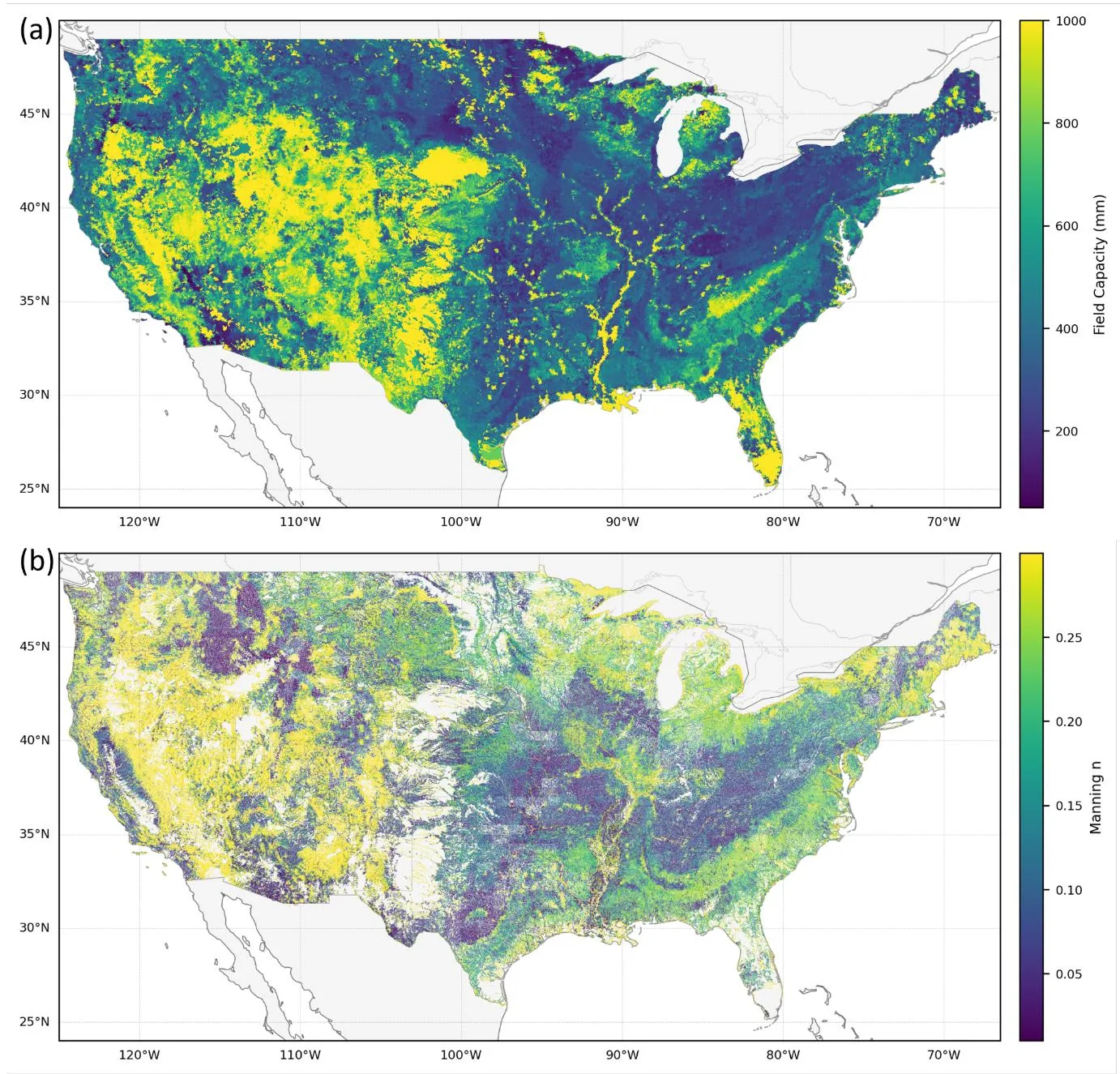
Previously, it was unclear whether such a distributed model with explicit routing could be trained on hourly data across the entire continental US and outperform the operational system at flood peaks. It turns out it can: the hybrid model with multiscale initialization, fast infiltration excess, and dynamic routing captures 33% more rare floods than the US National Water Model, and 159% more than a purely neural network baseline. At the same time, it produces physically interpretable parameters, such as field capacity and channel roughness, for each river reach.
They built a differentiable model where neural networks generate parameters for the physical core, and gradients flow through routing and runoff generation. Training on a single A100 GPU took about five days, while simulating 10 years of hourly streamflow for the entire network took about four hours. Such parameter fields used to require years of manual calibration; now they are generated in minutes.
Now all the lights in the control room are on. The dispatcher sees not only the rivers with sensors but also every small stream where water might rise suddenly. The model can be deployed in operational flood warning systems, especially for ungauged areas, and for real-time reservoir management.
Training the entire model for the continental United States took about five days on a single A100 GPU, and simulating 10 years of hourly streamflow for more than 800,000 river reaches took only about four hours on the same GPU. This is orders of magnitude faster than traditional calibration of distributed models, which could take years.
In Kim Stanley Robinson's novel 'The Ministry for the Future', a global system for predicting climate disasters warns of floods hours before they strike. The δHBV2.0MTS-MC model is a step toward such a system: it covers the entire river network of a country and provides forecasts every hour, enabling warnings about flash floods in ungauged places.