Popular

Geophysics physics.geo-ph

11 articles

Atmospheric physics, biogeosciences, geophysical techniques, hydrospheric geophysics, magnetospheric physics, planetology, solid earth geophysics.
articles

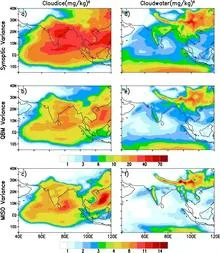
Cloud Spices: How a Neural Network Improves Climate

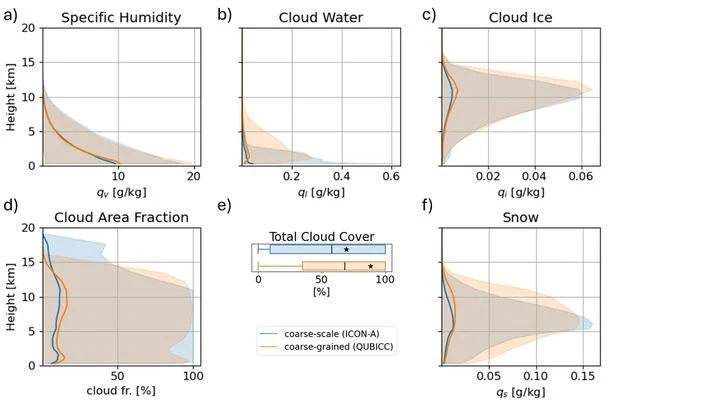
Climate models err due to small clouds. Scientists trained a neural network on detailed calculations and transferred its 'experience' to the global scale. Cloud-free sky physics is computed classically — the method works at any level of greenhouse gases.
arXiv:2510.05963 · 2025-10-07

Lunar Heating: How Tides Prolonged Earth's Magma Ocean

After the impact that created the Moon, Earth became a liquid ball. Gravitational 'kneading' heated the planet, prolonging the magma ocean's life from 30 to 500 million years—depending on oxygen levels. Water vapor trapped heat, and weak tides enriched the air with hydrogen. This paints a picture of
arXiv:2511.00952 · 2025-11-02

The Moon — a Giant Gravitational Bell

Computer modeling has shown that the Moon's uneven terrain and crust thickness turn its surface into an amplifier of spacetime ripples. In the region of the South Pole–Aitken basin, the signal is amplified dozens of times, paving the way for future lunar observatories capable of detecting the merger
arXiv:2511.04067 · 2025-11-06

The Moon as a Gravitational Wave Detector

The first accurate model of the Moon's response to gravitational waves reveals: uneven crust amplifies the signal tenfold. Energy transfers into extra vibration modes — like a bell with irregular walls. This will help pinpoint the ideal location for a lunar detector capable of catching the 'echo' of
arXiv:2601.16567 · 2026-01-23

Martian Ice: A Find Just a Meter Deep

Mars climate modeling showed that subsurface ice at mid-latitudes is remnants of ancient deposits from when the planet's axis was more tilted. The ice sublimated, and dust formed a protective crust. Calculations match the data: ice deposited 630,000 years ago lies at a depth of 25–150 cm. This is yo
arXiv:2602.18847 · 2026-02-21

How Sound Helped Find a Space Rock Over Alaska

A meteor missed by satellite cameras was reconstructed using sound and vibrations. A low-cost alternative for polar latitudes, where the never-setting sun blinds optics.
arXiv:2603.22630 · 2026-03-23

Mars's dense layer reveals the fate of rocky planets

When a young planet is covered in scorching liquid rock, heavy particles like iron want to sink. But the mantle melts from below, and light droplets float up, churning the ocean. On big Earth, the 'stirring' was strong—no layers formed. Mars is smaller, its rocky soup was shallower and calmer, so ir
arXiv:2605.04840 · 2026-05-06

River as a Mirror of the Universe

Researchers found that a lab-made river’s cross-section perfectly mirrors the form predicted by a cosmological equation for a negatively curved universe. Normally, this equation tracks how the Universe’s size evolves over time. Surprisingly, water sculpts its channel to maximize bottom friction, and
arXiv:2605.14670v1 · 2026-05-14

Light Carousel Measures Earth's Rotation

Deep inside the Gran Sasso underground lab, a prototype called TRIO has come to life—a device built like a light carousel. Two beams race around a ring in opposite directions, and the slightest rotation alters their meeting point. A special design suppresses internal tremors and lets the ring be sca
arXiv:2606.02594 · 2026-05-22

Levitating Graphite Web Captures the Moon's Embrace

In Southampton, the thinnest graphite flake has been turned into an ultrasoft gravitational antenna. Levitating above magnets, it shifts by nanometers under tidal forces, and a laser interferometer converts this into a precise signal. The instrument distinguishes lunar and solar contributions, achie
arXiv:2606.14738v1 · 2026-06-02

Neutrino Tomography of Earth: A New Look at the Planet's Interior

Earth's internal structure is traditionally studied using seismic methods and gravimetry. But neutrinos—particles that barely interact with matter—offer a fundamentally different, gentle probe. The IceCube collaboration analyzed 10.7 years of muon neutrino observations with energies from 500 GeV to
arXiv:2607.02644v2 · 2026-07-02