In 1920, Nikolai Vavilov, studying cereal collections from around the world, formulated the law of homologous series in hereditary variation. The essence is simple: genetically close species and genera have similar series of hereditary traits. Just as elements in chemistry form a periodic system, in biology traits repeat with such regularity that knowing the series of forms for one species allows predicting the existence of parallel forms in other species and genera. The closer the relationship, the more complete the similarity. For example, common wheat has forms with awned, awnless, red, white, and purple ears — and the same variations are found in durum wheat and rye. This is not a coincidence but a manifestation of common genetic programs inherited from an ancestor.
History
Nikolai Vavilov formulated the law in 1920 at the III All-Russian Congress of Breeders in Saratov, based on the analysis of an extensive collection of cultivated plants gathered during expeditions across five continents. He noticed that related cereal species repeat the same variations — awnedness, ear color, grain shape. Later, the law was confirmed on a vast amount of material, including wild species, and gained worldwide recognition. Vavilov developed the ideas of homologous variation, anticipating modern concepts of homeotic genes and the evolutionary conservatism of genetic programs. His work laid the foundations of scientific breeding and the conservation of plant genetic resources.
How it works
The law is applied in breeding to predict and search for new alleles (gene variants) with economically valuable traits. For example, knowing about the existence of dwarf forms in wheat, breeders sought and found similar mutations in rice, leading to the 'Green Revolution'. The limits of applicability are constrained by the degree of genetic relationship: in distant species, parallelism may be disrupted due to accumulated genomic differences. The law works at the level of genera and families but does not predict traits arising from unique evolutionary events.
In practice
Using this law, breeders predict which useful mutations have not yet been discovered in cultivated plants and purposefully search for them in wild relatives — for example, forms with drought or disease resistance.
Fun fact
Vavilov predicted the existence of a liguleless (without a ligule) form of rye based on his law — and a few years later it was indeed found in Afghanistan. It was as if he had glimpsed the future of evolution.
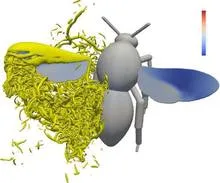
A metronome beats the rhythm, and the musician adjusts to it without thinking about note lengths. Similarly, vortices on an insect's wing follow a single rhythm set not by the mechanics of the flap but by a universal law of separated flow.