Why Insects Beat Their Wings in the Same Rhythm
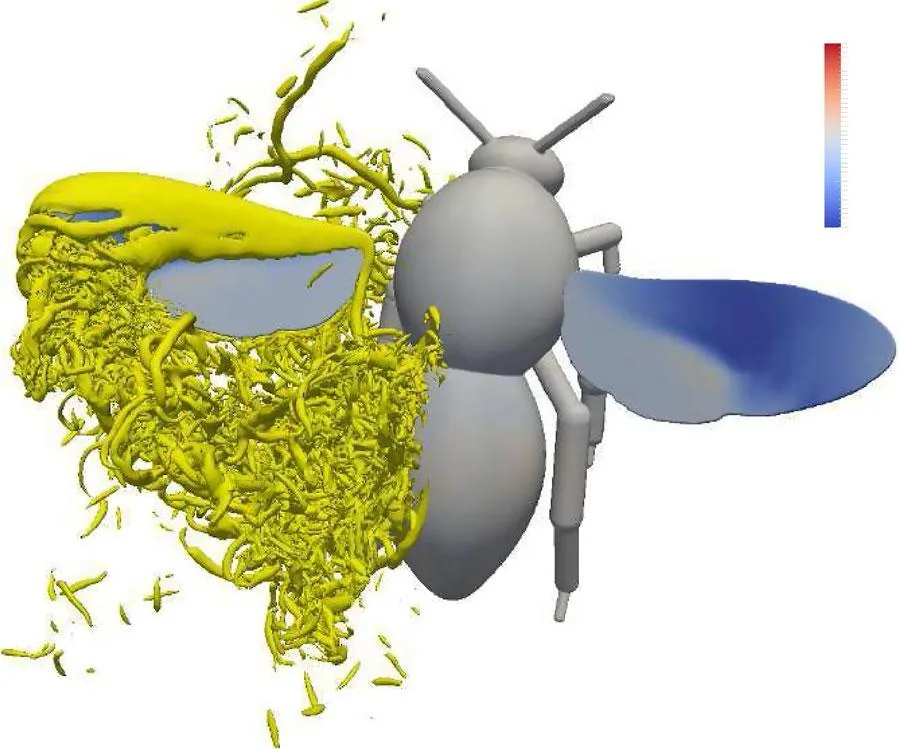
If you blow on a pipe stub, vortices will start shedding alternately behind it. Their frequency does not depend on how hard you blow: it is determined only by the pipe's size and the flow speed. This rhythm is described by the Strouhal number, which remains roughly constant for a wide range of bodies, around 0.16.
When an insect flaps its wing, a vortex forms on the leading edge, creating lift. Then the vortex sheds, and a new one appears on the next half-stroke. The author found that the frequency of these births follows the same Strouhal number, provided you choose the right characteristic size of the separation zone and the separation speed. For stationary wings with artificially excited vortices, maximum lift is achieved precisely at a Strouhal number of 0.17. For twelve species of hovering insects, from midges to beetles, the average Strouhal number turned out to be 0.162, again in the same range.
So an insect does not just flap its wings at an arbitrary pace; it locks into resonance with the natural rhythm of the separated flow. This rhythm is the same for a pipe stub and a bee's wing. Thanks to this law, engineers can calculate the flapping frequency and aerodynamic load for future flapping microrobots without tuning parameters for each species.
The average angle of attack at which hovering insects minimize aerodynamic power is about 42 degrees, which is remarkably close to the mean value of 40 degrees obtained from published data on real insects.