The theorem's history dates back to 1838, when the French mathematician Joseph Liouville was studying planetary motion. He noticed a remarkable property: if you take many copies of a mechanical system, slightly differing in initial conditions, the volume occupied by these copies in phase space (coordinates + momenta) remains constant over time. It is as if a flock of sheep scattered across a pasture, but the area they occupied remained unchanged. Later, in the works of Gibbs and Einstein, Liouville's theorem became the foundation of statistical mechanics. It explains why the entropy of an isolated system cannot decrease: microscopic trajectories do not compress.
History
Joseph Liouville published his theorem in 1838 in a note on the method of variation of arbitrary constants in celestial mechanics. In its modern formulation, it is often associated with Henri Poincaré, who used the conservation of phase volume in studies of the stability of the Solar System. At the beginning of the 20th century, Ehrenfest gave a vivid interpretation: 'the fluid of phase points is incompressible.' The quantum analog—the von Neumann equation—also conserves probability volume, but with caveats due to noncommutativity.
How it works
Liouville's theorem plays a key role in plasma physics and accelerator science, where beam compression is limited by the conservation of emittance (a parameter proportional to phase volume). In statistical physics, it explains why microscopic reversibility does not contradict macroscopic irreversibility: the phase volume is conserved, but due to the instability of trajectories, it becomes mixed to such an extent that the coarse-grained entropy increases (so-called mixing). Limits of applicability: the theorem holds only for isolated Hamiltonian systems without dissipation and without external fields that disrupt the canonical structure.
In practice
Liouville's theorem underlies statistical physics and particle accelerator design: it explains why a beam cannot be focused into an infinitely small spot without loss of brightness.
Fun fact
If not for Liouville's theorem, perpetual motion machines of the second kind would be possible. Air molecules could spontaneously gather in one corner of the room, and you would get free energy. But the conservation of phase volume forbids such tricks—chaos always takes its toll.
A transparent film of bismuth tungstate sits on a substrate and does not conduct electricity. Three minutes in a cloud of nitrogen plasma, and it turns black, with resistance dropping by a factor of a billion.
A laser beam passes through a glass cell filled with cesium vapor. The atoms in the vapor dart around chaotically, like a crowd at a train station: each one enters the beam, spends a moment there, and flies back out. Their internal state, something like the orientation of a tiny magnet, changes under the influence of light. If all atoms were identical and stationary, the signal would be steady.
An orchestra of billions of cesium atoms struck a single note, and it sounded for 17 hours without fading. That’s no exaggeration: Chinese physicists created a continuous time crystal with a record-breaking lifespan. A time crystal is a system that breaks time symmetry, spontaneously pulsating in an unchanging rhythm.
In the first moments of its life, the Universe resembled a boiling cauldron. As it cooled, phase transitions occurred — much like steam turning into water, but instead of molecules, the very state of space changed. In this cauldron, bubbles of the new phase were born, akin to bubbles in a pot coming to a boil.
In the early 20th century, Einstein showed that gravity is the curvature of space and time. A bit earlier, Maxwell had unified electricity and magnetism into a single theory.
A pot of water has just been stirred: the whirlpools and eddies gradually calm down, and the liquid becomes smooth. A similar process, but in the quantum world, occurs in superfluid helium or in a cloud of ultracold atoms.
A handful of sand lands on the table. The grains settle in different ways, but if the handful is large, the total volume barely changes. That's roughly how classical gravity works: space appears smooth and definite. But look closely at the individual grains, and you'll find that at the quantum level, volume itself is no longer fixed.
Water churns behind a rock in a river, air swirls behind an airplane wing: it seems like completely random motion. But the authors of the study found a rigid kitchen recipe in this chaos.
They decomposed the fluid's rotation (angular momentum) into two independent parts.
The quantum world loves order, but reality often brings disorder. In this work, physicists study one-dimensional chains of spins — tiny magnetic arrows that can point up or down. Usually, topological phases (stable states protected by symmetry) are defined for pure states, where each arrow is precisely known.
A drop of ink falls into a glass of water, and ripples spread out from it. Water seems simple, but if you look inside, each molecule isn't just moving forward: it's also spinning like a tiny top. Physicists call this intrinsic rotation spin. Usually, it goes unnoticed: in calm water, the tops spin every which way, and their rotation doesn't affect the fluid's overall motion.
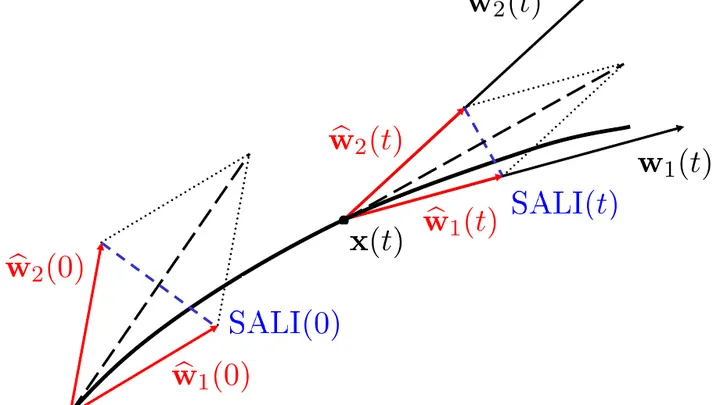
Drop a stone into a calm pond — the ripples spread evenly. Drop it into a churning stream — the water swirls unpredictably. Scientists have long wrestled with a similar question: how can you tell from a single particle's path whether its motion is chaotic? Previously, this meant comparing the particle's path with neighboring ones, which is complicated and time-consuming.
A waterfall doesn't ask if you're ready to jump. Its flow accelerates, and at some point even light can't escape back. A McVittie black hole is such a waterfall, but not in an ordinary river; it's in an expanding universe: the water here is space itself, which continuously stretches, carrying galaxies apart from each other.
A single photon passes through two slits and leaves an interference pattern on a screen. Quantum mechanics describes this process with a wave function, but what happens to the particle itself?