Georg Ohm in 1826 experimentally investigated how metals conduct electricity. At that time, it was believed that current is a flow of a mysterious fluid. Ohm established a clear mathematical relationship: current I = U / R, where R is a characteristic of the conductor. He presented the result in the book 'The Galvanic Circuit Investigated Mathematically', but colleagues received the work coldly. Recognition came only a few years later. Today Ohm's law is the ABC of electrical engineering: in any microchip, transformer, LED strip, it is essential.
History
Georg Simon Ohm, a German physicist, in 1825–1826 conducted a series of meticulous experiments with galvanic cells and metal wires of different lengths and cross-sections. Using a modified Coulomb torsion balance to measure current, he discovered a linear dependence. In 1827, his book 'Die galvanische Kette, mathematisch bearbeitet' was published, where he introduced the concepts of electromotive force, current strength, and resistance. Contemporaries, including Georg Hegel, mocked the 'useless fantasies', but by the 1840s the law gained universal recognition. James Clerk Maxwell later integrated it into the unified theory of electromagnetism.
How it works
Ohm's law forms the basis of analyzing electrical circuits — from household appliances to superconducting magnets. Its limits: materials with a nonlinear current-voltage characteristic (semiconductors, diodes, gas discharges) do not obey simple proportionality. Also, at high frequencies or temperatures near absolute zero, effects appear that require quantum corrections.
In practice
In any electrical device, the calculation of the resistance of a heating element or fuse uses Ohm's law. Without it, you cannot adjust speaker volume or select wire gauge for wiring.
Fun fact
The human body is a conductor. The resistance of dry skin is ~100 kΩ, while wet skin drops to 1 kΩ. The danger of electric shock increases dramatically after a shower.
Inside an MRI magnet, current flows through a closed superconducting loop, like water circling in a bucket after you give it a spin, it just keeps going on its own. To change that current, you heat the loop with a small heater: it stops being superconducting, becomes an ordinary resistor, and then an external source can 'top up' or 'draw off' current.
The river splits in two. One branch is wide and fast, with water flowing smoothly, but as temperature rises, the flow slows: eddies and waves appear. The second branch is narrow, with rapids, where water leaps from rock to rock. This flow, on the contrary, becomes more lively with warming.
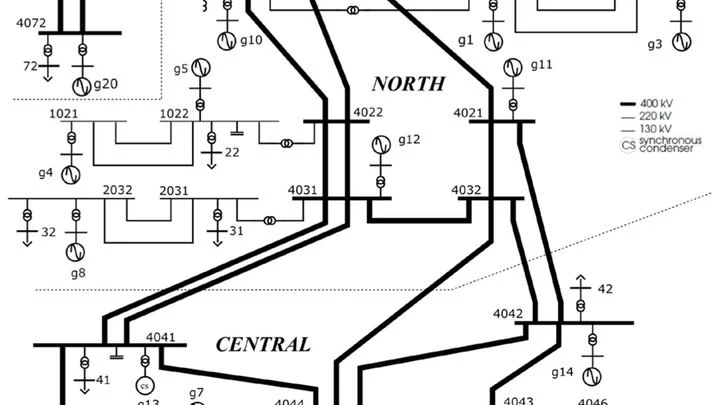
The power grid can be pictured as a water supply system: pipes are the lines, and pumps are the converters. When pressure (voltage) drops in some district, powerful pumps can send extra water (power) there. The trouble is, too strong a flow causes overload, and too weak a flow doesn't help. You need to know exactly how far to open the valve.
Engineers found the answer.
A thin semiconductor layer at low temperatures behaves like a pot of honey: electrons flow not as individual particles but as a thick liquid. If you run an alternating current through such a layer, the resistance responds with a smooth curve.