A Universal Vortex-Shedding Law for Hovering Insects
Context
This work stands apart: it has almost no close neighbors, the nearest being at a distance of 0.49, and the map's thematic cluster groups quasiparticles, squeezed states, superpositions, and quantum-like models. Neighboring studies explore vortices in superfluid helium, magnetic vortices as electron lenses, plasma waves, and turbulence. This paper, in contrast, addresses classical hydrodynamics of separated flows and the biomechanics of insect flight. It connects two seemingly distant worlds: the universal law of vortex shedding behind bluff bodies and the formation of leading-edge vortices on flapping wings. This is not a quantum analogy but a direct application of Roshko's classical scaling to biological flight.
Methods
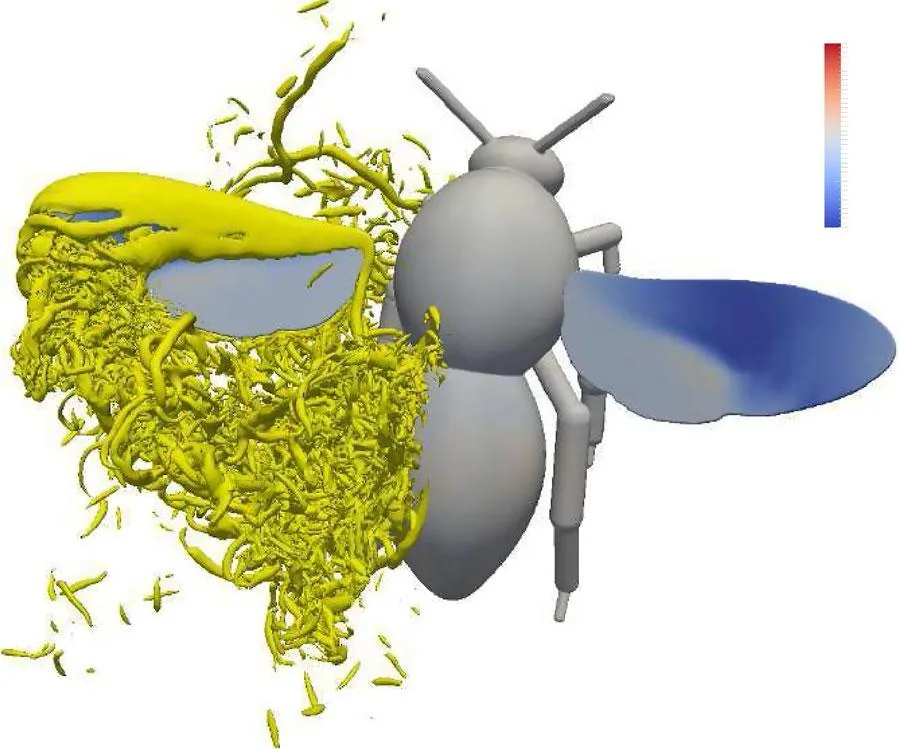
The author constructs a reduced-order model for stationary flat wings, where discrete LEVs are generated by periodic leading-edge perturbations via a dielectric barrier discharge. The separation bubble height is estimated from the projection of the chord onto the normal to the flow, the separation velocity is computed from the pressure distribution on the upper surface using Roshko's relation, and the pressure on the lower surface is approximated by a modified Newtonian formula. The single calibration constant is set to unity and fixed across all datasets. For hovering insects, the same scheme is applied using cycle-averaged quantities: lift from weight balance, wingtip velocity from geometry and wingbeat frequency, and a representative angle of attack determined from published kinematics for each species. A key point: the LEV formation frequency equals twice the wingbeat frequency, because one vortex is formed per half-stroke.
Results
For stationary wings with periodic excitation, maximum lift occurs at a Strouhal number of 0.171 ± 0.018, matching Roshko's classical value of 0.167. For twelve datasets on hovering insects, spanning Reynolds numbers from 686 to 7018 and body masses from 27 to 1648 mg, the mean Strouhal number is 0.162 ± 0.038. The data scatter is comparable to that of the usual reduced frequency, but only the Strouhal number reproduces the classical range. The reduced frequency, doubled to account for two LEVs per wingbeat, gives 0.452 ± 0.082, far from the lift maximum on stationary wings (0.885 ± 0.135). Thus, agreement emerges only when the characteristic size of the separation zone and the separation velocity are introduced through Strouhal scaling.
Implications
Unlike neighboring studies that examine quantum vortices, magnetic structures, or plasma waves, this paper transfers the classical law of vortex formation to biological flight. It shows that the LEV formation frequency in insects is governed not by wingbeat mechanics but by a universal timescale of separated flow. This is not merely a correlation but a physical link between aerodynamic loading, wing kinematics, and energy expenditure. The work aligns with the broader search for universal patterns in complex flows, yet its method and subject are unique: none of the neighbors have applied Roshko scaling to living organisms.
Future development
The topic could develop toward incorporating three-dimensional effects, such as spanwise flow that stabilizes the LEV after its formation. One could also investigate how the universal law is modified during unsteady maneuvers, such as takeoff or turning. For practical purposes, it is important to test how well the proposed scheme applies to the design of flapping microrobots with specified geometry and stroke amplitude.
Impact
The results will impact the biomechanics of insect flight, the aerodynamics of separated flows, and the design of flapping microrobots.
Next steps
The next step is to test the universal law on a larger number of insect species with precisely measured angles of attack and kinematics. It is also worth investigating how three-dimensional spanwise flow affects LEV formation time.
Key open problems
The work links the classical problem of vortex formation in separated flows to the biological challenge of generating lift during hovering. It shows that the unresolved question of LEV stabilization on flapping wings can be separated from the question of its formation time: stabilization is governed by three-dimensional vorticity transport, while formation is governed by the universal Strouhal number.
The average angle of attack at which hovering insects minimize aerodynamic power is about 42 degrees, which is remarkably close to the mean value of 40 degrees obtained from published data on real insects.
Key numbers
- Universal Strouhal number range: 0.15–0.17
- Mean Strouhal number for insects: 0.162 ± 0.038
- Mean Strouhal number for stationary wings: 0.171 ± 0.018
- Reynolds number range for insects: 686–7018
- Mean angle of attack for minimum power: 42°