The Metronome of Separated Flow: How Insects Catch the Rhythm of Vortices
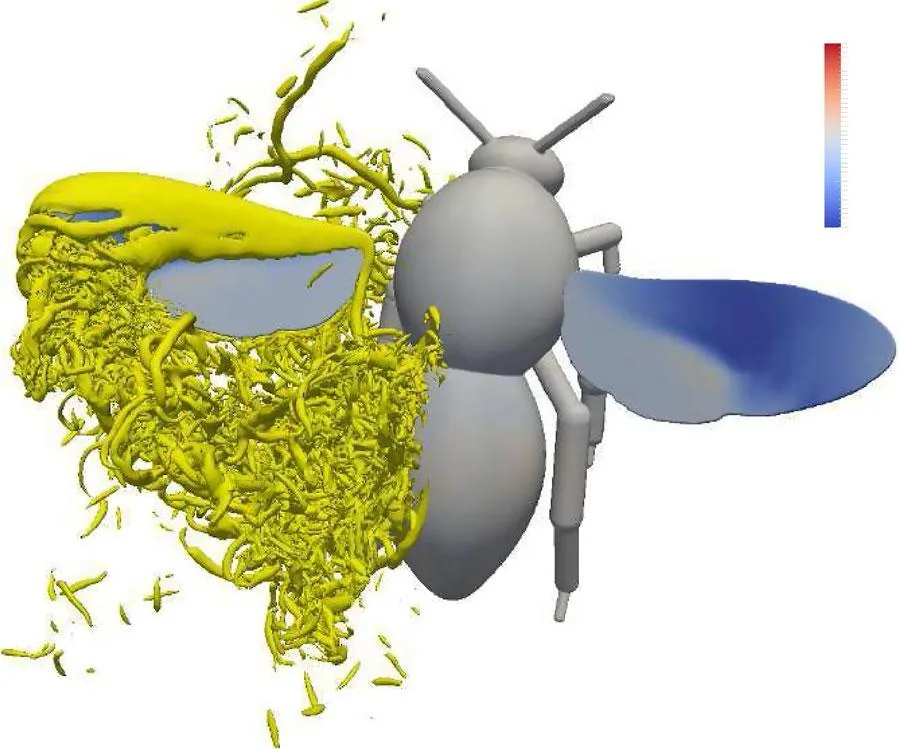
A metronome beats the rhythm, and the musician adjusts to it without thinking about note lengths. Similarly, vortices on an insect's wing follow a single rhythm set not by the mechanics of the flap but by a universal law of separated flow. This rhythm is expressed by the Strouhal number, a dimensionless frequency that remains constant across very different flows.
When an insect wing flaps, a vortex forms at the leading edge, briefly generating powerful lift. Then the vortex sheds, and a new one is born on the next half-stroke. The author of the study hypothesized that the frequency of these births follows the same Strouhal number, provided the characteristic size and velocity are chosen correctly. For stationary wings with artificial vortex excitation, maximum lift is achieved precisely at a Strouhal number of 0.17, which nearly matches the classical value.
This result connects two worlds previously considered distant: classical hydrodynamics of separated flows and the biomechanics of flight. The usual reduced frequency, often used to describe flapping wings, does not yield such agreement. Only the Strouhal number, which accounts for the size of the separated region and the velocity of separation, reproduces the universal rhythm. This means that the insect is not merely flapping its wings at a convenient pace; it is resonating with the inherent rhythm of the separated flow.
The metronome of separated flow ticks the same for a truncated pipe and a bee's wing. This finding allows us to calculate aerodynamic loads and flapping frequencies for future flapping micro-robots without tuning parameters for each species. The rhythm is already set by nature; engineers just need to tune their machines to it.
The average angle of attack at which hovering insects minimize aerodynamic power is about 42 degrees, which is remarkably close to the mean value of 40 degrees obtained from published data on real insects.