Una batería con un electrodo que no quiere soltar la carga exprés
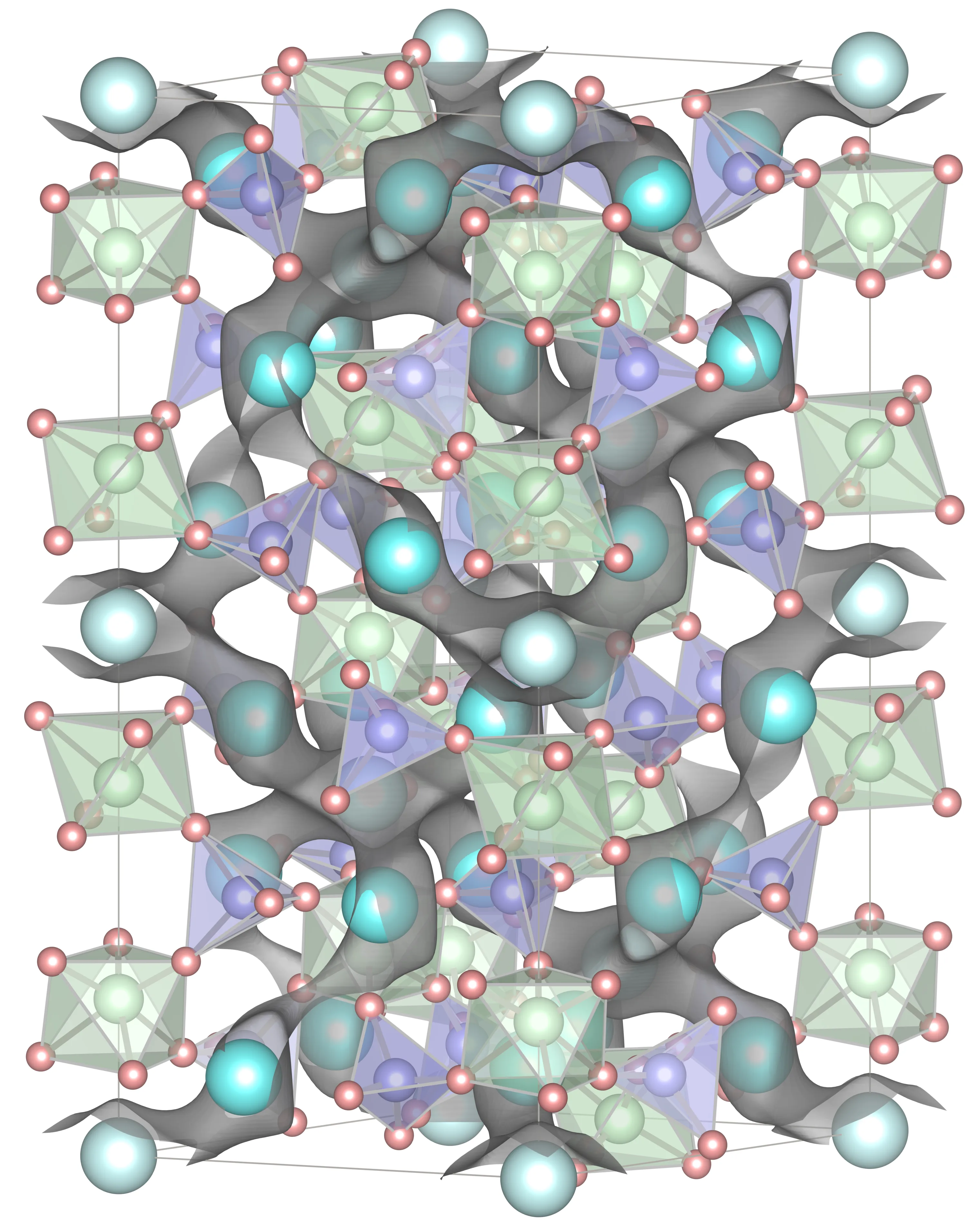
Una hucha en la que las monedas caen fácilmente, pero solo se pueden sacar rompiéndola. Algo parecido ocurre con un nuevo material para baterías de sodio. Acepta con gusto los iones de sodio durante la carga, pero al descargarse apenas devuelve nada.
El material con fórmula Na4NiCr(PO4)3 pertenece a la familia NASICON: son estructuras de armazón donde los iones de sodio pueden viajar por una red tridimensional de canales. Los cálculos mostraron que la barrera para el movimiento de los iones es baja: solo 0,468 electronvoltios, aproximadamente la energía del movimiento térmico a temperatura ambiente. Es decir, los iones podrían moverse libremente.
Tras un ciclo de carga y descarga, la red cristalina permaneció intacta y los cálculos mostraron que los iones de sodio aún pueden migrar. Entonces, el problema no está en el movimiento de los iones. Más bien, la culpa la tiene la mala conductividad electrónica: los electrones no pueden llegar a los lugares donde están los iones para completar la reacción.
Es como si en una casa las tuberías de agua funcionaran, pero la bomba no. El agua (los iones) está, las tuberías (los canales) están bien, pero sin la bomba (los electrones) no fluye.
Para que este material funcione, hay que mejorar su conductividad electrónica, por ejemplo, añadiendo impurezas o modificando la estructura. Entonces la hucha no solo aceptará, sino que también devolverá.
Resumen original
tal como lo escribieron los autores, en inglés arXiv:2601.07012
We examine a new NASICON-type Na$$_4$$NiCr(PO$$_4$$)$$_3$$ material designed for high-voltage and multi-electron reactions for the sodium-ion batteries (SIBs). The Rietveld refinement of the X-ray diffraction pattern, using the R$$\bar{3}$$c space group, confirmed the stabilization of the rhombohedral NASICON framework. Furthermore, the Raman and Fourier transform infrared spectroscopy are employed to probe the structure and chemical bonding. The core-level photoemission analysis reveals the Cr$$^{3+}$$ and mixed Ni$$^{2+}$$/Ni$$^{3+}$$ oxidation states in the sample. Moreover, the bond valence energy landscape (BVEL) analysis, based on the refined structure, revealed a three-dimensional network of well-connected sodium sites with a migration energy barrier of 0.468 eV. The material delivered a good charge capacity at around 4.5 V, but showed no sodium-ion intercalation during discharge, resulting in negligible discharge capacity. The post-mortem analysis confirmed that the crystal structure remained intact. The calculated energy barrier values indicated a reversal in sodium site stability after cycling, though the barriers can still permit feasible ion migration. This suggests that ion transport alone cannot explain the lack of reversibility, which likely arises from intrinsically poor electronic conductivity. These findings highlight key challenges in achieving stable, reversible capacity in this system and underscore the need for doping, structural modification, and electrolyte optimization to realize its full potential as a high-voltage SIB cathode.
El sodio es el sexto elemento más abundante en la corteza terrestre y se puede extraer del agua de mar. Por eso, las baterías de sodio se consideran una alternativa más barata a las de litio.