Por qué la enfermedad del banano no se rinde exprés
La plantación de bananos se cubre de franjas oxidadas. Es la sigatoka negra, un hongo cuyas esporas viajan por el aire como un polen invisible. Ataca las hojas y debilita la planta. El agricultor reduce la infección, pero la enfermedad regresa de repente, como una maleza que fingía estar muerta.
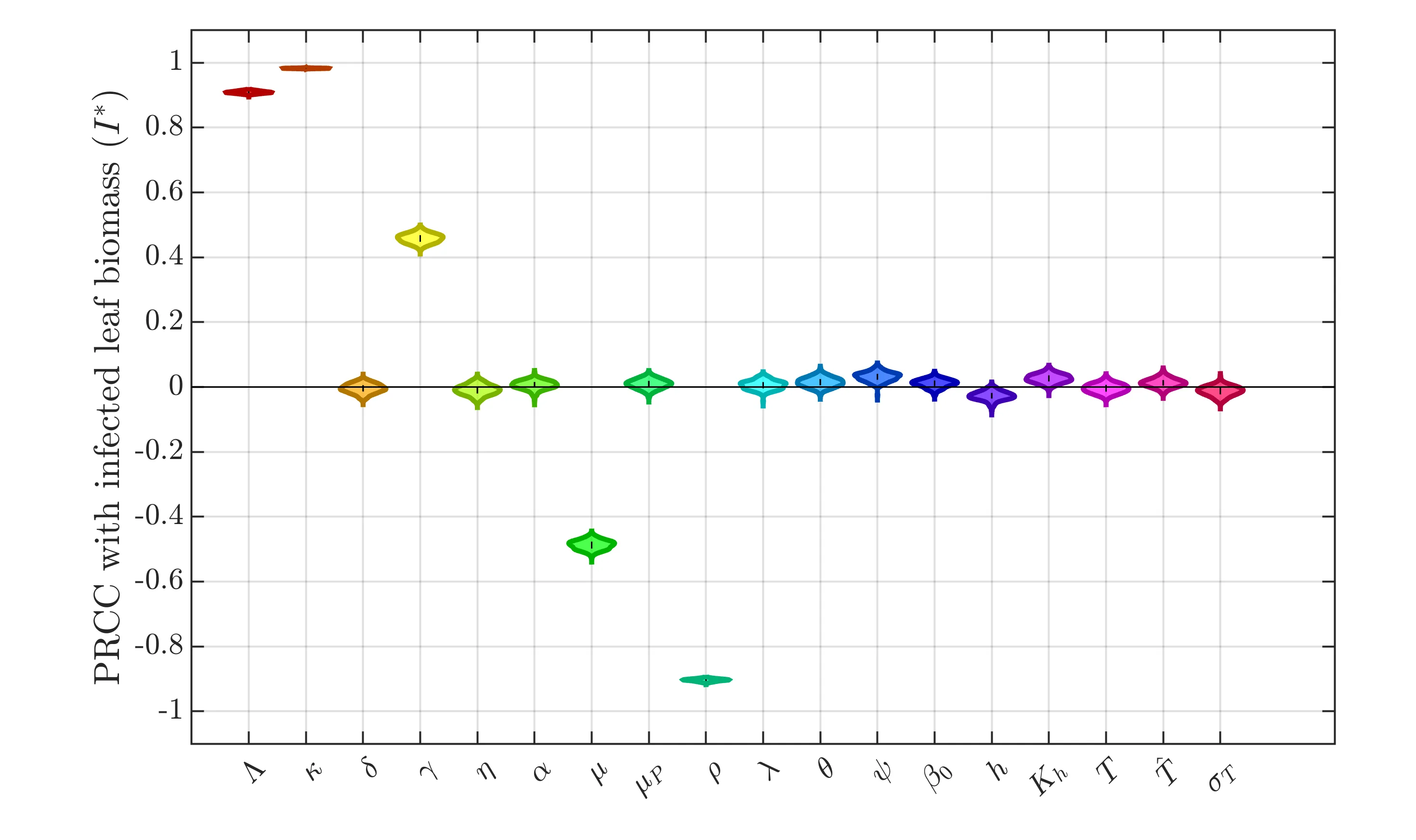
El modelo matemático reveló una trampa: la infección puede caer por debajo de uno y el foco aún sigue latente. Por eso, las cuarentenas por sí solas no bastan. Los cálculos señalan dos palancas: la selección de variedades resistentes y la protección de las hojas jóvenes en la temporada de lluvias. El modelo también tuvo en cuenta los brotes aleatorios de infección (por ejemplo, debidos al clima), probando miles de escenarios. El panorama es claro: solo se puede vencer al hongo atacándolo por dos frentes a la vez.
Resumen original
tal como lo escribieron los autores, en inglés arXiv:2604.26060
Black Sigatoka disease (BSD), also known as black leaf streak disease, is an airborne fungal infection caused by \textit{Pseudocercospora fijiensis} that severely impacts global banana and plantain production. Its persistence and resistance to eradication make it one of the most challenging plant diseases to manage. In this paper, we propose a deterministic pathogen-host model to describe BSD dynamics. Due to dual transmission pathways (ascospores and conidia) and mate limitation in sexual reproduction, the model exhibits a backward bifurcation: a stable endemic equilibrium coexists with the disease-free equilibrium for certain parameter values in which the basic reproduction number, $$\mathcal{R}_0$$, is less than 1. This phenomenon explains why control strategies that solely reduce $$\mathcal{R}_0$$ below one may fail. For the backward bifurcation regime, we perform sensitivity analysis of the endemic equilibrium using normalized forward sensitivity indices, Latin Hypercube Sampling, and Partial Rank Correlation Coefficients. Results indicate that effective control must extend beyond $$\mathcal{R}_0$$ reduction and prioritize (1) limiting production of new susceptible leaves during high-risk periods and (2) developing and deploying disease-resistant plant varieties. To incorporate transmission variability, we also formulate a stochastic version of the model using the Stochastic Simulation Algorithm (SSA). Extensive numerical simulations compare stochastic realizations with deterministic predictions and quantify variability in disease dynamics. To identify the principal drivers of persistence and variability, we analyze the endemic equilibrium using Sobol's variance-based sensitivity method, which highlights the role of nonlinear parameter interactions in shaping variability.
Un centímetro cuadrado de hoja de banano enferma puede liberar hasta 20 000 esporas al aire en un día; eso basta para infectar una plantación entera.
En la novela 'El año de las maravillas' de Geraldine Brooks, el aislamiento de una aldea no la salva de la peste; lo mismo ocurre con los bananos: mientras exista un solo foco oculto, la enfermedad espera su momento.