Temblores de estrellas recién nacidas exprés
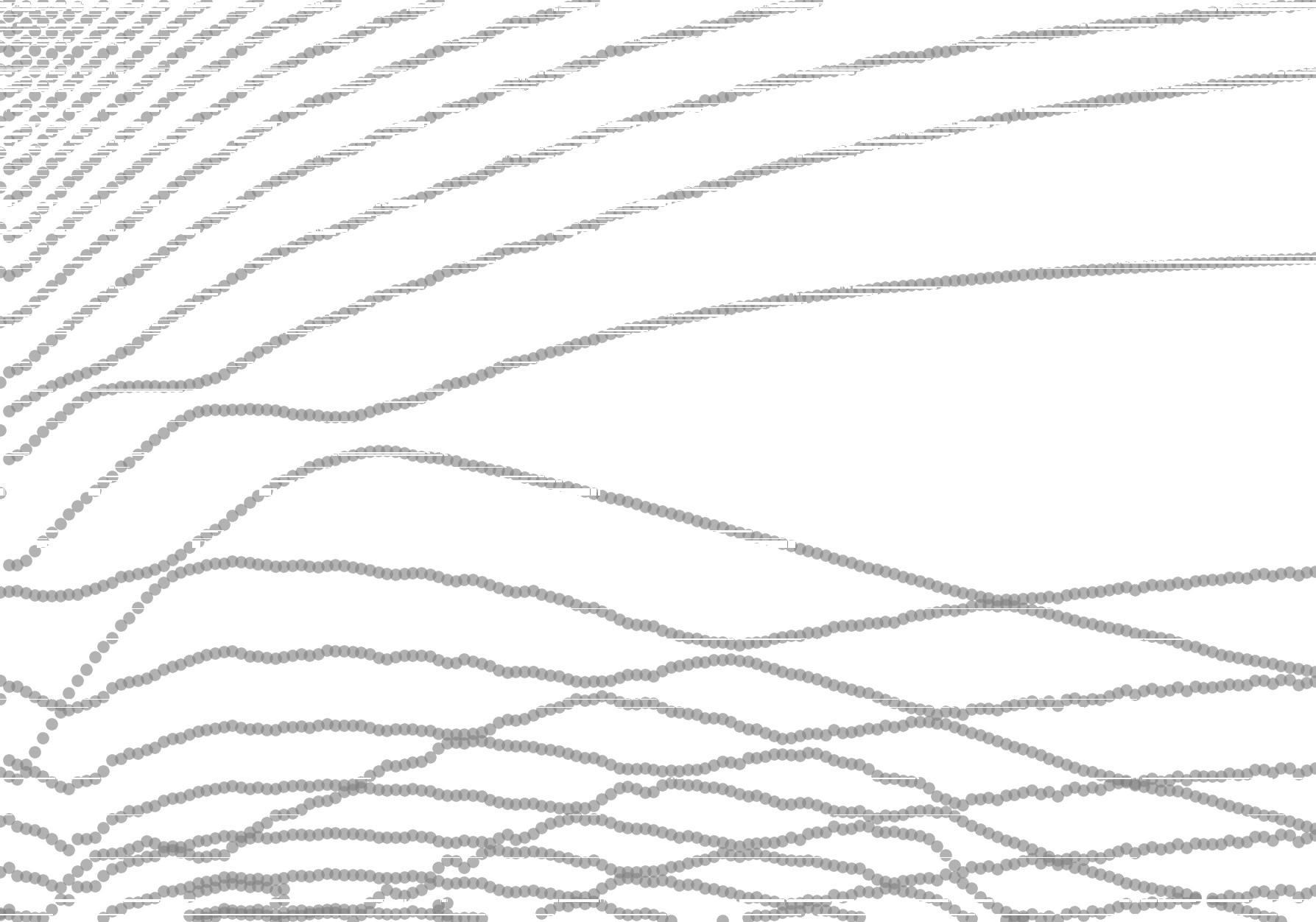
Tras la explosión de una supernova, en el centro queda una bola densa del tamaño de una ciudad: una estrella de neutrones recién nacida. Está caliente, comprimida y tiembla como una campana después de un golpe. Esos temblores —las oscilaciones de la estrella— emiten ondas gravitacionales que los sensibles detectores en la Tierra podrían captar.
Pero, ¿cómo saber qué tiembla exactamente en el interior de la estrella? Los autores del artículo descompusieron las oscilaciones en familias, como un músico descompone un acorde en notas. Resulta que algunas oscilaciones viven en el núcleo de la estrella, otras en su superficie, y otras en la onda de choque que la rodea. El tono principal más agudo es la oscilación de la superficie, donde la densidad cae bruscamente.
Este análisis ayudará a los futuros detectores de ondas gravitacionales: según el tono escuchado, se podrá determinar la masa y el tamaño de la estrella recién nacida, incluso sin verla con un telescopio.
Resumen original
tal como lo escribieron los autores, en inglés arXiv:2608.10264v1
Newborn proto-neutron stars (PNS) are potential targets of gravitational wave asteroseismology, the study of the (inner) structure of stars via their oscillation modes. To prepare for the eventual detection of such modes by current and future gravitational wave observatories, theoretical studies have obtained the possible spectrum of oscillations. However, there has been disagreement when it comes to identifying and classifying specific modes according to the physical mechanism that excites them. In this paper, we present a novel scheme to classify the oscillation modes of a newly born PNS surrounded by a stalled accretion shock in core-collapse supernovae (CCSNe). Our classification is physically motivated, as it is based on the energy of the restoring forces of the mode. We investigate the nature of the modes by considering the different regions of the CCSN that they stem from. We apply this scheme to a set of 28 non-rotating 1D, 2D and 3D CCSN simulations performed with two different numerical codes and using different progenitors and equations of state. In that way, we find that there are different families of f-, p- and g-modes in the system, living in different areas. More specifically, we identify two families of f- and p-modes associated with the PNS and the shock, respectively, and two families of g-modes originating from the two convectively stable regions, one in the PNS core and one near its surface. We also find that the dominant high-frequency emission mode is the f-mode of the PNS, associated with the strong density gradient at its surface. Our classification procedure is automatic, performs consistently for all the models considered, and paves the way to systematic studies of the dependence of the mode frequencies on the PNS properties, with direct application to parameter estimation from future observations of gravitational wave signals.
Una estrella de neutrones recién nacida tiembla con una frecuencia de miles de hercios, más alta que la nota más aguda de un piano.
En la película 'Interstellar', las ondas gravitacionales ayudaban a los protagonistas, pero allí las generaban los agujeros negros; aquí, las estrellas recién nacidas que tiemblan.