Martin Obergaulinger

4 articles · 8 co-authors · latest: 2026-08-10
10,798 citations · h-index 43 · 137 papersData: Semantic Scholar

We have retold 4 papers by this author. most often about: supernova remnant, star formation, supernova. 8 co-authors across our retellings.

Links in the knowledge graph
Stellar2026-05-212 minarXiv:2605.22927express
Stellar Kitchen Before the Bang: Turbulence Instead of a Recipe
A pot of boiling porridge, where instead of grains there are layers of oxygen and silicon, and the fire beneath is about to go out, and the star will collapse in on itself. Until now, astrophysicist cooks have used a simplified recipe: they assumed that bubbles and eddies in the porridge obey one and the same average temperature throughout the depth.
Stellar2026-05-212 minarXiv:2605.22938express
A Star Before It Blows: How Rotation and Magnetic Fields Reshape Its Final Minutes
In the minutes before a massive star becomes a supernova, a hidden drama unfolds in its depths. A giant cauldron boils: matter churns, rotates, and invisible magnetic threads snap and rejoin. This moment, which has eluded direct observation, has now been recreated for the first time in three-dimensional computer models.
High Energy2026-05-272 minarXiv:2605.28944express
A Spiral at the Heart of a Star
A figure skater pulls their arms in, and their spin suddenly accelerates. When a massive star exhausts its fuel and its core collapses, something similar happens, but on a cosmic scale. The core shrinks to a city-sized sphere, and if it is spinning rapidly, a peculiar instability can arise.
General Relativity2026-08-101 minarXiv:2608.10264express
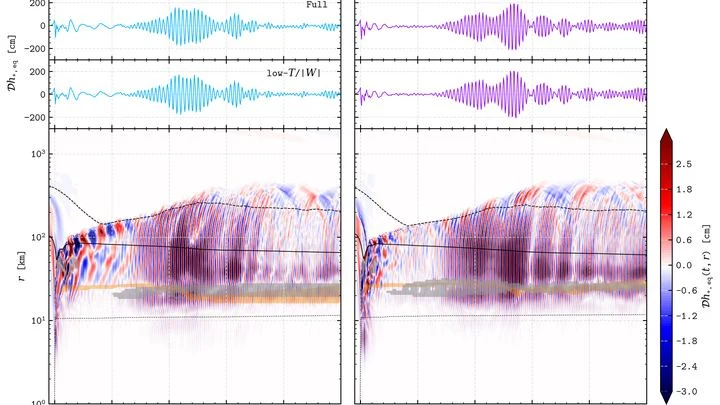
Starquakes of Newborn Stars
After a supernova explosion, a dense ball the size of a city remains at the center — a newborn neutron star. It is hot, compressed, and rings like a bell after being struck. These tremors, the star's oscillations, emit gravitational ripples that sensitive detectors on Earth can catch.
