Comment les oiseaux voient le champ magnétique terrestre express
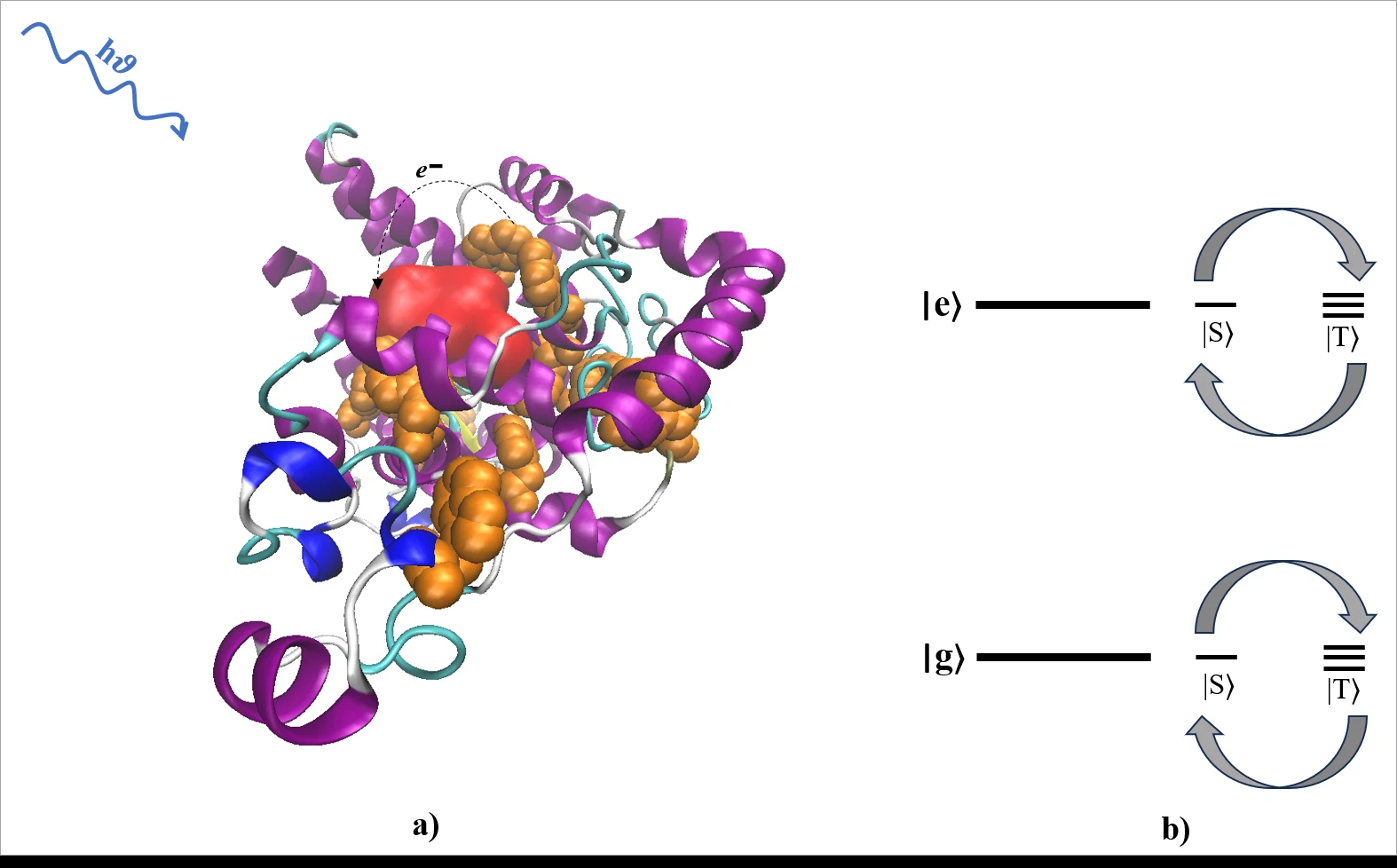
Les oiseaux migrent en utilisant le champ magnétique. Dans leurs yeux se trouve la protéine cryptochrome. Elle capte la lumière du soleil, surtout la lumière bleue, et déclenche une réaction. L'absorption de la lumière mène à la formation d'une paire de particules très sensibles au champ magnétique.
Sous l'effet du champ, ces particules changent de position relative, ce qui provoque un faible courant électrique dans la protéine. Ce courant est transmis au cerveau et perçu comme une sensation visuelle — comme si une grille transparente de lignes magnétiques se superposait au monde. Étonnamment, la boussole ne fonctionne que sous la lumière bleue du jour ; au crépuscule, le système s'éteint, et la nuit, les oiseaux se fient aux étoiles.
Comprendre ce mécanisme ne révèle pas seulement le secret de la navigation, mais promet aussi de nouvelles technologies. La protéine est composée de matière organique ordinaire, y compris du carbone, donc les scientifiques espèrent créer des biocapteurs plus compacts et plus sensibles que leurs équivalents électroniques.
Résumé original
tel que rédigé par les auteurs, en anglais arXiv:2510.13840
Photoreduction of cryptochrome protein in the retina is a well-known mechanism of navigation of birds through the geomagnetic field, yet the biosignal nature of the mechanism remains unclear. The absorption of blue light by the flavin adenine dinucleotide (FAD) chromophore can alter the distribution of electrons in cryptochrome and create radical pairs with separated charges. In this study, the spin dynamics of electrons in the radical pair including its spin-orbit coupling were investigated by quantum mechanical modeling. Spin-orbit coupling is negligible relative to other terms and has no significant role in the dynamics. However, it engages the spatial states of the radical pair and make possible to study spatial related observables. Several interactions were considered in the presence of an external magnetic field, and the resulting electric dipole moment in cryptochrome was computed as the quantity emerging from this coupling. The computations show the induced electric dipole moment clearly depend on the characteristics of the applied magnetic field even after considering dissipative effects. In fact, our findings indicate that the radical pair in cryptochrome protein is a magnetic biosensor, in the sense that in the presence of the geomagnetic field, variations in spin states can influence its electric dipole moment, which may be interpreted via the bird as an orientation signal. The results can be used in the advancement of bio-inspired technologies which replicate animal magnetic sensitivity.
Cette même protéine existe aussi dans l'œil humain, mais chez nous elle ne fait que régler l'horloge biologique ; nous ne percevons pas le champ magnétique.