Comment une bactérie nage à travers le mucus express
Escherichia coli est un nageur minuscule dans un monde où l'eau est épaisse comme de la gelée. Dans notre intestin, elle ne glisse pas librement, mais se fraye un chemin à travers le mucus — un réseau emmêlé de longues molécules, semblable à un écheveau de fils emmêlés. Comment la bactérie parvient-elle à se déplacer dans un tel milieu ?
Les scientifiques ont construit un modèle informatique dans lequel une bactérie avec une tête ovale et une fine queue-flagelle nage à travers le mucus. La queue fonctionne comme une minuscule hélice, mais elle est si fine qu'elle glisse entre les brins de mucus. Le modèle montre : la queue pousse l'eau, et l'eau pousse le mucus, et c'est de la façon dont le mucus s'écoule autour de la tête et de la queue que dépend la vitesse de la bactérie.
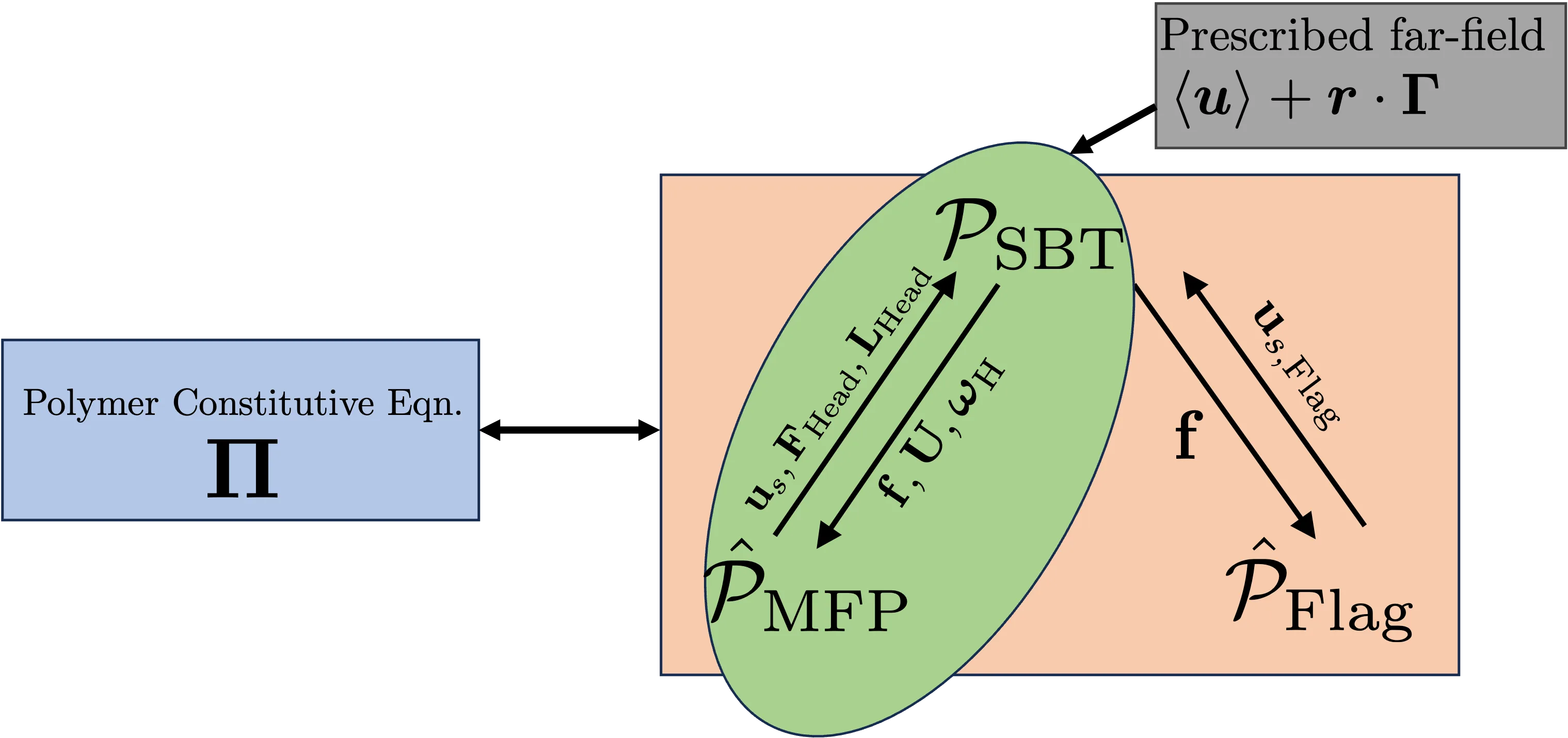
Le résultat principal : le mouvement de la bactérie peut être décomposé en trois parties — comment elle déplace son corps elle-même, comment fonctionne sa queue, et comment le mucus réagit en la poussant. Cela permet de calculer rapidement comment la bactérie nagera dans n'importe quel mucus. Auparavant, ces calculs prenaient des jours ; maintenant, ils prennent des minutes.
Cette approche aidera à comprendre comment les bactéries pathogènes se frayent un chemin à travers le mucus protecteur des poumons ou de l'intestin, et peut-être suggérera comment les arrêter.
Résumé original
tel que rédigé par les auteurs, en anglais arXiv:2603.27445
We develop a numerical framework to simulate the locomotion of a flagellated bacterium with a spheroidal head (such as Escherichia coli) in biological fluids like mucus, which are entangled polymer solutions exhibiting elasto-viscoplastic (EVP) rheology and porous microstructure. To account for the scale disparity between the large bacterial head and the slender flagellar bundle, whose thickness is comparable to the pore size, we employ a two-fluid model in which the bundle directly drives the solvent and exchanges momentum with the polymer phase via drag proportional to their relative velocity. The numerical implementation combines a finite-difference discretization of the two-fluid equations with a slender-body theory (SBT) to model flagellar forcing. A key observation is that the coupled mass and momentum equations for these inertialess flows, together with SBT, are linear in the pressure and velocity fields and in the force distribution along the flagellar bundle. By treating the polymer stress as a body force, we decompose the flow field and hydrodynamic moments into three additive contributions: kinematic (motion), flagellar forcing, and polymer stress. This decomposition allows several components of the flow to be precomputed and enables the determination of swimming velocity via a resistivity formulation driven by polymer-induced forces, which greatly improves computational efficiency during transient calculations of the polymer stress and the resulting flow. We validate the method and use it to analyze how polymer microstructure and its interactions with the bacterial head and tail affect motility in complex biofluids.
Escherichia coli peut parcourir une distance 10 fois supérieure à sa propre longueur en une seconde — c'est comme si un humain parcourait 20 mètres en une seconde.