Алмазные часы без термометра экспресс
Нагрейте обычные кварцевые часы на десять градусов — и они начнут убегать на секунды в сутки. Атомные часы точнее, но занимают целый шкаф. Алмаз с крошечным дефектом — азотной вакансией — обещает точность атомных часов в объёме песчинки. Одна беда: этот дефект очень чувствителен к теплу, как камертон, который меняет тон от температуры воздуха.
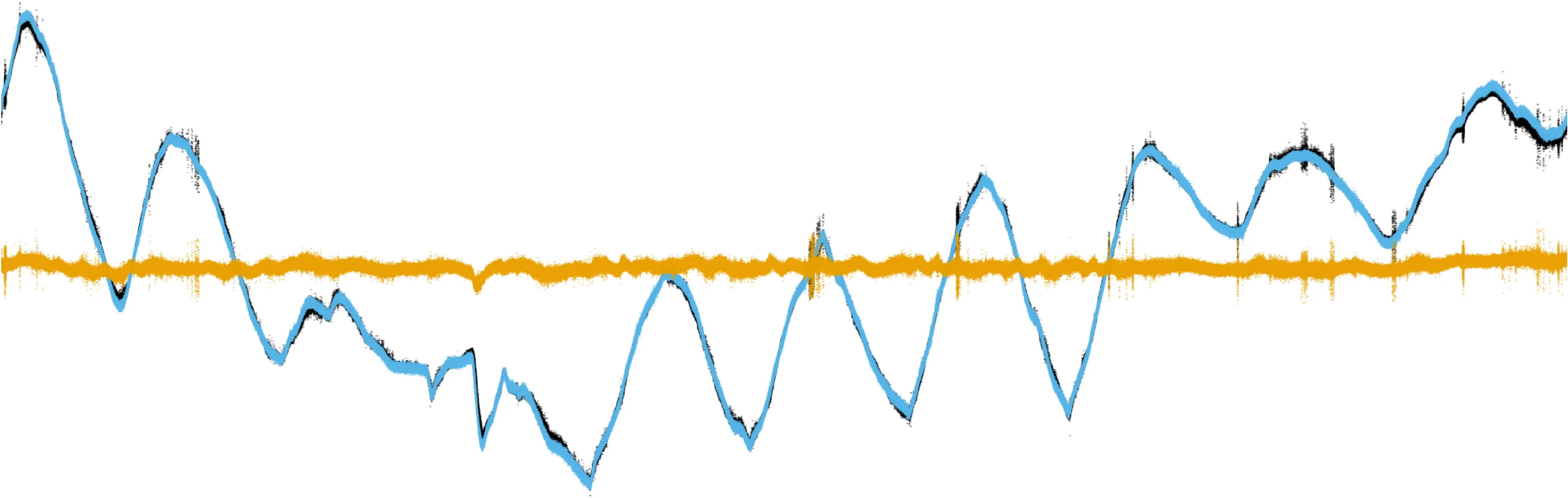
В новой работе дефект заставили петь на два голоса сразу. Один голос — электронный, он сильно зависит от тепла. Второй — ядерный, он тепла почти не замечает. Если измерить оба и вычесть один из другого, тепловой сбой сокращается в двести раз. Такой приём похож на то, как моряки в старину определяли долготу: сравнивали местное время с временем в порту, и разница давала точное положение.
Часы из такого алмаза проверяли десять дней подряд при комнатной температуре, сверяя с рубидиевыми атомными часами. Стабильность хода оказалась лучше, чем у любых других твердотельных часов такого размера. Причём теперь главный враг точности — не температура, а слабые магнитные поля и колебания мощности лазера.
Эти алмазные часы не заменят большие атомные эталоны, но могут встать в смартфоны, дроны и спутники, где важны размер и прочность. Маленький алмаз, который не боится тепла, — шаг к тому, чтобы сверхточное время всегда было под рукой.
Оригинальная аннотация
как её написали авторы, на английском arXiv:2601.00157
Frequency references based on solid state spins promise simplicity, compactness, robustness, multifunctionality, ease of integration, and high densities of emitters. Nitrogen-vacancy (NV) centers in diamond are a natural candidate, but the electronic zero-field splitting exhibits a large fractional temperature dependence, which has precluded its use as a stable clock transition. Here we show that this limitation can be overcome by forming a composite frequency reference that combines measurements of the electronic splitting D with the nuclear quadrupole splitting of the $$^{14}$$N nuclear spin intrinsic to the NV center. We further benchmark this composite approach against alternative strategies for mitigating temperature sensitivity. By implementing a specially designed pulse sequence with an eight-phase control scheme that suppresses pulse imperfections, we interleave measurements of D and Q in a high-density NV ensemble and demonstrate a temperature-compensated composite frequency reference. The stability of this composite diamond clock is characterized over a 10-day period at room temperature through a comparison to a Rb vapor-cell clock, yielding a fractional instability below $$5 \times 10^{-9}$$ for an averaging time of $$\tau = 200$$ s and below $$1 \times 10^{-8}$$ at $$\tau = 2 \times 10^5$$ s, corresponding to measured improvements by a factor of 4 and 200, respectively, over a clock based purely on the single frequency D for the same periods. By characterizing the residual sensitivity to magnetic fields, optical power, and radio-frequency drive amplitudes, we find that temperature is no longer the dominant source of instability. These results establish complementary electron- and nuclear-spin transitions in diamond as a viable route to thermally robust frequency metrology, providing a pathway toward compact, multifunctional solid-state clocks and quantum sensors.
Азотная вакансия в алмазе настолько чувствительна, что может заметить магнитное поле одиночного электрона на расстоянии десятков нанометров.