Солнечные циклы: как магнитные качели качают будущее экспресс
Солнечные пятна — это следы магнитных полей, которые выходят на поверхность. Они живут своей жизнью: пятна, появившиеся ближе к экватору, наклоняются сильнее, а те, что дальше, — слабее. Эти два эффекта, как два регулятора на старом радиоприёмнике, управляют тем, сколько магнитного поля доберётся до полюсов Солнца и накопится там к следующему циклу.
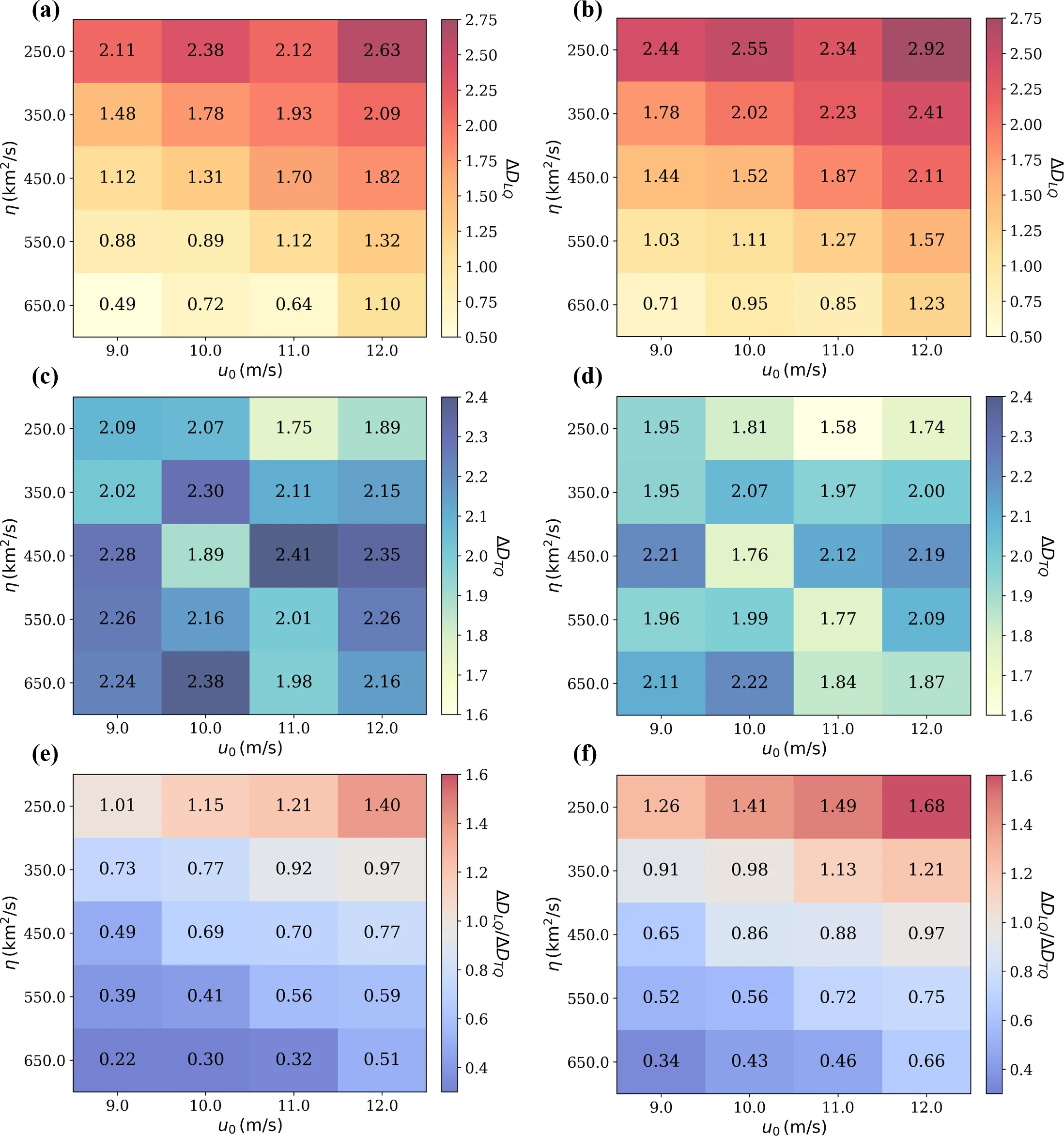
Исследователи обучили нейросеть решать уравнение переноса магнитного поля по поверхности Солнца, встроив в неё физические законы. Такой подход позволил отделить влияние наклона пятен от влияния их широты. Выяснилось, что при быстром перемешивании магнитных полей наклон пятен подавляется сильнее, а при мощных потоках плазмы доминирует эффект широты.
Ключевая находка: отношение вкладов этих двух эффектов плавно меняется в зависимости от эффективности солнечного динамо. Это уточняет прежние приближённые формулы и снижает разброс данных. Нейросетевой подход дал меньшие ошибки, чем традиционная одномерная модель, и надёжнее восстановил нелинейные тренды.
Такое понимание помогает лучше предсказывать силу будущих солнечных циклов, от которых зависят спутники, связь и даже космические полёты.
Оригинальная аннотация
как её написали авторы, на английском arXiv:2602.16656
The solar dynamo relies on the regeneration of the poloidal magnetic field through processes strongly modulated by nonlinear feedbacks such as tilt quenching (TQ) and latitude quenching (LQ). These mechanisms play a decisive role in regulating the buildup of the Sun's polar field and, in turn, the amplitude of future solar cycles. In this work, we employ Physics-Informed Neural Networks (PINN) to solve the surface flux transport (SFT) equation, embedding physical constraints directly into the neural network framework. By systematically varying transport parameters, we isolate the relative contributions of TQ and LQ to polar dipole buildup. We use the residual dipole moment as a diagnostic for cycle-to-cycle amplification and show that TQ suppression strengthens with increasing diffusivity, while LQ dominates in advection-dominated regimes. The ratio $$\Delta D_{\mathrm{LQ}}/\Delta D_{\mathrm{TQ}}$$ exhibits a smooth inverse-square dependence on the dynamo effectivity range, refining previous empirical fits with improved accuracy and reduced scatter. The results further reveal that the need for a decay term is not essential for PINN set-up due to the training process. Compared with the traditional 1D SFT model, the PINN framework achieves significantly lower error metrics and more robust recovery of nonlinear trends. Our results suggest that the nonlinear interplay between LQ and TQ can naturally produce alternations between weak and strong cycles, providing a physical explanation for the observed even-odd cycle modulation. These findings demonstrate the potential of PINN as an accurate, efficient, and physically consistent tool for solar cycle prediction.
Солнечный цикл длится около 11 лет, но его сила может отличаться в разы: например, 24-й цикл был почти вдвое слабее предыдущего.