Как капли внутри клетки лепят мембраны экспресс
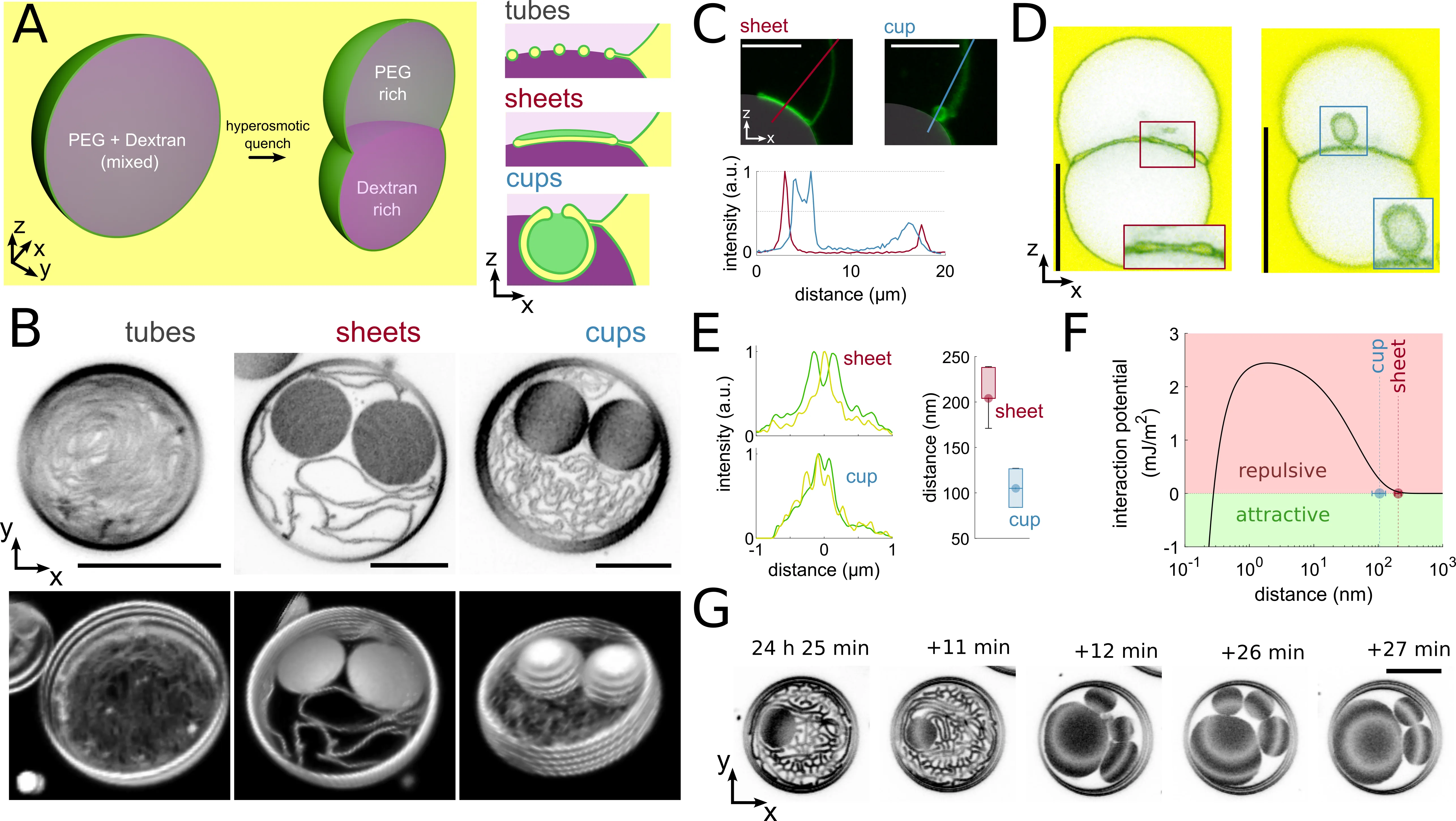
Внутри живой клетки плавают капли, которые не смешиваются с окружающей жидкостью, как масло в воде. Эти капли — не просто пассивные скопления, они активно давят на мембраны и заставляют их изгибаться. Учёные наблюдали этот процесс в живых растительных клетках, воспроизвели его в пробирке и рассчитали на компьютере.
Оказалось, что форма мембраны зависит от силы натяжения на границе капли. Если натяжение большое, мембрана расплющивается в плоский лист. Если натяжение слабее, мембрана сворачивается в трубочку или чашу. Переход между этими формами не всегда обратим: чтобы вернуться от чаши к трубочке, нужно преодолеть энергетический барьер, и мембрана «помнит» свою прежнюю форму.
Этот механизм объясняет, как в клетках растений образуются «луковицы» внутри вакуолей — крупных пузырей с жидкостью. Мембрана вакуоли втягивается внутрь под действием капель и формирует чашеобразные структуры. Управляя свойствами поверхности капель, клетка может лепить мембраны нужной формы в нужный момент.
Оригинальная аннотация
как её написали авторы, на английском arXiv:2603.15904
Phase-separated biomolecular condensates with liquid-like properties play a key role in the organization and compartmentalization of the intracellular environment. Condensate-mediated capillary forces acting on membranes drive physiologically important reshaping of membrane-bound organelles, such as vacuoles and autophagosomes. Here, we explore condensate-mediated membrane shape transformations. We employ {\textit{in planta}} live-cell imaging, an \textit{in vitro} reconstitution system with tunable interfacial tension, and computer simulations of an elastic membrane model to describe three morphologies of membrane structures localized at condensate interfaces: tubes, sheets, and cups. We find that the forces associated with high interfacial tension drive the formation of stable sheets, while tubes and cups prevail at lower interfacial tension. We calculate the free energies of each membrane shape and identify the energy barriers that govern the transitions between the shapes. With this approach, we find that shape transformations depend on the history of the interfacial membrane and exhibit a tube-to-cup hysteresis. These findings indicate that temporal control of condensate surface properties can mediate the morphogenesis of cup-like structures in cells, such as the formation of "bulbs" within plant vacuoles. Our results further generalize how the interplay of condensates and membranes contributes to intracellular organization.
В клетках растений вакуоли могут занимать до 90% объёма, и капли внутри них помогают формировать сложные внутренние структуры.