Жидкий ксенон вместо кристаллов: томограф видит втрое точнее экспресс
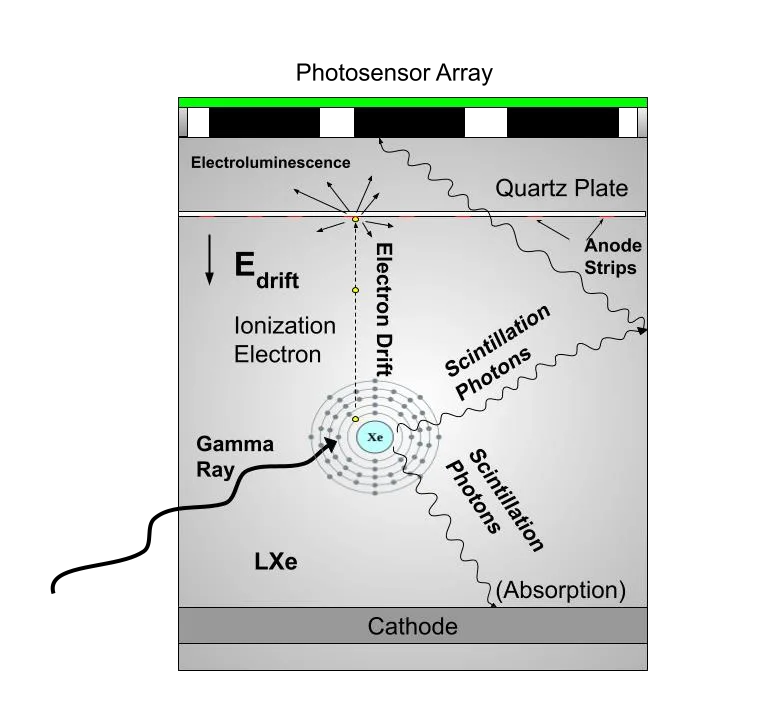
Камера, которая ищет опухоли, работает как очень чувствительный фотоаппарат: ловит слабое свечение от вещества, накопленного в больных клетках. В обычных аппаратах свет рождается в кристалле — твёрдом куске, похожем на стекло. Но кристалл не всегда точно передаёт, где именно вспыхнул свет, и картинка получается слегка размытой.
Новая идея — заменить кристалл на жидкий ксенон. Это прозрачная жидкость, которая при попадании частицы света вспыхивает сама. Вспышка получается очень чистой: ксенон почти не путает оттенки, поэтому прибор легко отличает «полезный» свет от случайных помех. А ещё жидкость показывает, на какой глубине внутри себя родился сигнал — как вода в стакане выдаёт, где упала капля.
Такая точность важна, когда опухоль маленькая или находится рядом с жизненно важными органами. Врач видит её границы чётко и не задевает лишнего. Жидкость к тому же легко заливать в ёмкости любой формы — аппарат можно сделать шире, чтобы за один раз осмотреть больше тела.
Это пока компьютерная модель, но она повторяет физику реальных приборов. Если расчёты подтвердятся, томографы с жидким ксеноном смогут заглядывать в тело с точностью, о которой сегодня только мечтают.
Оригинальная аннотация
как её написали авторы, на английском arXiv:2603.25974
Liquid xenon time projection chambers offer a homogeneous detection medium with excellent intrinsic energy resolution, fast scintillation, and true three-dimensional position sensitivity, making them an attractive alternative to crystal-based detectors for positron emission tomography (PET). In this work, we present a new single-phase liquid xenon time projection chamber (TPC) concept optimized for medical imaging, employing combined scintillation and electroluminescence-based ionization readout to enable low-noise signal amplification and intrinsic depth-of-interaction measurement. We evaluate the system-level performance of this detector concept using Monte Carlo simulations based on OpenGATE and Geant4, with direct comparison to conventional LYSO-based PET systems. The study focuses on detection sensitivity, energy-based event selection efficiency, and reconstructed spatial resolution. While LYSO detectors provide higher absolute stopping efficiency due to their higher density, liquid xenon detectors exhibit improved photopeak purity as a result of superior intrinsic energy resolution, leading to enhanced rejection of scattered events. Point-source reconstruction studies demonstrate that the intrinsic three-dimensional position sensitivity of the liquid xenon TPC translates into a reconstructed spatial resolution of approximately 1~mm full width at half maximum (FWHM) at the system level, compared to approximately 4~mm for LYSO-based systems under comparable conditions. These results indicate that liquid-xenon-based PET detectors can achieve competitive or superior imaging performance, particularly for applications requiring high spatial resolution, large axial acceptance, and scalable detector geometries.
Ксенон — тот самый газ, которым заполняют лампы в автомобильных фарах. В жидком виде он прозрачен, как вода, и вспыхивает от невидимого излучения.