Свет и атомы: как анизотропия управляет теплом экспресс
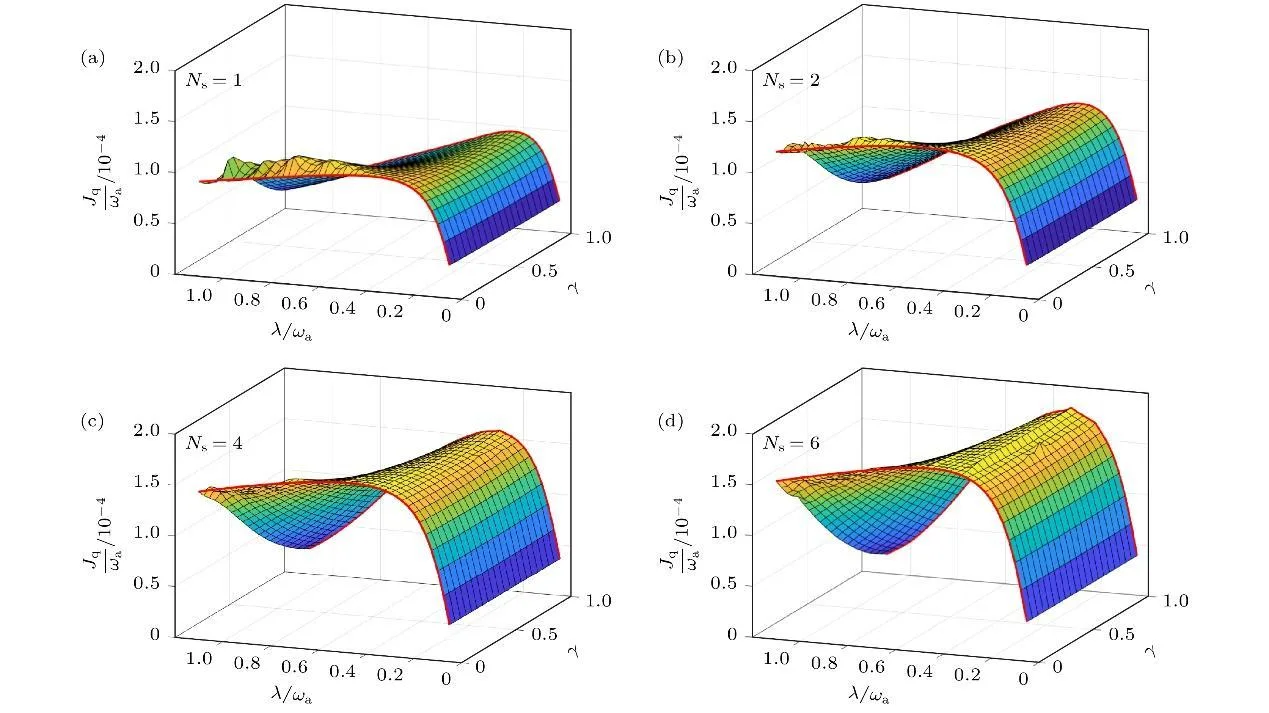
Свет и атомы, как танцоры, могут двигаться в унисон или вразнобой. Когда их взаимодействие анизотропно — то есть зависит от направления, — танец усложняется. В новой работе физики рассмотрели модель, где множество атомов (кубитов) коллективно взаимодействуют с анизотропным полем света, и каждый компонент подключен к тепловому резервуару. Оказалось, что анизотропия может кардинально менять поток тепла через систему.
Число атомов играет роль усилителя: с его ростом пики теплового потока становятся выше, а впадины — глубже. В пределе бесконечного числа атомов (термодинамический предел) удалось вывести простые формулы, которые задают верхнюю границу теплового потока для конечных систем. Эти формулы описывают процесс, похожий на котуннелирование — когда тепло переносится не поодиночке, а согласованными порциями.
Тепловой диод — устройство, пропускающее тепло в одну сторону лучше, чем в другую, — также зависит от анизотропии. Настройка взаимодействия света с атомами открывает путь к управлению теплом на квантовом уровне, что может пригодиться в микроэлектронике будущего.
Оригинальная аннотация
как её написали авторы, на английском arXiv:2603.29180
Nonequilibrium heat transport and quantum thermodynamics in light-matter interacting systems have received increasing attention. Quantum thermal devices, e.g., heat valve and head diode, have been realized. Recently, it has been discovered that the anisotropic light-matter interactions can greatly modify the eigenvalues and eigenvectors of hybrid quantum systems, leading to nontrivial quantum phase transitions, quantum metrology, and nonclassicality of photons. To explore the influences of anisotropic light-matter interactions on quantum transport, we investigate heat flow in the nonequilibrium anisotropic Dicke model. In this model, an ensemble of qubits collectively interacts with an anisotropic photon field. Each component interacts with bosonic thermal reservoirs. Quantum dressed master equation (DME) is included to properly study dissipative dynamics of the anisotropic Dicke model. Within the eigenbasis of the reduced anisotropic Dicke system, strong qubit-photon couplings can be properly handled. Our results demonstrate that anisotropic qubit-photon interactions are crucial for modulating steady-state heat flow. In particular, it is found that under strong coupling the heat flow is dramatically suppressed by a large anisotropic qubit-photon factor. While under moderate coupling, the anisotropic qubit-photon interactions enhance the heat flow. Moreover, the increase in the number of qubits amplifies the flow characteristics, with the peaks increasing and the valleys decreasing. Besides, we derive two analytical expressions of heat flows in thermodynamic limit approximation with limiting anisotropic factors. These heat currents exhibit the cotunneling heat transport pictures. They also serve as the upper boundaries for the heat flows in the finite-size anisotropic Dicke model. We also analyze the thermal rectification effect in the anisotropic Dicke model.
В модели Дике анизотропия взаимодействия может приводить к необычным квантовым фазовым переходам, где свойства системы меняются скачком при плавном изменении параметров.