Квантовый трюк ускоряет Вселенную без тёмной энергии экспресс
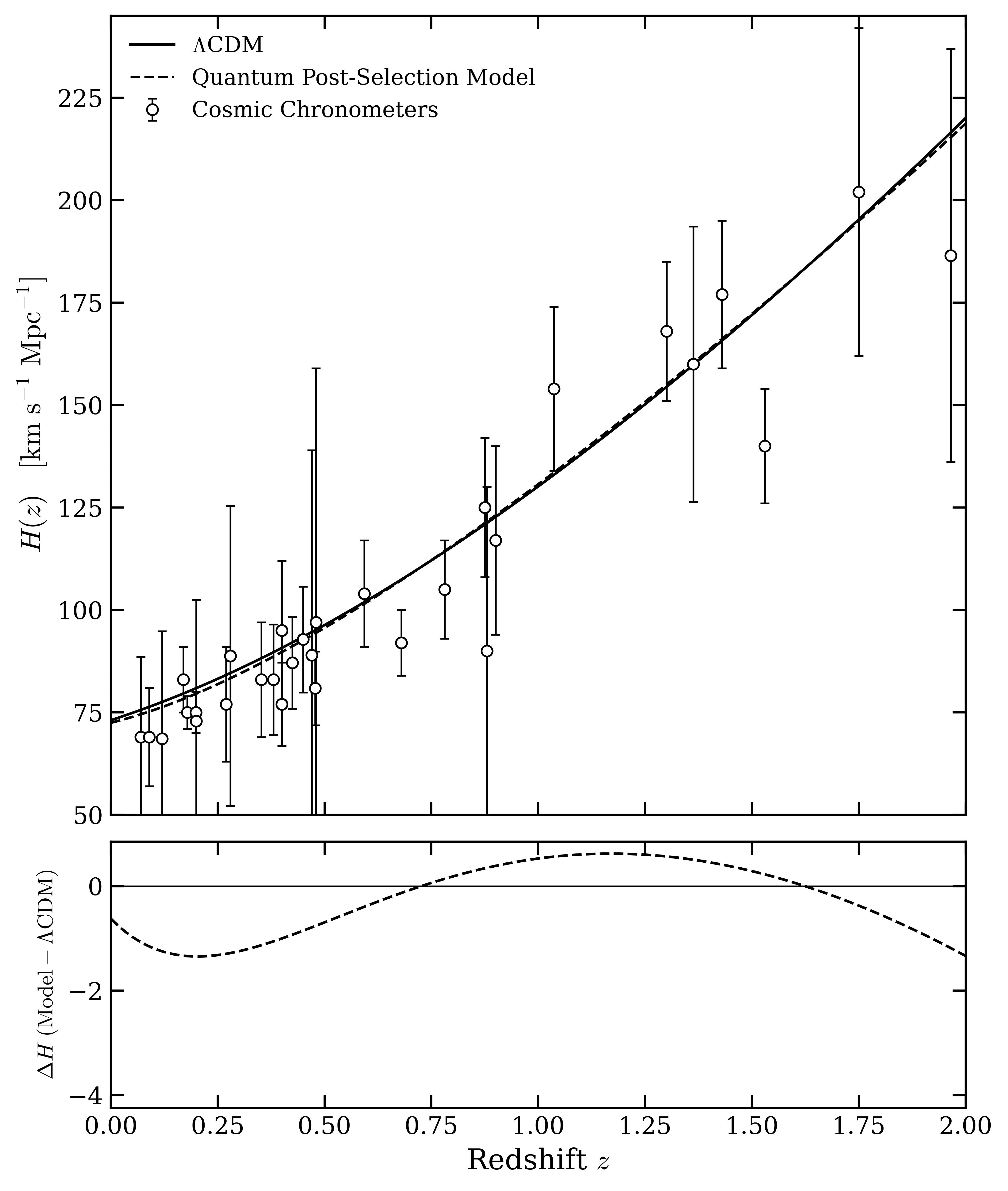
С конца XX века известно: расширение Вселенной ускоряется — галактики разлетаются всё быстрее. Открытие принесло Нобелевскую премию Адаму Риссу, Солу Перлмуттеру и Брайану Шмидту. Стандартное объяснение опирается на тёмную энергию — невидимую силу, расталкивающую пространство. Новая работа выдвигает иной механизм: всё дело в пост-селекции — квантовом правиле, напоминающем детектив с известным финалом, под который подгоняют улики. Будущее отбирает лишь те варианты событий, что ведут к нужному итогу. Это решает давнюю загадку: почему ускорение началось именно сейчас, когда есть мы и галактики. Модель не вводит мистику и отлично вписывается в данные о сверхновых и возрасте галактик. Она же верно описывает ранние эпохи после Большого взрыва. Неожиданный вывод: без такой «подгонки» ускорение стартовало бы в эпоху одних лишь атомов — и звёзды никогда бы не зажглись.
Оригинальная аннотация
как её написали авторы, на английском arXiv:2606.12297
The origin of cosmic acceleration remains a central problem in cosmology, commonly attributed to a cosmological constant within the $$\Lambda$$CDM model or to dynamical dark energy. Here, we develop an alternative approach in which acceleration emerges from quantum post-selection, a standard feature of quantum theory that is not usually incorporated into cosmological modelling. While quantum theory admits both pre-selected and post-selected ensembles, quantum cosmological models are almost exclusively formulated in terms of initial conditions. Building on previous work on post-selected quasiclassical dynamics, we construct a minimal predictive cosmological model in which post-selection and coarse-graining generate effective late-time acceleration without introducing a cosmological constant, dark energy, or modifications of general relativity. The resulting expansion history is highly constrained theoretically and depends on at most two parameters beyond standard Friedmann evolution. Confrontation with type Ia supernova and cosmic chronometer data yields statistically competitive fits while naturally avoiding the coincidence problem. The model also reproduces the standard radiation- and matter-dominated behaviour at early times and predicts a present-day jerk parameter significantly different from the $$\Lambda$$CDM value. These results suggest that cosmic acceleration may arise as a macroscopic quantum cosmological effect rather than from additional cosmological fluids or modified gravitational dynamics.
Сверхновые типа Ia — это взрывы звёзд с почти одинаковой мощностью: их используют как стандартные «линейки» для измерения расстояний в миллиарды световых лет.
Пост-селекция напоминает сюжет рассказа «История твоей жизни» Теда Чана, где знание будущего определяет поступки в настоящем.