Кто разносит, а кто болеет: скрытая жизнь эпидемии экспресс
Оркестр играет без дирижёра. Мы знаем общую громкость — это базовый показатель заразности R0, спектральный радиус эпидемии. Но сама партитура — матрица контактов между людьми разных возрастов — хранит в себе мелодию: кто разносит инфекцию, а кто принимает на себя главный удар.
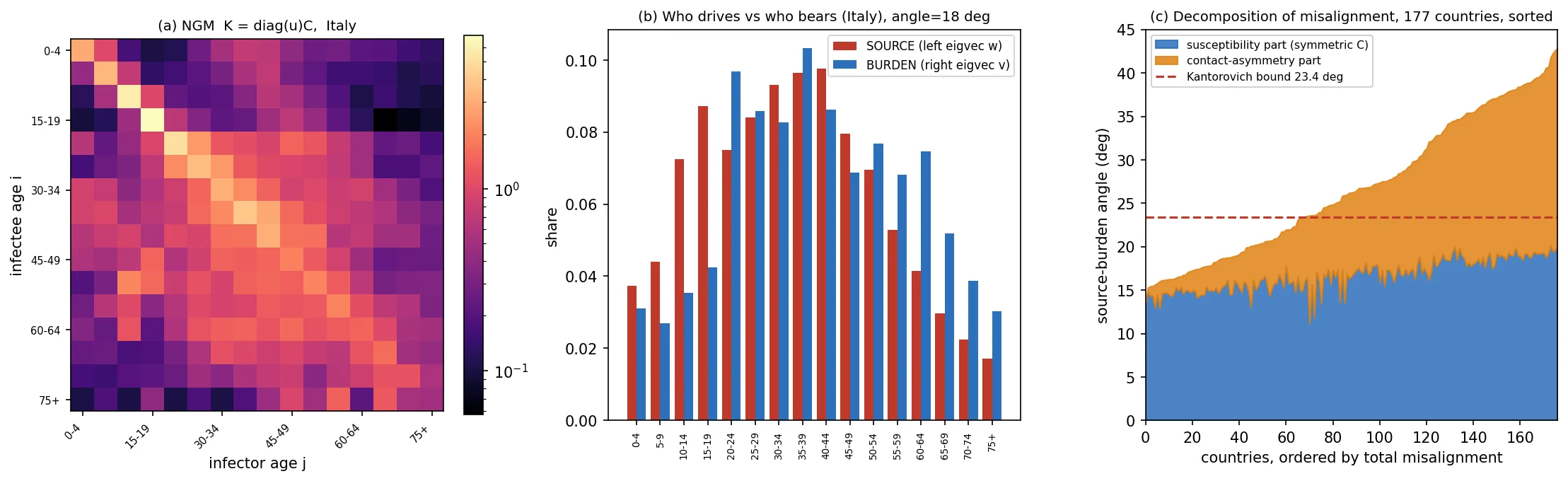
Учёные изучили данные о контактах из 177 стран, собранные в работе Prem et al., и увидели любопытную картину. В идеальном мире «источники» и «жертвы» эпидемии совпадают: те, кто больше всех заражает, сами же и болеют. Но в реальности эти группы разошлись. В среднем по миру угол между ними составил 26°, а в некоторых странах — больше 40°. Похоже на пожарных, которые тушат огонь, оставаясь невредимыми, пока пламя бушует в соседнем квартале.
Авторы доказали теорему: когда контакты взаимны (сколько раз я встретил вас, столько и вы меня), этот разрыв ограничен простым отношением самой высокой восприимчивости к самой низкой. Но в реальности контакты не взаимны — и разрыв становится ещё больше. Самое тревожное, что стратегия, нацеленная только на снижение R0, иногда бьёт мимо цели: она защищает тех, кто разносит заразу, а не тех, кто от неё умирает. В итоге средняя смертность от инфекции может даже вырасти.
Оригинальная аннотация
как её написали авторы, на английском arXiv:2607.03979
The basic reproduction number is the spectral radius of a matrix, $$R_0=\rho(K)$$. Taking that definition literally, we ask what $$K\mapsto\rho(K)$$ discards. A matrix carries three kinds of information: its dominant eigenvalue, its dominant eigenvectors, and its departure from normality. $$R_0$$ keeps only the first; the other two are where the epidemic's social structure lives. The right eigenvector is the burden distribution, the left the source distribution; they coincide when the system is normal and diverge under heterogeneity. Across the $$177$$ national contact matrices of Prem et al., the operator is \emph{never} normal, and once age-specific susceptibility is included, its source and burden eigenvectors are misaligned by a median of $$26^{\circ}$$, exceeding $$40^{\circ}$$ in some countries: the groups that drive transmission are systematically not those that bear it. We prove that under reciprocal contact this misalignment obeys a Kantorovich bound set by the susceptibility contrast $$q_{\max}/q_{\min}$$ alone, and zero when susceptibility is uniform, with the excess in real, non-reciprocal matrices contributed by contact asymmetry. Transient amplification, by contrast, stays small, so the operative social content is the misalignment, not transient blow-up. The omission also has teeth: because minimizing $$R_0$$ protects those who \emph{spread} infection, while minimizing deaths protects those who \emph{die} from it, the two target different age groups; the former sometimes raises average infection fatality even as it lowers the scalar. When contact is strongly structured and susceptibility is heterogeneous, we suggest reporting $$R_0$$ along with its eigenvectors rather than reporting it alone.
В некоторых странах разница между теми, кто разносит инфекцию, и теми, кто от неё страдает, превышает 40 градусов — как если бы стрелка компаса показывала не на север, а на северо-восток.