تدريب الكون على التنبؤ سريع
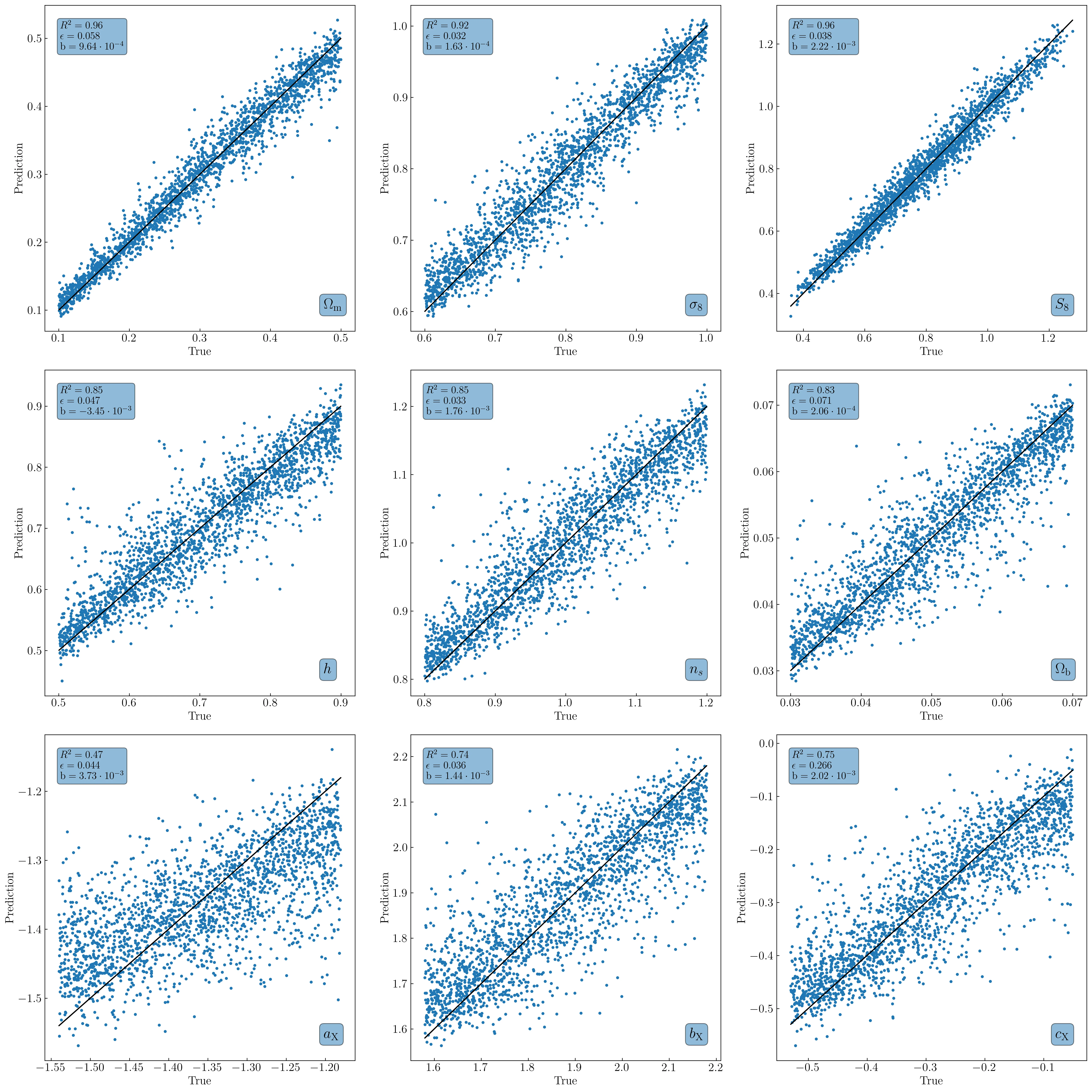
وُلدت آلاف الأكوان داخل الحاسوب لكي تحكي يومًا ما عن كوننا. كلٌّ منها يحمل عناقيد مجراته الخاصة، موزعة وفق قوانين الجاذبية، مثل حبات البازلاء في وعاء هزّته قوة مختلفة. من طريقة استقرار الحبات يمكننا أن نفهم أي يد هزّت الوعاء. وهكذا هنا: من نمط توزيع العناقيد، يريد العلماء تحديد كمية المادة المظلمة في الكون ومدى سرعة تجمعها في كتل.
في السابق، كان يُستخرج من هذه الأنماط رقمان فقط — العدد الإجمالي للعناقيد ومدى ميلها للبقاء على مسافات معينة. هذا يشبه الحكم على لوحة فنية من متوسط ألوانها وعدد ضربات الفرشاة. أما الآن، فتنظر الشبكة العصبية إلى الصورة بأكملها: خريطة ثلاثية الأبعاد حيث كل نقطة هي عنقود مجرات. وتتعلم من اثنتين وثلاثين ألف صورة كهذه، مولّدة وفق سيناريوهات مختلفة.
النتيجة مشجعة: النهج الجديد يخطئ في تقدير كثافة المادة بنسبة عشرة بالمئة أقل من القديم، وفي تقدير التكتل بنسبة عشرين بالمئة أقل. وإذا أُعطيت الشبكة العصبية معلومات إضافية عن سطوع كل عنقود، ترتفع الدقة بمقدار الضعف. السطوع هنا يشبه حجم حبة البازلاء: فهو يعتمد أيضًا على كمية المادة المظلمة المحيطة.
هكذا تصبح الأكوان الحاسوبية كتابًا مدرسيًا لقراءة كوننا. وكلما كان الكتاب أفضل، زادت دقة معرفتنا بمكونات الكون واتجاه حركته.
الملخص الأصلي
كما كتبه المؤلفون، بالإنجليزية arXiv:2601.03894
The possibility to constrain cosmological parameters from galaxy surveys using field-level machine learning methods that bypass traditional summary statistics analyses, depends crucially on our ability to generate simulated training sets. The latter need to be both realistic, as to reproduce the key features of the real data, and produced in large numbers, as to allow us to refine the precision of the training process. The analysis presented in this paper is an attempt to respond to these needs by (a) using clusters of galaxies as tracers of large-scale structure, together with (b) adopting a 3LPT code (Pinocchio) to generate a large training set of $$32\,768$$ mock X-ray cluster catalogues. X-ray luminosities are stochastically assigned to dark matter haloes using an empirical $$M-L_X$$ scaling relation. Using this training set, we test the ability and performances of a 3D convolutional neural network (CNN) to predict the cosmological parameters, based on an input overdensity field derived from the cluster distribution. We perform a comparison with a neural network trained on traditional summary statistics, that is, the abundance of clusters and their power spectrum. Our results show that the field-level analysis combined with the cluster abundance yields a mean absolute relative error on the predicted values of $$\Omega_{\rm m}$$ and $$\sigma_8$$ that is a factor of $$\sim 10 \%$$ and $$\sim 20\%$$ better than that obtained from the summary statistics. Furthermore, when information about the individual luminosity of each cluster is passed to the CNN, the gain in precision exceeds $$50\%$$.
احتوت مجموعة التدريب على 32,768 كونًا افتراضيًا — وهو بالضبط 2 مرفوعًا للأس 15، وهو رقم "مستدير" في عالم الحاسوب.