كيف تتحول السلسلة إلى حلقة سريع
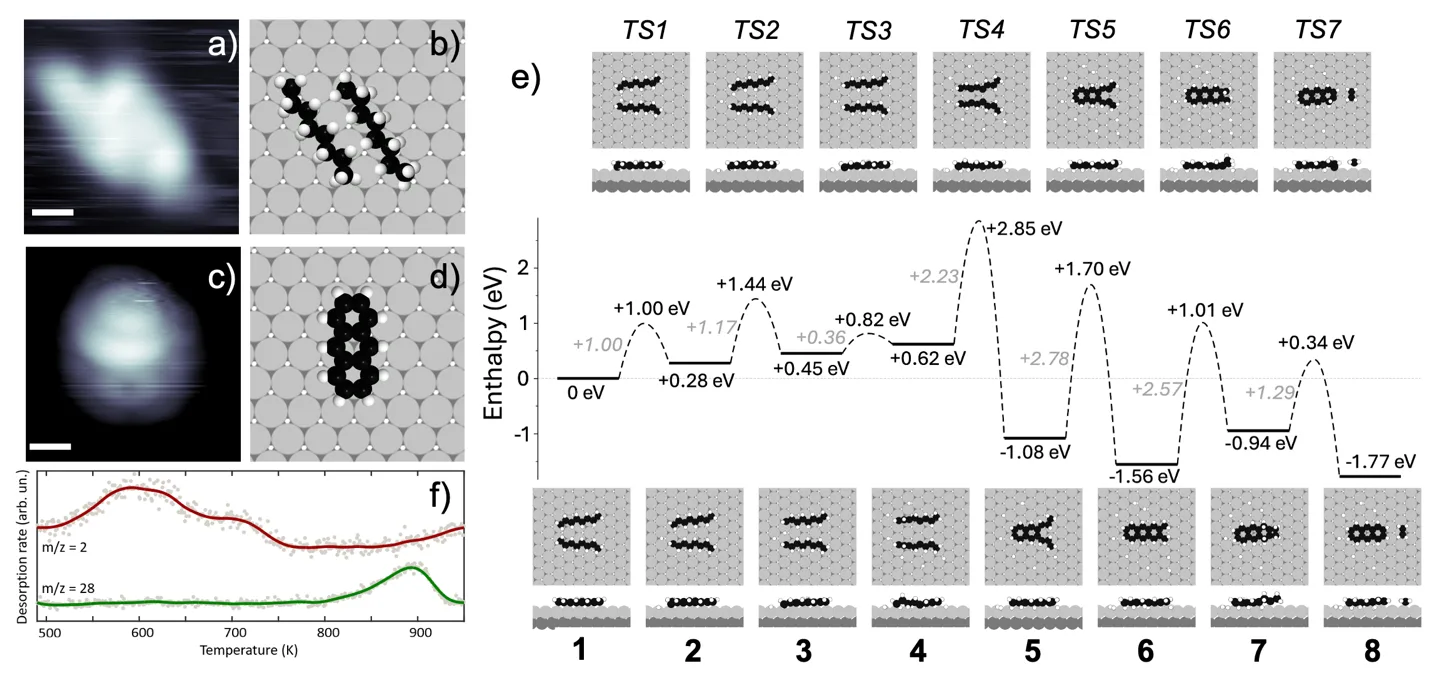
جزيء الأوكتان العادي هو سلسلة من ثماني ذرات كربون، مثل سلك مرن. على سطح البلاتين الساخن (فوق 600 كلفن)، لا يبقى ساكناً بل يبدأ بالتلوّي. أولاً، تنحني السلسلة بحيث تقترب نهايتاها. ثم تنفصل ذرات الهيدروجين، وتنشأ رابطة قوية بين الطرفين — ينغلق الجزيء ليشكل حلقة بنزين سداسية. يُسمى هذا التحول الأرومة: من سلسلة مرنة نحصل على حلقة صلبة مسطحة.
أحياناً يقع جزيئا أوكتان متجاورين. عندها يلحم البلاتين طرفيهما، وتبدأ الرابطة بالانتشار على طول السلسلتين، مثل سحّاب. الناتج جزيء مزدوج طويل يمكن أن ينطوي ليشكل بنى أكثر تعقيداً. هكذا تولد على السطح مركبات متعددة الحلقات — أساس العديد من الأصباغ والأدوية واللدائن.
الملخص الأصلي
كما كتبه المؤلفون، بالإنجليزية arXiv:2601.18600
Aliphatic hydrocarbons, such as normal alkanes, constitute a naturally abundant source of carbon atoms. Of special interest is the formation of cyclic and aromatic products from aliphatic reactants. Combining scanning tunneling microscopy and ab initio calculations, we investigate the thermal induced aromatization of linear n octane molecules on the catalytic Pt(111) surface and the reactions of intermolecular homocoupling between them at temperatures above 600 K. The cycloaromatization of individual n octane molecules requires bending the linear adsorbates prior to their dehydrogenation and the formation of an intramolecular C-C bond, yielding adsorbed benzene rings. In addition, the Pt(111) surface catalyzes a homocoupling reaction by initiating the formation of a C-C bond between the dehydrogenated methyl ends of the chemisorbed n octane molecules and then propagating along the carbon backbone in a zipper like fashion. Our findings provide molecular level insight into the heterogeneous catalytic processes underlying the generation of aromatic products and stable on surface polycyclic species.
حلقة البنزين هي واحدة من أقوى الحلقات في الكيمياء: شكلها السداسي من ذرات الكربون لا يتمزق حتى عند التسخين الشديد.