لماذا تدور النجوم الساخنة أسرع؟ سريع
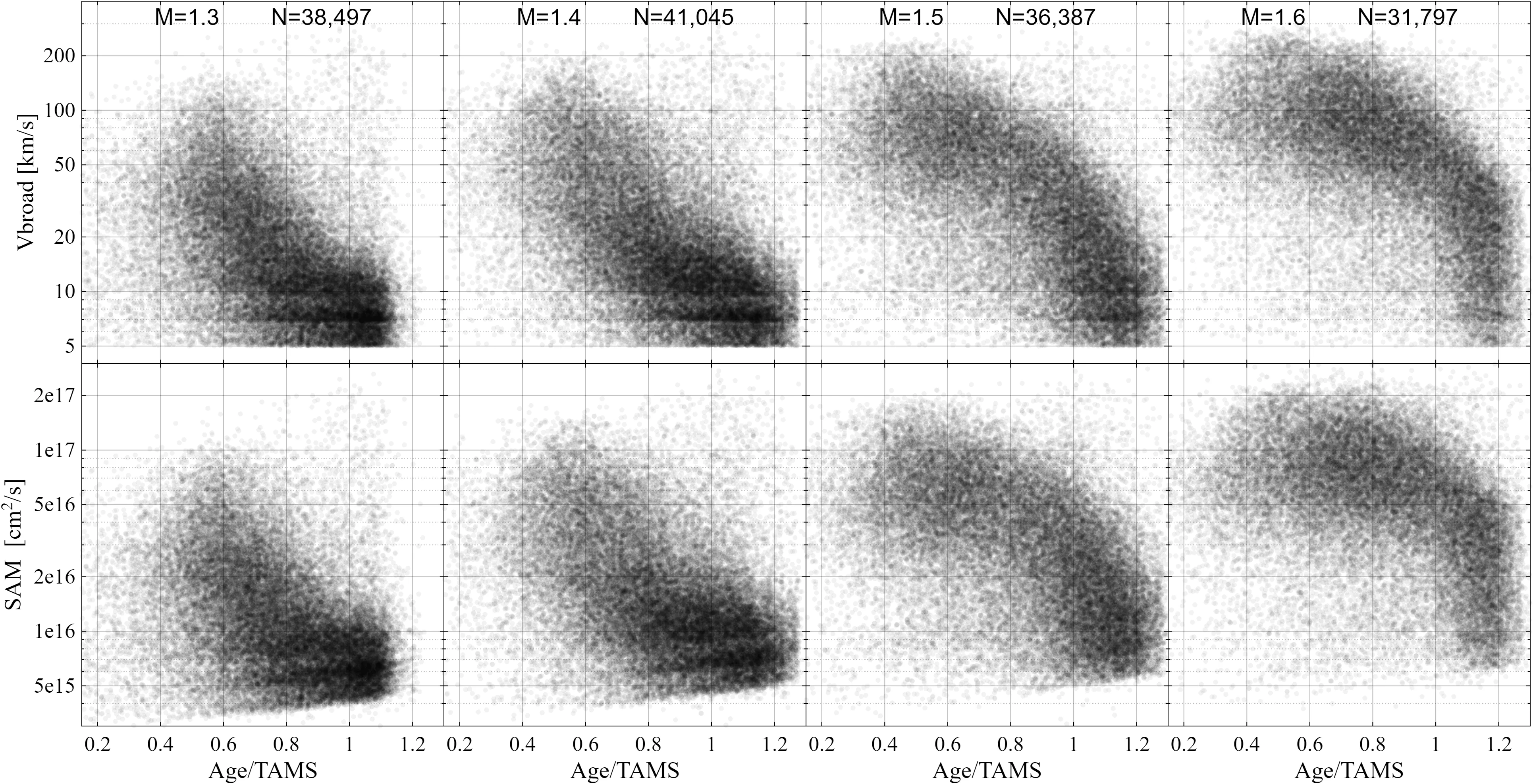
قام التلسكوب الفضائي Gaia بقياس سرعة دوران أكثر من مائة ألف نجم. اتضح أن سرعة الدوران تعتمد على درجة حرارة النجم. في النجوم الأبرد من 6500 درجة، تتحرك السطح بسرعة تتراوح بين 10 و20 كيلومترًا في الثانية. ولكن بمجرد أن يصبح النجم أكثر سخونة، تقفز السرعة فجأة إلى 100 كيلومتر في الثانية.
يكمن السر في المجال المغناطيسي. في النجوم الباردة، مثل شمسنا الشمس، تختلط الطبقات الخارجية باستمرار، مثل عصيدة تغلي. هذا الاختلاط يخلق مجالًا مغناطيسيًا قويًا يعمل كمرساة غير مرئية تبطئ دوران النجم. أما في النجوم الساخنة، فالطبقات الخارجية هادئة، ولا يوجد كبح مغناطيسي، لذلك تدور بسرعة.
لكن مع مرور الوقت، يتقدم النجم الساخن في العمر ويتمدد. تبدأ طبقاته الخارجية في الاختلاط، ويظهر مجال مغناطيسي، ويتباطأ الدوران. وقد تحقق علماء الفلك من ذلك بتقسيم النجوم إلى مجموعات حسب العمر. في النجوم الباردة، يتباطأ الدوران بشكل منتظم طوال حياتها، بينما في النجوم الساخنة، يتباطأ فقط بعد أن تتقدم في العمر وتبدأ في التمدد.
الملخص الأصلي
كما كتبه المؤلفون، بالإنجليزية arXiv:2601.20008
We used more than $$10^5$$ Gaia DR3 line broadening vbroad measurements to examine stellar rotation as a function of stellar temperature, mass and age. The large sample clearly displays the Kraft break at $$\sim 6{,}500$$\,K, or mass of $$\sim1.3\,M_{\odot}$$-while vbroad are small, on the order of $$10$$-$$20$$ km/s, for stars cooler than the Kraft break, they sharply rise above the break, reaching up $$\sim100$$ km/s with temperature of $$7{,}000$$ K. To follow the stellar rotation as a function of age, we consider vbroad as a function of scaled age-stellar age divided by the relevant Terminal Age Main Sequence (MS), for four narrow mass bins. We find that stellar rotation deceleration is slow during the MS phase and fast afterwards for stars hotter than the break, whereas deceleration rate is relatively high and does not vary much for the cool stars. Our findings are consistent with the theory that stellar rotation slowing is due to magnetic breaking, emanating from magnetic fields that are anchored to the stellar convective envelopes. Therefore, deceleration is high in cool stars, but in hot stars only after they leave the MS and develop convective outer layers
نجم مشابه للشمس كان في شبابه يدور أسرع بعدة مرات مما هو عليه الآن. الكبح المغناطيسي على مدى مليارات السنين أبطأ دورانه.