اندماج المجرتين خارا 11: كيف يفسر تسرب الضوء الكون المبكر سريع
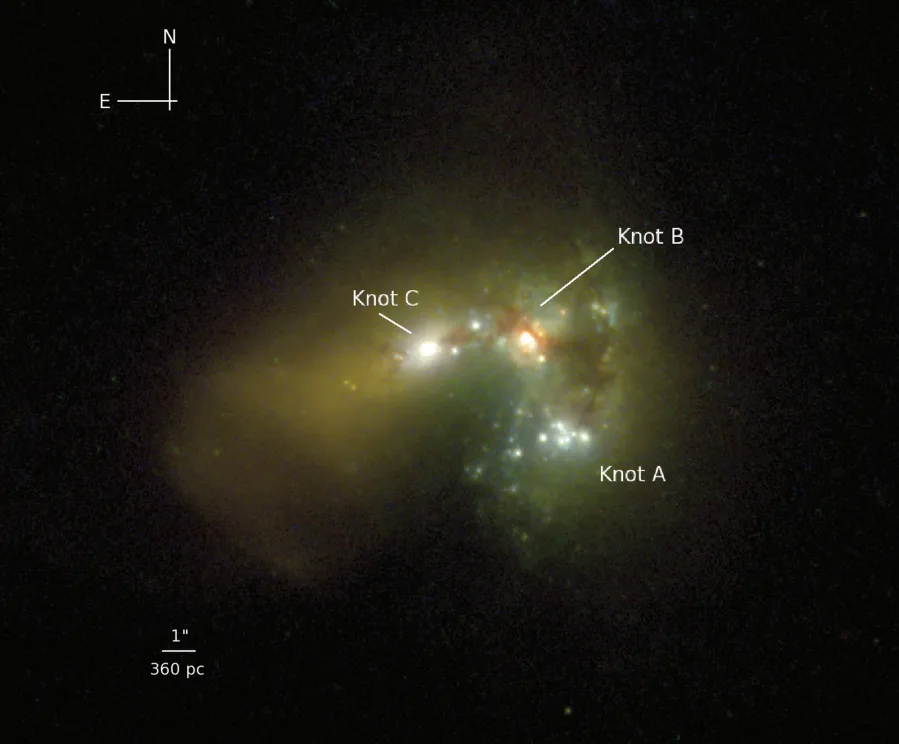
مجرة تقترب من أخرى، مثل راقصين يتفرقان ثم يتجاذبان مجددًا. في لحظة الاقتراب الوثيق بشكل خاص، ينضغط غازهما، وينبعث ضوء فوق بنفسجي ساطع من الأعماق. هذا بالضبط ما يحدث في نظام خارا 11 — أقرب زوج من المجرات المندمجة إلينا، والذي يسمح بتسرب هذا الضوء إلى الخارج. بنى العلماء نموذجًا حاسوبيًا لهذه الرقصة لفهم كيفية نشوء هذا التسرب.
في النموذج، اقتربت المجرتان الأم، ثم تباعدتا، ثم اقتربتا مرة أخرى. في كل مرة تمران فيهما بالقرب من بعضهما، يزداد تسرب الضوء فوق البنفسجي حوالي عشرة أضعاف. السبب بسيط: ينضغط الغاز، وتظهر فيه فجوات يندفع الضوء من خلالها إلى الخارج. كما أن ومضات ولادة نجوم جديدة عززت التسرب — فالنجوم الفتية تعمل على تسريع الغاز وتحدث فيه ثقوبًا.
ومن المثير للاهتمام أن تسرب ضوء آخر — خط ليمان-ألفا — لم ينمُ بنفس القدر. هذا الضوء يصدره الهيدروجين، وغالبًا ما يعلق في الغاز الكثيف. لذلك، عند النظر إلى خط ليمان-ألفا، قد نقلل من كمية الأشعة فوق البنفسجية التي تخرج فعليًا من المجرة. في النموذج، كانت العقدة الكثيفة من النجوم المسماة "العقدة C" هي الأكثر سطوعًا — وقد تبين أنها المصدر الرئيسي للإشعاع المتسرب إلى الخارج.
المجرة المحاكاة تشبه خارا 11 الحقيقية — في الشكل والسطوع. وهذا يعني أن مثل هذه الرقصات الحاسوبية تساعدنا على فهم كيف قامت المجرات الأولى في الماضي البعيد بتطهير الكون من ضباب الهيدروجين المتعادل.
الملخص الأصلي
كما كتبه المؤلفون، بالإنجليزية arXiv:2601.20943
The Haro 11 galaxy merger is the closest known Lyman Continuum (LyC) leaker and a strong Lyman-$$\alpha$$ (Ly$$\alpha$$) emitter, making it an important analogue of the high-$$z$$ galaxies that reionised the early Universe. To investigate how Haro 11's properties arise, we perform a radiation hydrodynamics simulation of the merger, and create mock observations of LyC, Ly$$\alpha$$, and H$$\alpha$$, from which we compute their luminosities ($$L$$) and escape fractions ($$f_{\rm esc}$$). We track these quantities along multiple sightlines as the two progenitor galaxies merge, from the first interaction until the system resembles present-day Haro 11. We find that $$L$$ and $$f_{\rm esc}$$ vary by 1-2 orders of magnitude for LyC due to sightline variations. At the two pericentre passages, the total $$f_{\rm esc}^{\rm LyC}$$ increases by roughly an order of magnitude. Conversely, $$f_{\rm esc}^{\rm Ly\alpha}$$ shows a moderate increase at the pericentre passages, which affects the inference of LyC properties from Ly$$\alpha$$. We attribute this to a displacement of the LyC-emitting stars relative to the \Lya-emitting gas, combined with an increased density from gas compression. Furthermore, $$f_{\rm esc}^{\rm LyC}$$ is boosted during star formation bursts, likely due to stellar feedback. As direct comparison with Haro 11, the simulation qualitatively matches its morphology and luminosities. We find that among the dense stellar knots, knot C is the main contributor to both intrinsic and escaping LyC emission. Additionally, the Ly$$\alpha$$ spectra displays distinct features found in observations, implying similar gas conditions are present.
تقع خارا 11 على بعد 82 مليون سنة ضوئية فقط منا — وهي مسافة قريبة جدًا بالمقاييس الكونية. ولهذا السبب تُعتبر "مختبرًا" لدراسة العمليات التي حدثت في الكون المبكر على مسافات شاسعة.