الضوء يولد تيارًا كهربائيًا دون بطارية سريع
جهاز استشعار الضوء العادي يشبه البئر ذات البكرة: لرفع الدلو، عليك أن تدير المقبض. كذلك يحتاج المستقبل الضوئي إلى جهد خارجي لسحب الشحنة الكهربائية. لكن هناك مواد تحول الضوء إلى تيار بنفسها — مثل النبع الذي يتدفق دون مضخة. أحد هذه المواد هو أكسيد الزنك، المعروف في الأصباغ البيضاء وكريمات الوقاية من الشمس.
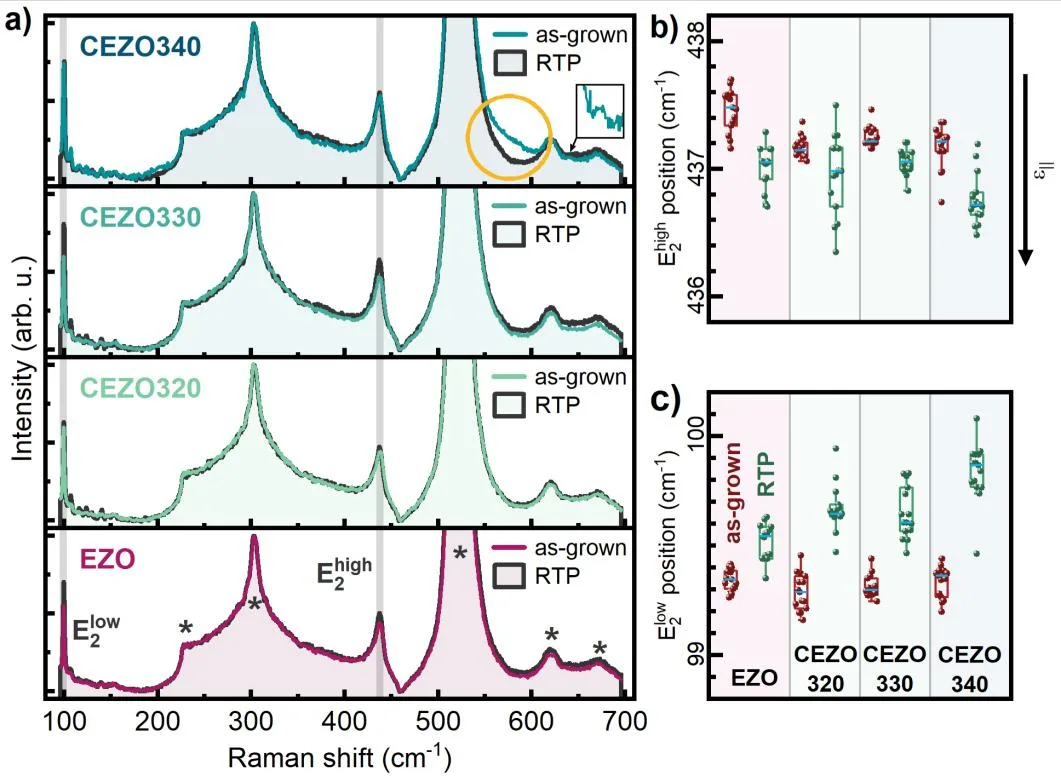
التحليل الطيفي أظهر أنه تم دمج أيونات الأوروبيوم في الشبكة البلورية لأكسيد الزنك — فهي تتوهج باللون الأحمر عند تعرضها للإشعاع. كما أن إضافة الكادميوم غيّرت سلوك المادة: اختفى الحاجز الذي كان يمنع التيار من التدفق بين الطبقات. ونتج عن ذلك تقاطع يمرر التيار في اتجاه واحد فقط — مثل الصمام في القلب أو الدايود في الراديو القديم.
النتيجة: الجهاز ينتج تيارًا عند إضاءته من الأشعة فوق البنفسجية إلى الأشعة تحت الحمراء القريبة، ويستجيب خلال 10 ميكروثانية. هذا أسرع من وميض البرق. هذه المستشعرات يمكن أن تعمل لسنوات دون إعادة شحن — على سبيل المثال، في أجهزة كشف الدخان أو في الكاميرات على المسابير الفضائية.
الملخص الأصلي
كما كتبه المؤلفون، بالإنجليزية arXiv:2602.04426
Photodetectors (PDs) are essential in imaging, communication, and sensing technologies. However, their reliance on external power makes them energy-consuming. This creates a strong need for self-powered PDs as a sustainable alternative. ZnO is a promising semiconductor material due to its pyroelectric properties, stemming from non-centrosymmetric wurtzite crystal structure, enabling the pyro-phototronic effect that enhances response speed. Properties of ZnO can be tailored via alloying and doping. Thus, this work explores thin layers of ZnCdO:Eu random alloys grown by molecular beam epitaxy (MBE) on silicon substrates, with varying Cd content. The study shows that doping with Eu notably affects growth kinetics, promoting strong [0001] orientation preference. Moreover, photoluminescence measurements confirm the successful incorporation of Eu3+ ions into the structure. Electrical measurements show that the introduction of Cd eliminates the problem of Schottky barrier formation on the ZnO/Si interface. The n-ZnCdO:Eu/p-Si junctions exhibit rectifying behavior and generate photocurrent across 380-1150 nm wavelength range without external electrical bias. Utilizing the pyro-phototronic effect, these devices achieved ultrafast response times: rise time below 10 us and decay time below 5 us for 405 nm and 650 nm illumination - placing them among the fastest self-powered oxide-based detectors that do not rely on additional performance-enhancing layers.
أكسيد الزنك — هو المسحوق الأبيض الذي كان المنقذون على الشاطئ يدهنون به أنوفهم. الآن يلتقط الضوء ويحوله إلى كهرباء.