الضوء يلتقط الإلكترونات أثناء الطيران سريع
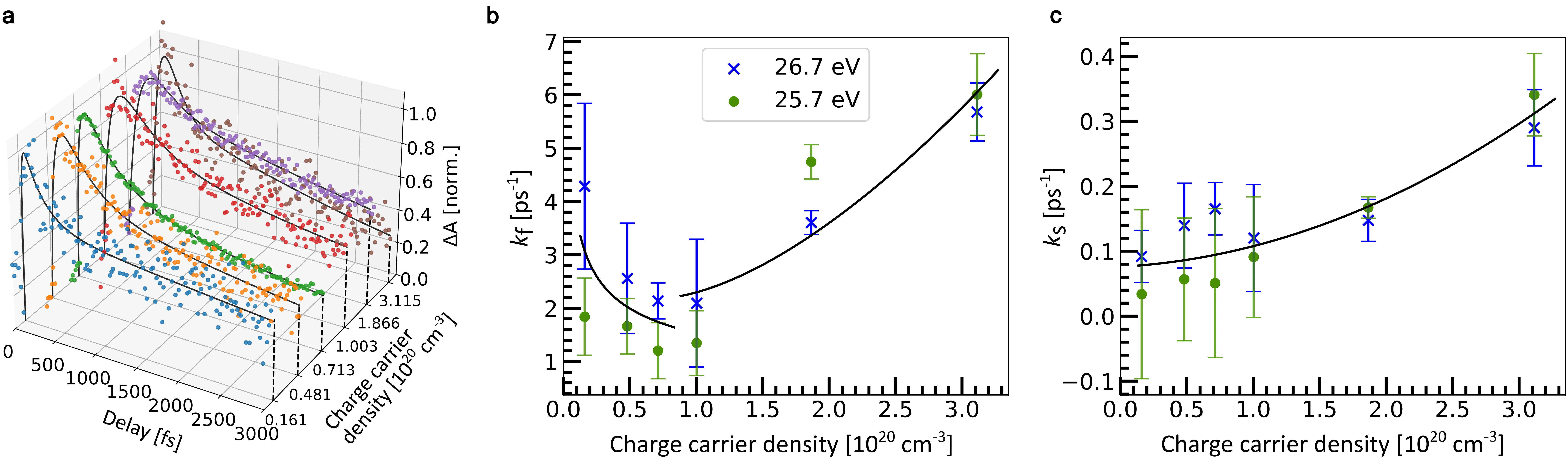
يسقط ضوء الشمس على السطح، وتولد الإلكترونات في الغشاء الرقيق. يجب أن تصل إلى الأسلاك قبل أن تبرد وتفقد طاقتها. في كبريتيد القصدير — مادة رخيصة ومتاحة للبطاريات — تم تصوير هذا الجري والتبريد بدقة غير مسبوقة: اللقطات تتبع بعضها البعض كل جزء من مليار من مليار جزء من الثانية.
نبضة الليزر تقذف الإلكترونات، مثل ضربة عصا البلياردو التي تسرع الكرات. مباشرة بعد الضربة، تندفع الكرات بسرعة، لكنها تتباطأ تدريجياً بسبب التصادم مع بعضها البعض ومع الجدران. نظر العلماء إلى الضوء الذي تمتصه المادة لحظة هذه التصادمات. في الضوء الخافت — كما لو كان عدد الكرات قليلاً، فتتباطأ أساساً بفعل الجدران. في الضوء القوي — الكرات كثيرة جداً لدرجة أنها تبدأ في إعاقة بعضها البعض، وتتجمد الدفعة بأكملها بشكل أسرع.
لكن في هذه الدفعة هناك أيضاً اهتزاز الطاولة. ذرات البلورة تهتز، وإيقاعها — 188 فيمتو ثانية لكل اهتزازة — يظهر في كل صورة. الإلكترونات لا تطير بمفردها فقط: بل تدفعها اهتزازات الشبكة البلورية. فهم هذا الإيقاع سيساعد في بناء ألواح شمسية تصل فيها الإلكترونات إلى الهدف دون أن تفقد طاقتها في الطريق.
الملخص الأصلي
كما كتبه المؤلفون، بالإنجليزية arXiv:2602.13886
Metastable cubic tin(II) sulfide ($$\pi$$-SnS) is an earth-abundant semiconductor whose three-dimensionally bonded chiral lattice may overcome the short minority-carrier lifetime of orthorhombic SnS while maintaining a near-ideal bandgap for tandem photovoltaics. Despite its promise, ultrafast carrier cooling and recombination mechanisms over illumination density remain poorly constrained. We use core-level extreme-ultraviolet attosecond transient absorption spectroscopy at the Sn $$4d$$ edge to track carrier injection, cooling, and recombination in $$\pi$$-SnS with element- and orbital-specific sensitivity. Following femtosecond near-infrared excitation, the Sn $$4d\rightarrow$$CB onset exhibits conduction-band state filling and a carrier-induced edge shift, enabling extraction of density-dependent kinetics. The transient response follows a biexponential decay with a fast hot-carrier cooling component and a slower recombination component. At low carrier densities, recombination is consistent with interface-limited processes, whereas above $$\sim1\times10^{20}$$ cm$$^{-3}$$ both cooling and recombination accelerate, indicating a crossover to carrier-carrier interaction-dominated dynamics. Coherent phonon oscillations with a period of $$\sim188$$ fs reveal coupling between electronic excitation and lattice motion. These results provide a comprehensive picture of nonequilibrium carrier and phonon dynamics in cubic SnS, reveal a change of mechanisms over a range of carrier densities, and establish the value of using attosecond transient absorption spectroscopy to study ultrafast processes in complex semiconductors that have optoelectronic and energy-conversion applications.
الأتوثانية قصيرة جداً لدرجة أنه في ثانية واحدة يمر منها أكثر من عدد الثواني التي مرت منذ الانفجار العظيم.