نجوم منارة في المجرات البعيدة سريع
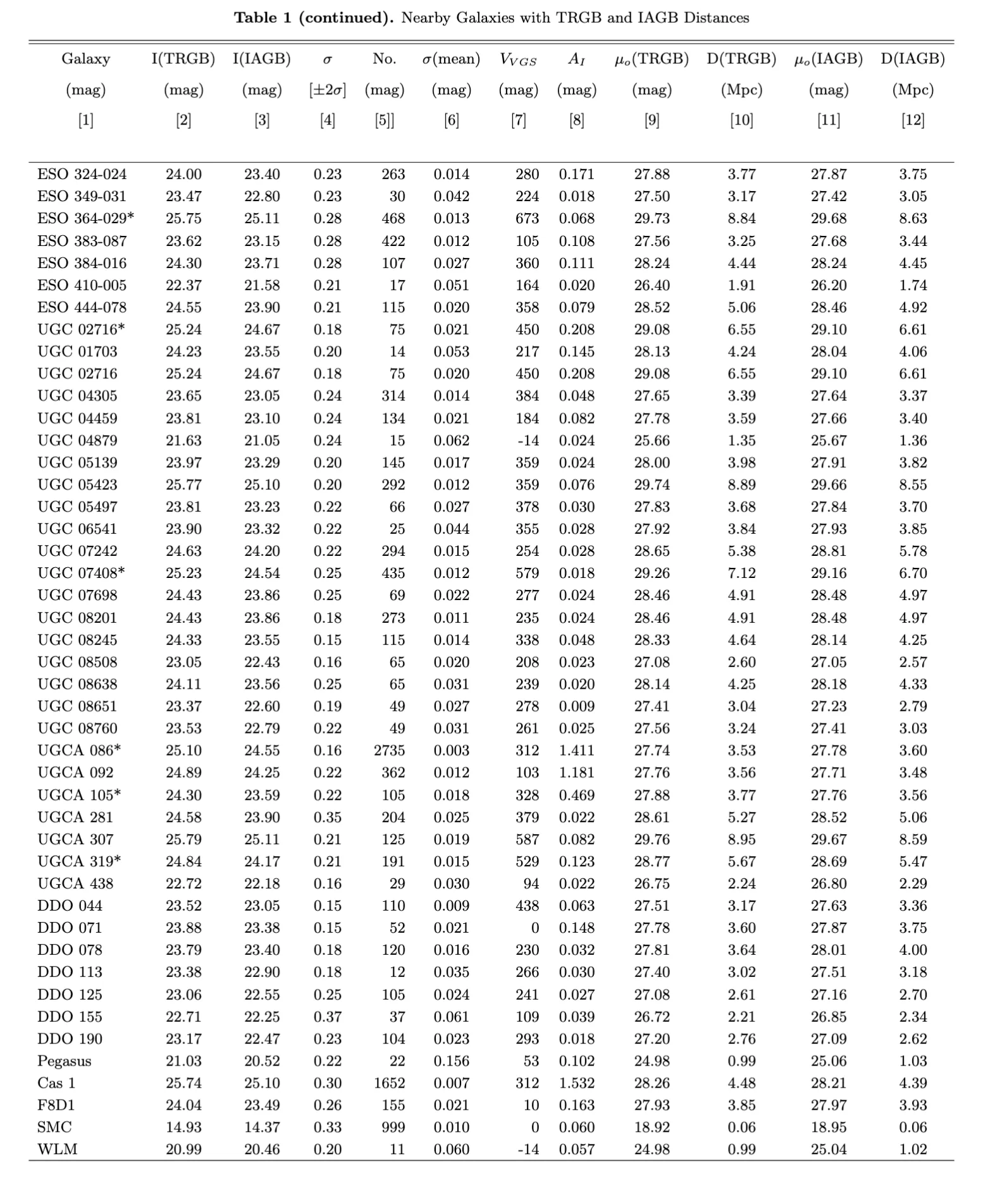
في المجرات البعيدة تعيش نجوم قديمة تنتفخ وتحمر. بينها مجموعتان تشبهان المنارات: بعضها بدأ للتو احتراق الهيليوم، والبعض الآخر يحرق الكربون والأكسجين. استخدم علماء الفلك تلسكوب هابل للنظر في 92 مجرة ومقارنة سطوع هذين النوعين من النجوم.
اتضح أن النجوم في المرحلة المتأخرة (الفرع المقارب للعمالقة) هي في المتوسط أكثر سطوعًا بمقدار 0.589 قدر نجمي من النجوم في قمة فرع العمالقة الحمراء. هذا يشبه أن يكون لديك مسطرة بعلامتين، والمسافة بينهما دائمًا متساوية في أي مجرة، بغض النظر عن الغبار والمسافة. الآن، إذا قمت بقياس سطوع مثل هذا النجم، يمكنك حساب مدى بعد مجرته.
هذا يفتح الطريق لقياس المسافات إلى المجرات التي كانت سابقًا باهتة جدًا لمثل هذه الطرق. بالفعل، تسمح البيانات الأرشيفية لهابل بالعثور على هذه النجوم المنارة في مجرات على مسافة تصل إلى 9 ميغابارسك، أي حوالي 30 مليون سنة ضوئية.
الملخص الأصلي
كما كتبه المؤلفون، بالإنجليزية arXiv:2602.14304
Hubble Space Telescope (HST) observations of 92 galaxies that have a strong showing of I-band Asymptotic Giant Branch (IAGB) stars in their color-magnitude diagrams (CMDs), are used to measure the relative offset between the mean apparent I-band magnitudes of the IAGB population and the corresponding apparent I-band magnitudes of the TRGB as measured in the same frames (and CMDs) of those individual galaxies. This first exploratory, large-sample comparison is independent of any extinction (foreground or internal) that may be shared by these two populations. The marginalized luminosity functions used to determine the modal value of the {\it IAGB } population are well fit by a single, symmetric Gaussian. The difference in the two apparent magnitudes (in the sense IAGB minus TRGB) is -0.589 mag, with a combined standard deviation of +/- 0.119 mag. Adopting M_I = -4.05 mag for the TRGB stars, the modal absolute magnitude of the IAGB is then calculated to be M_I(IAGB) = -4.64 +/- 0.12 mag. The ensemble dispersion quoted above gives a standard error on the mean of +/- 0.012 mag (based on the full sample of 92 galaxies). Independently, the three geometry-based zero points for I-band AGB stars are found (in Paper I) to be M_I = -4.49 +/- 0.003~mag in the LMC (4204 stars), M_I = -4.67 +/- 0.008 mag, for the SMC (916 stars) and M_I = -4.78 +/- 0.030 mag for NGC4258 (62 stars), leading to a global zero-point (weighted) average of
النجوم على الفرع المقارب للعمالقة تنبض بفترات تصل إلى مئات الأيام، ويتغير سطوعها مثل مصباح يومض ببطء.
في رواية "ضوء المجرات البعيدة"، يستخدم رواد الفضاء هذه النجوم كعوامات ملاحية طبيعية لضمان عدم انحرافهم عن المسار في الفضاء بين المجرات.