نفثات SS 433: رقصة مع خلل سريع
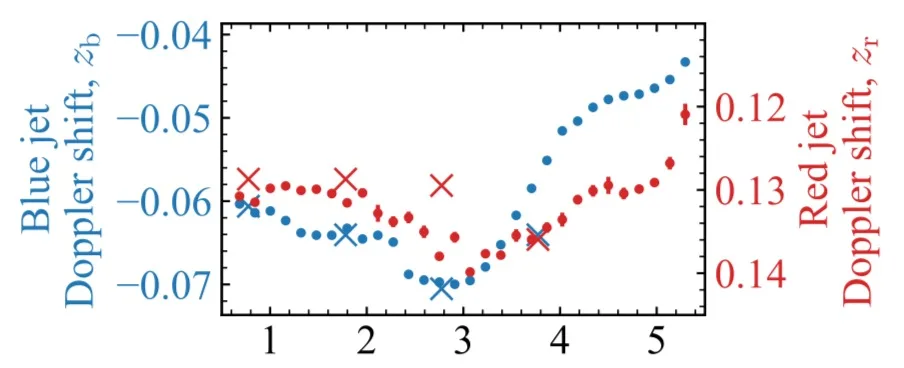
يقذف النظام الثنائي SS 433 نفاثتين رفيعتين من الغاز بسرعة تقارب سرعة الضوء. إحداهما تتجه نحونا، والأخرى بعيدًا عنا. في أبريل 2024 ومارس 2025، تمت متابعتهما بثلاثة أجهزة في وقت واحد: تلسكوب الأشعة السينية XRISM، وتلسكوبات بصرية تقليدية، وكاميرا تعمل في نطاق الأشعة تحت الحمراء القريبة.
عند مقارنة السرعة التي تتحرك بها النفاثات في الأشعة السينية والضوء المرئي، لاحظوا إزاحة: يبدو أن الإشعاع البصري يتخلف بخطوة. مثل مترجم يسمع الجملة ولا ينطقها إلا بعد لحظة. ربما يولد الضوء بعيدًا قليلاً عن المركز مقارنة بالأشعة السينية، ويحتاج وقتًا للوصول إلى أجهزتنا.
لم تكن سرعة النفاثات ثابتة. في عام 2024، تذبذبت حول 26% من سرعة الضوء، وفي 2025 حوالي 30%. تغيرت بفترة تبلغ حوالي 6.3 يوم. يشبه هذا الإيقاع الذي يتمايل به النظام، وهو ما يسمى بدورة المبادرة (nutation cycle). لكن انزياح الطور بلغ حوالي ناقص 90 درجة: تصل النفاثة إلى ذروة سرعتها ليس عندما تتوقع بناءً على التمايل.
استمرت التوهجات في الضوء المرئي حوالي 400 ثانية في عام 2024 و1600 ثانية في عام 2025. قفز السطوع بنسبة تصل إلى 15%. لكن الأشعة السينية في نفس الوقت كانت صامتة — لا توهج واحد ملحوظ. القناة تحت الحمراء أيضًا لم تر شيئًا مشابهًا. يبدو أن التوهجات تولد فقط في الضوء المرئي، بينما تبقى الأشعة السينية هادئة.
هذه الملاحظات مثل ثلاثة شهود مختلفين لحدث واحد. كل منهم يرى شيئًا مختلفًا، وفقط معًا يشكلون الصورة الكاملة. في المستقبل، سيواصل XRISM مراقبة SS 433، وعندها ربما يتضح لماذا يتأخر الضوء البصري ومن أين تأتي هذه التوهجات.
الملخص الأصلي
كما كتبه المؤلفون، بالإنجليزية arXiv:2602.21661
We present results from coordinated multiwavelength observations of the SS 433, obtained with XRISM, optical telescopes, and near-infrared camera during 2024 April and 2025 March. The XRISM exposures amounted to ~200 ks in 2024 and ~100 ks in 2025. With XRISM/Resolve's high spectral resolution and large effective area, we clearly resolved numerous emission lines even in short time segments, achieving improved accuracy in Doppler-shift measurements relative to earlier observations. The simultaneously obtained X-ray and optical Doppler shifts suggest a possible tendency for the optical emission to lag slightly behind the X-rays. In the Resolve data, the Doppler shifts of the two jet components exhibited apparent asymmetries, with jet speeds fluctuating around ~0.26$$\pm$$0.01$$c$$ in 2024 and ~0.30$$\pm$$0.01$$c$$ in 2025. The velocity variations indicated modulations on a timescale of ~6.3 d, with a phase offset of about -90$$^{\circ}$$ relative to the nutation cycle. The observed line widths and flux of the approaching and receding jets appear consistent with the expected geometrical effects, indicating systematically larger line widths in the inner regions of the jets, as proposed by Shidatsu et al. (2025). Optical light curves show flares of ~400 s in 2024 and ~1600 s in 2025, with amplitudes up to ~15% during out-of-eclipse intervals, while the XRISM/Xtend light curves show no significant variability within the overlapping intervals and given the statistical uncertainties. Near-infrared photometry in 2024, obtained during an out-of-eclipse interval at a different epoch from the optical observations, showed no flare-like variability, and the X-ray band also remained constant within uncertainties. These coordinated observations provide a foundation for future XRISM studies aimed at probing the dynamical properties of the relativistic jets in SS 433.
تتحرك نفاثات SS 433 بسرعة تبلغ حوالي 26–30% من سرعة الضوء — أي حوالي 80,000 كيلومتر في الثانية. في ثانية واحدة، يمكن لمثل هذه النفاثة أن تعبر المحيط الأطلسي ثماني مرات.