Hiroya Yamaguchi

7 articles · 30 co-authors · latest: 2026-06-15
319 citations · h-index 10 · 46 papersData: Semantic Scholar

We have retold 7 papers by this author. 1 of them with a full read. most often about: Solar wind, accretion_disc_wind, supernova remnant. 30 co-authors across our retellings.

Links in the knowledge graph
A Veil over the Beacon: The Slow Wind of GX 13+1
About 25,000 light-years from Earth, in the constellation Sagittarius, a dense veil wraps around the neutron star GX 13+1. It scatters X-ray photons the way fog scatters streetlight, and for a long time it hid the source's true power from astronomers.
High Energy2026-01-121 minarXiv:2601.07394express
A Cosmic Blast That Scattered Iron Unevenly
When a massive star runs out of fuel, it collapses and explodes, scattering the material from its interior across space. The remnant of such an explosion, Cassiopeia A, has long been known to astronomers for its lopsided appearance: bright clumps of material are scattered unevenly.
High Energy2026-01-252 minarXiv:2601.17792express
How Iron Reveals the Secrets of Cold Gas
A flashlight shines through fog, and its light changes color slightly. From that change, you can tell what the fog is made of. That's how astronomers study cold gas around X-ray sources: iron atoms in the gas absorb and re-emit X-rays at a very specific energy, like a fingerprint. But there's a catch: if you strip a few electrons from the atom, the line shifts.
Instrumentation2026-01-261 minarXiv:2601.18311express
X-ray Light from the Lab
An X-ray telescope captures light from hot gas around stars, but that light arrives 'blurred'—like a voice over a bad phone line. To make out the words, you need a dictionary of the exact frequencies at which atoms glow. Such a dictionary is written not only with calculations but also with direct experiments.
High Energy2026-02-252 minarXiv:2602.21661express
SS 433's Jets: A Dance with a Glitch
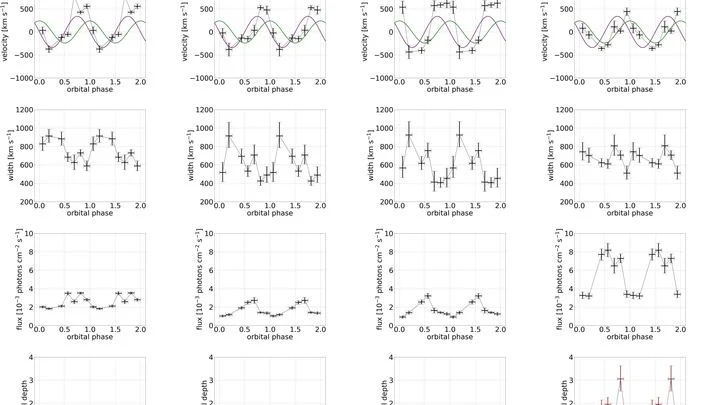
The binary system SS 433 ejects two thin jets of gas at nearly the speed of light. One flies toward us, the other away from us. In April 2024 and March 2025, three instruments watched them simultaneously: the X-ray telescope XRISM, ordinary optical telescopes, and a near-infrared camera.
High Energy2026-04-252 minarXiv:2604.23185express
Cosmic Weather Vane: How a Star's Wind Reveals Its Secrets
Deep in the constellation Cygnus, two stars circle each other. One is a giant, the other a black hole. The giant continuously ejects a stream of gas into space — a stellar wind. When this wind falls under the black hole's X-rays, it lights up like a neon sign. Astronomers captured this light and split it into colors to learn what the wind is made of and how it moves.
Galaxies2026-06-152 minarXiv:2606.17141express
Cosmic Cocktail Without the Secret Ingredient
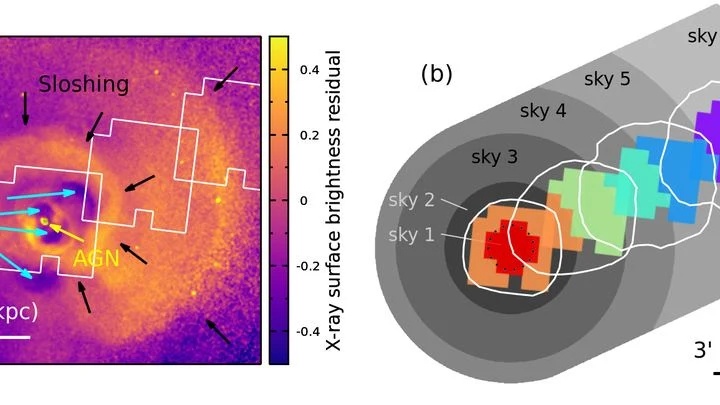
The Perseus galaxy cluster is a giant metropolis of thousands of star islands, bathed in an invisible ocean of scorching gas. Like urban smog, this gas preserves traces of all the chemical factories that have operated in galaxies for billions of years: supernova explosions that scatter freshly forged atoms across the surroundings.