حلقات من ذرات الكربون: كيف جمع العلماء جزيئًا من 88 حلقة سريع
على سطح ملح الطعام العادي، تنمو حلقة من ذرات الكربون — مثل سوار يُجمع حلقةً حلقة. لكن الحلقات هنا ليست معدنية بل كربونية، ولا يصل بينها صائغ، بل طرف مجهر ماسح. تعلم الفيزيائيون نسج مثل هذه الأساور بطول يصل إلى 88 ذرة، واختبار كيفية تمريرها للكهرباء.
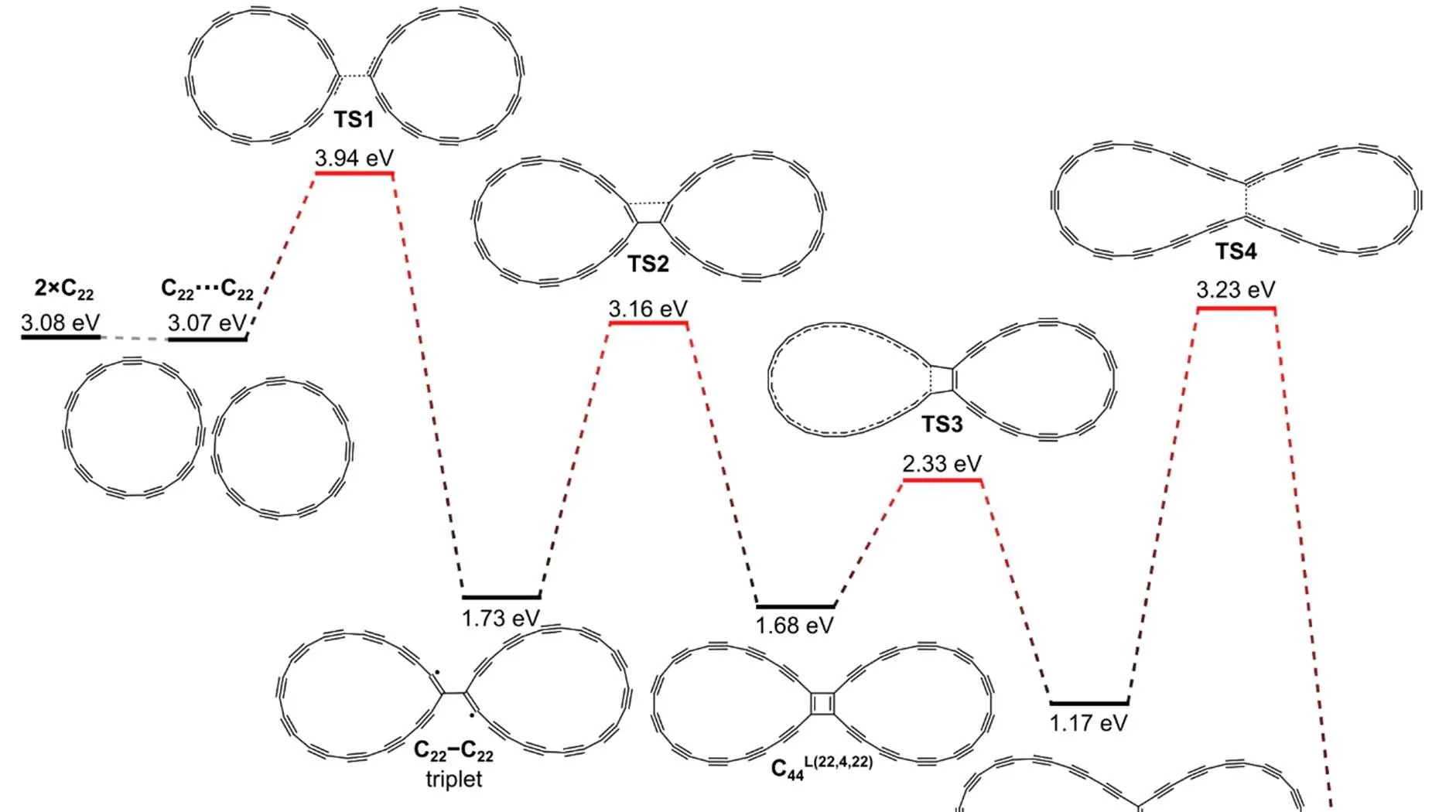
كل حلقة هي جزيء حلقي الكربون (cyclocarbon). ليس له فروع جانبية، فقط سلسلة مغلقة من الذرات. لتجميع حلقة كبيرة، صنع العلماء أولاً قطعًا صغيرة من 20 و22 ذرة، ثم دمجوها معًا بنفس الطرف المجهري. فنتجت حلقات من 42 و44 و46 و66 و88 ذرة.
الفرق بين الحلقات التي عدد ذراتها مضاعف للعدد 4 (20، 44) وجاراتها (22، 42) يتكرر في كل مرة، لكنه يضعف مع زيادة الحجم. وعند حلقة من 88 ذرة يكاد لا يُرى. هذا يعني أن حلقات الكربون الكبيرة جدًا تفقد عطرتها وتتصرف مثل أسلاك موصلة عادية.
قد تصبح هذه الأساور الجزيئية أساسًا لأسلاك بسمك ذرة واحدة. إذا تعلمنا ربطها في سلاسل والتحكم في التيار، فستظهر دوائر إلكترونية مبنية حرفيًا من جزيئات منفردة.
الملخص الأصلي
كما كتبه المؤلفون، بالإنجليزية arXiv:2603.02040
Molecular rings of N carbon atoms, that is, cyclo[N]carbons, or C$$_N$$, can be formed by tip-induced chemistry [1-7]. Because of their monocyclic geometry, cyclocarbons are fundamentally important for testing theoretical models of aromaticity [8-11]. Here, we synthesized large cyclo[N]carbons, with N up to 88, by tip-induced chemistry on a NaCl surface and studied their aromaticity by measuring their transport gaps by scanning tunnelling spectroscopy. We first generated C$$_{20}$$ and C$$_{22}$$, and then fused multiple cyclocarbons [5-7] by means of atom manipulation, obtaining C$$_{42}$$, C$$_{44}$$, C$$_{46}$$, C$$_{66}$$ and C$$_{88}$$. In agreement with predictions obtained using a finely tuned density functional [12-15] and large active space approximate configuration interaction calculations executed on quantum hardware [16, 17], we observe a substantially smaller transport gap for C$$_{20}$$ (N = 4n) compared to C$$_{22}$$ (4n+2), and for C$$_{44}$$ (4n) relative to C$$_{42}$$ (4n+2). In larger cyclocarbons, the oscillation of the transport gap between anti-aromatic N = 4n and aromatic N = 4n+2 cyclocarbons becomes smaller, and is expected to eventually vanish with increasing N, indicating non-aromaticity. Our experimental results show that aromaticity persists at N = 42, and theory predicts ring currents comparable in magnitude to that of benzene in cyclocarbons of this size. In the future, such large cyclocarbons could be used to study conductance, quantum interference, and the effects of aromaticity in single atomic carbon wires and circuits.
حلقة من 20 ذرة كربون هي الأصغر بين كل ما تم تجميعه وقياسه. قطرها أقل من نانومتر، أي أنحف بعشرات آلاف المرات من شعرة الإنسان.
في قصة تيد تشانغ «الفهم»، يبني البطل بنى فائقة الدقة بالتلاعب بالذرات — تمامًا كما تُجمع حلقات الكربون في هذا العمل.