التوهجات النجمية الفائقة: تدفئ الكواكب وتُخلّق الأحماض الأمينية سريع
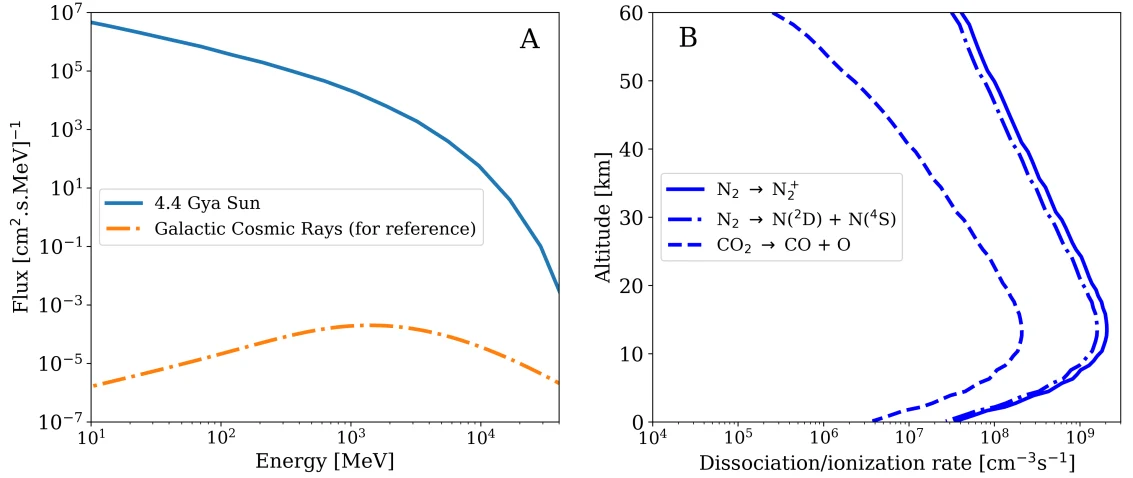
الشمس الفتية كانت أبهت بنسبة 30%، لكن المحيطات لم تتجمد. اللغز يكمن في التوهجات الفائقة: فقد قصفت الغلاف الجوي بوابل من الجسيمات النشطة. كررت تجربة مختبرية ذلك: خليط من النيتروجين وثاني أكسيد الكربون تحت وابل الجسيمات أنتج أكسيد النيتروز والجلايسين، وهو لبنة بناء البروتينات. الجو هنا هو القدر، والجسيمات النجمية هي الطباخ الذي يعد من الغازات البسيطة 'مرقًا' للمناخ والحياة. كل توهج قوي يمكن أن ينتج ما يصل إلى 20 مليار كيلوغرام من أكسيد النيتروز سنويًا — ما يكفي لصنع 'غطاء' محكم للقدر الكوكبي.
أكسيد النيتروز هو غاز دفيء أقوى بـ 300 مرة من ثاني أكسيد الكربون. لقد حبس حرارة الشمس الضعيفة، مانعًا الأرض من التجمد. هذه الآلية نفسها توسع المنطقة الصالحة للسكن للكواكب الصخرية الخارجية — حيث الحرارة العادية غير كافية. وفي الأثناء، تتشكل الأحماض الأمينية، لبنات الحياة. وهكذا، فإن العاصفة الكونية، التي تُرى عادةً كتهديد، ربما تكون قد أطلقت كيمياء الحياة على الأرض.
الملخص الأصلي
كما كتبه المؤلفون، بالإنجليزية arXiv:2603.18206
The emergence of habitable conditions on the early Earth and on rocky exoplanets requires persistent energy sources that can drive both prebiotic chemistry and climate warming under magnetically active young G to M stars. To quantify the contribution of stellar energetic particle (StEP) events associated with superflares to the atmospheric chemistry of young planets with primitive atmospheres, we carried out a suite of laboratory proton irradiation experiments on mildly reduced gas mixtures. We present first proton irradiation experiments of $$N_{\mathrm{2}}$$/$$CO_{\mathrm{2}}$$ rich gas mixtures that yield abundant nitrous oxide ($$N_{\mathrm{2}}O$$) at mixing ratios up to 1000 ppmv, together with amino acid precursors including glycine, corresponding to global production rates of order $$2\times10^{10}$$ kg/yr on the early Earth. Our photochemical modeling of StEP driven proton irradiation reproduces the experimentally inferred $$N_{\mathrm{2}}O$$ production rates and provides self-consistent atmospheric $$N_{\mathrm{2}}O$$ profiles. We then use these profiles of $$N_{\mathrm{2}}O$$ as input to a 3D global climate model to evaluate the radiative and climatic impact of StEP generated $$N_{\mathrm{2}}O$$ in primitive atmospheres representative of the early Earth and young rocky exoplanets. Our results show that frequent StEP events can help alleviate the faint young Sun paradox on the early Earth and can maintain temperate surface conditions on young rocky exoplanets beyond the outer edges of habitable zone, while simultaneously enhancing the buildup of prebiotic molecules. Together, these processes may constitute a robust pathway toward early planetary habitability.
كل توهج قوي على نجم فتي يمكن أن ينتج ما يصل إلى 20 مليار كيلوغرام من أكسيد النيتروز سنويًا — وهذا يكفي لتدفئة غلاف كوكب بأكمله.
فكرة تدفئة كوكب بالغازات الدفيئة مألوفة من ثلاثية كيم ستانلي روبنسون 'المريخ الأحمر'. لكن هناك كان المهندسون بشرًا، وهنا النجم نفسه.