دوامات في مهد الكواكب سريع
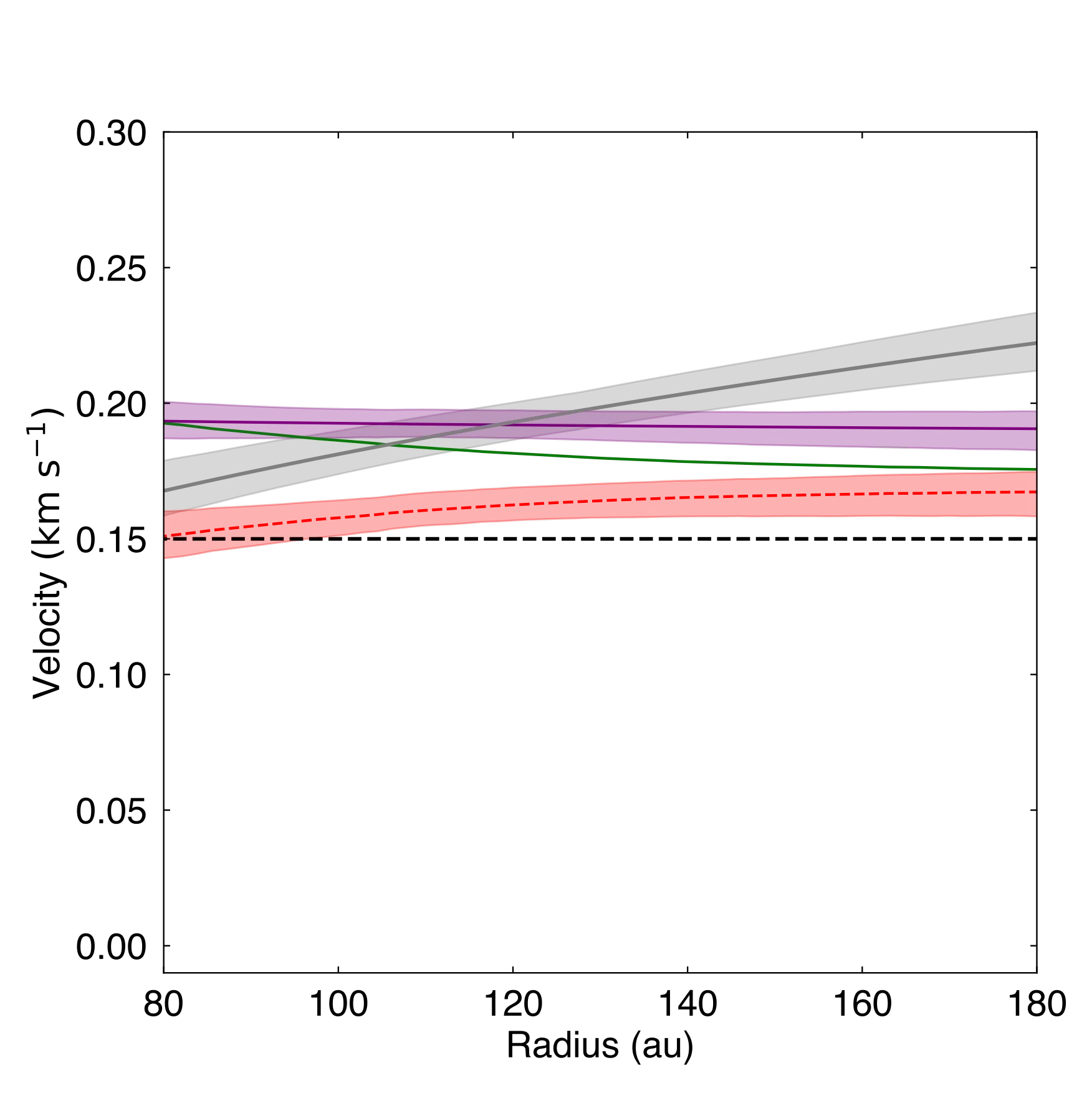
النجم الفتي HL Tau محاط بقرص من الغاز والغبار — مهد الكواكب المستقبلية. داخل هذا القرص، لا يبقى الغاز ساكنًا: فهو يتحرك في مدارات دائرية، لكنه في الوقت نفسه يرتجف ويختلط، مثل الماء في نهر جارف. ولأول مرة، قاس علماء الفلك قوة هذا الاختلاط مباشرة.
المجرة هي نظام ضخم من النجوم والغاز والغبار، والقرص حول HL Tau ليس سوى جزء صغير منها. استخدم العلماء بيانات من تلسكوب ALMA، بمراقبة إشعاع جزيئات الفورمالديهايد (H2CO). من عرض خطوط هذا الإشعاع يمكن استنتاج سرعة حركة الغاز. اتضح أن الغاز في القرص يرتجف بسرعة تبلغ حوالي 0,15 كم/ث — وهي تقريبًا سرعة المشاة. لكن بالنسبة للغاز البارد، هذا كثير جدًا: الاضطرابية أقوى بعدة مرات من تلك الموجودة في الأقراص الأكثر نضجًا.
من أين تأتي هذه الحياة العاصفة؟ قرص HL Tau لا يزال فتيًا ومحاطًا بغاز يسقط عليه من السحابة الخارجية. هذا الغاز المتساقط يصطدم بالقرص ويهزه، مثلما تهز الرياح سطح بحيرة. بالإضافة إلى ذلك، القرص نفسه ضخم وقد يكون غير مستقر، مما يولد دوامات. هذه الاضطرابية القوية تمنع الغبار من الاستقرار بسرعة في منتصف القرص، وبالتالي تتشكل الكواكب في مثل هذه الظروف بشكل أبطأ وبطريقة مختلفة عن الأقراص الهادئة.
هذا الاكتشاف يُظهر أن الأنظمة الكوكبية الفتية تمر بمرحلة عاصفة. وهذا يغير الفهم حول مدى سرعة وأين تتشكل الكواكب بالضبط. في المستقبل، ستساعد هذه القياسات في فهم لماذا تحصل بعض النجوم على كواكب بينما يبقى البعض الآخر وحيدًا.
الملخص الأصلي
كما كتبه المؤلفون، بالإنجليزية arXiv:2603.29147
Turbulence in protoplanetary disks plays a crucial role in the evolution of disk structures and the planet formation process therein. However, the strength of the turbulence remains unclear in young, embedded disks surrounded by infalling envelopes. In this paper, we present the first direct measurement of the nonthermal velocity dispersion within the embedded disk around HL Tau, which possesses a dusty disk with multiple rings and gap structures but is still associated with infalling gas flows from an envelope. Using ALMA archival data of the $$\mathrm{H_2CO}$$ emission, we measured the local line width through a parametric model fitting that accounts for the contribution of Keplerian shear motion. After subtracting the thermal component, the nonthermal velocity dispersion is $$\sim\!\!0.15~\mathrm{km~s^{-1}}$$ on average over radii of $$80$$-$$180~\mathrm{au}$$, and it slightly increases with radius. The estimated nonthermal motions correspond to a turbulent mach number of $$\mathcal{M}\!\!\sim\!\!0.4$$ or a viscous $$\alpha$$ value of $$\alpha \!\!\sim\!\!0.16$$, assuming that it is entirely caused by turbulence and $$\alpha \!\!\sim \!\! \mathcal{M}^2$$. Our analysis also suggests that the $$\mathrm{H_2CO}$$ emission traces near the disk midplane ($$z\lesssim 0.1 R$$). Turbulence driven by the gravitational instability or infall from the envelope most naturally explains the large nonthermal motions, considering the large disk mass and associated infalling streamers. The strong turbulence measured in the outer disk, in contrast to the vertically settled inner dusty disk, suggests a pronounced radial variation in the turbulence strength and/or an anisotropic nature of the turbulence within the disk.
سرعة الحركات الاضطرابية في قرص HL Tau — 0,15 كم/ث — تساوي تقريبًا سرعة المشي السريع للإنسان. لكن بالنسبة للغاز البارد، هذا سريع جدًا: درجة الحرارة هناك حوالي 30 كلفن فقط (−243°م)، والجزيئات بالكاد تتحرك من تلقاء نفسها.