نبض البلازما: ما الذي يجعل توكاماك يرتجف؟ سريع
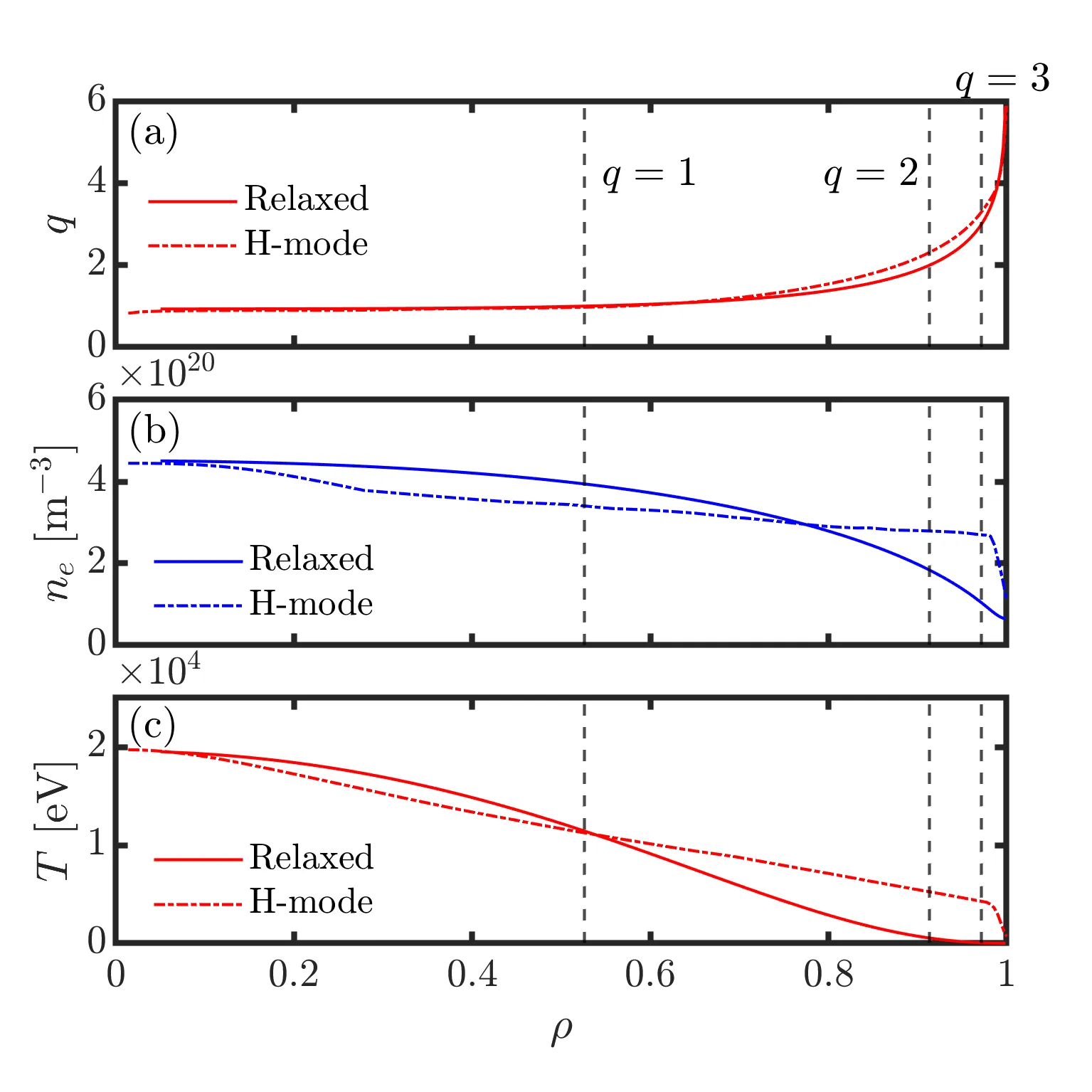
داخل التوكاماك — وهو جهاز على شكل كعكة محلاة، حيث تُحتجز البلازما بواسطة مجالات مغناطيسية — قد يبدأ الغاز الساخن من الجسيمات المشحونة بالارتعاش. في البداية يكون كل شيء هادئًا، ثم تنخفض درجة الحرارة فجأة، وتظهر على الرسم البياني أسنان المنشار. تُسمى هذه الأحداث بالتذبذبات المسننة، وهي قد تعيق بدء التفاعل النووي الحراري.
لأول مرة، قام العلماء بحساب تفصيلي لكيفية نشوء هذه التذبذبات في المفاعل المصمم SPARC. استخدموا نموذجًا حاسوبيًا يأخذ في الاعتبار السلوك ثلاثي الأبعاد للبلازما وخصائصها الكهربائية. وتبين أن السبب الرئيسي هو عدم استقرار داخلي يشبه التواء حزمة من خطوط المجال المغناطيسي. عندما يصبح الالتواء قويًا جدًا، تعيد البلازما ترتيب نفسها فجأة — وتنخفض درجة الحرارة.
أظهرت الحسابات أنه حتى التغيير الطفيف في درجة الحرارة أو شكل التيار داخل البلازما يمكن أن يؤثر بشدة على لحظة الانهيار. إذا لم تؤخذ العوامل المثبتة في الاعتبار، مثل الجسيمات السريعة، فإن الانهيار يحدث فورًا تقريبًا بعد أن يصل الالتواء إلى المستوى الحرج. هذا يعني أنه في SPARC الحقيقي، قد تبدأ التذبذبات المسننة في وقت أبكر مما كان متوقعًا، وسيكون من الضروري التحكم فيها.
فهم هذه التذبذبات سيساعد في التنبؤ بدقة أكبر بكمية الحرارة التي تفقدها البلازما، وسيقربنا في النهاية من تشغيل أول محطات طاقة الاندماج النووي.
الملخص الأصلي
كما كتبه المؤلفون، بالإنجليزية arXiv:2604.02172
A relaxed baseline case, based on the SPARC Primary Reference Discharge (PRD) design point, is used to conduct a thorough investigation for the most unstable low-$$n$$ MHD instabilities for the first time. The simulations use the high-fidelity 3D extended-MHD code M3D-C1. The linear simulation, by scanning over the resistivity, identifies a dominant internal kink mode at the $$q=1$$ surface with a toroidal mode number $$n=1$$. Both the current and the pressure profiles are strongly affecting the kink instability in the baseline case. The linear growth rate is sensitive to the keV-level temperature profile and the on-axis $$q_0$$ around unity. A simplified 1D eigenvalue solver shows a good qualitative agreement for the observed pressure effects. In 3D nonlinear simulations, the marginally unstable case gives a moderate sawtooth crash soon after $$q_0$$ drops below unity, likely because of the lack of stabilizing effects in our simulations, such as heating and energetic particles. When both the current and the pressure drives exist (the baseline case), a strong sawtooth is observed, which features a magnetic reconnection event and a hollowed pressure profile. This can be explained by mixing both the Kadomtsev and Wesson models. The actual sawtooth crash may occur in SPARC before $$q_0$$ drops far below unity due to the sensitive changes of the instability around $$q_0\sim 1$$. The sawtooth-like oscillations shown in low-$$\beta$$ simulations also provides an opportunity to investigate periodic sawtoothing timescales in SPARC. This work forms a basis for understanding particle and heat transport under the influence of MHD instabilities, which can be essential for properly assessing the performance of the SPARC tokamak and future fusion pilot plants.
سُميت التذبذبات المسننة بهذا الاسم لأنها تبدو على الرسم البياني لدرجة الحرارة مثل أسنان المنشار: ارتفاع بطيء وانخفاض حاد.