صدى راديوي مزدوج من اصطدام المجرات سريع
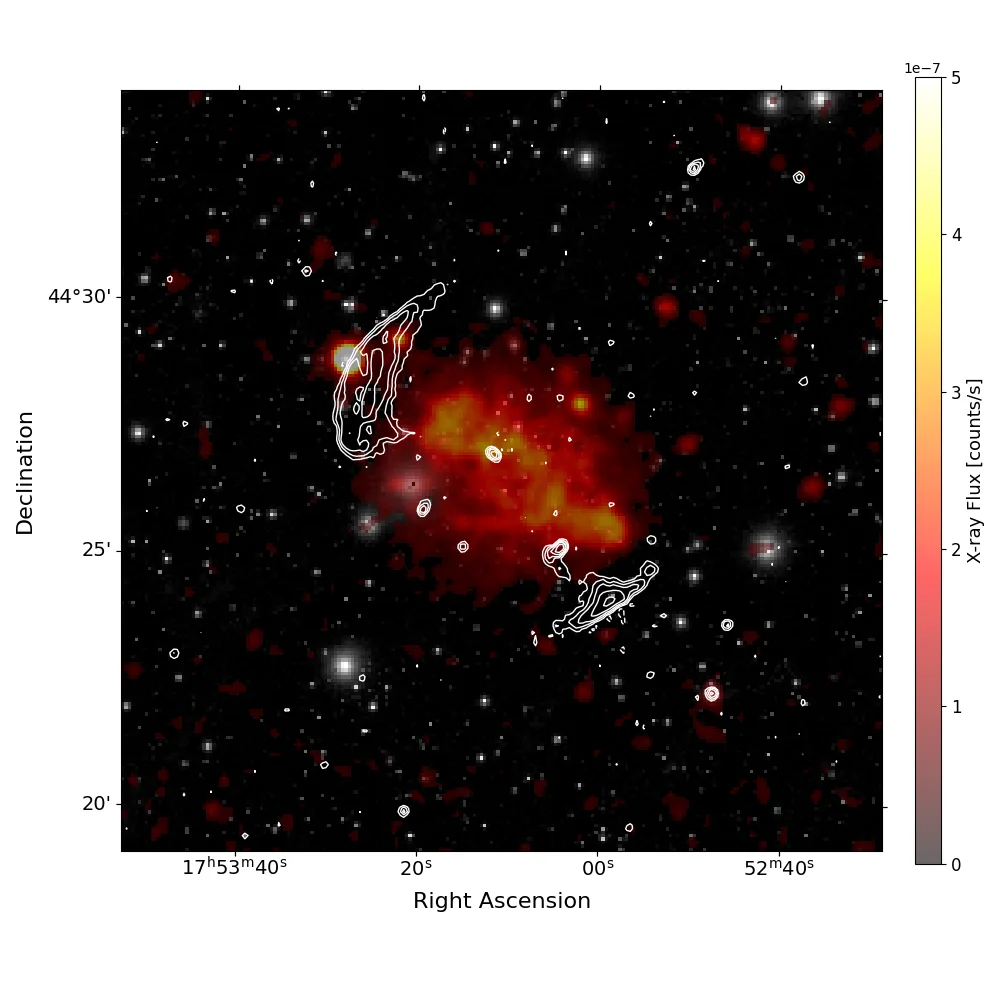
عندما يصطدم عنقودان من المجرات، تنشأ موجات صدمية في الفضاء بينهما، تمامًا مثل دوي الصوت من طائرة أسرع من الصوت، لكن بدلًا من الهواء، يكون الوسط غازًا مخلخلًا. تعمل هذه الموجات على ضغط الغاز وتسريع الجسيمات المشحونة إلى طاقات هائلة. الجسيمات المتسارعة، أثناء تحركها في المجال المغناطيسي، تصدر موجات راديوية نراها على شكل أقواس عملاقة تُعرف بالبقايا الراديوية.
في عنقود MACS J1752 يوجد قوسان من هذا القبيل، واحد على كل جانب من المركز. استخدم علماء الفلك ثلاثة تلسكوبات راديوية لفحصهما بدقة عالية. اتضح أن البقايا الشمالية الشرقية لها قمة سطوع مزدوجة وفي داخلها شريط لامع يُسمى "شريطًا". طيف الانبعاث (توزيع الطاقة عبر الترددات) لكلا البقيتين مسطح بشكل مدهش: هذا يعني أن الجسيمات لم تفقد طاقتها بعد، أي أن التسارع حدث مؤخرًا أو لا يزال مستمرًا.
الصورة البسيطة بموجة صدم واحدة لا تفسر التفاصيل المرصودة. يبدو أن البقايا تشكلت بواسطة عدة أسطح صدمية، بالإضافة إلى احتمال إعادة تسارع الجسيمات وتأثيرات الإسقاط. هذا يغير فهمنا لكيفية عمل موجات الصدم الكونية كمسرعات طبيعية للجسيمات.
نظام البقايا المزدوج في MACS J1752 هو مختبر ممتاز لدراسة فيزياء موجات الصدم على المقاييس الكونية. كلما قسنا شكلها وطيفها بدقة أكبر، كلما فهمنا بشكل أفضل مصدر الجسيمات الأكثر طاقة في الكون.
الملخص الأصلي
كما كتبه المؤلفون، بالإنجليزية arXiv:2604.02410
Radio relics are diffuse, extended synchrotron sources located at the outskirts of merging galaxy clusters. Their origin has been linked with shock waves injected into the intracluster medium, but the acceleration mechanism at the shock front is still under debate. Some clusters, like MACS J1752.0+4440, host a double relic system, with two relics found on opposite sides with respect to the cluster center. To investigate the acceleration mechanism that generates radio relics, we study the morphological and spectral properties of the double relic system in MACS J1752. We present new wideband radio continuum observations made with uGMRT and JVLA, and LOFAR data. We perform a detailed, high-resolution spectral analysis of the double relic system in MACS J1752, observing and characterizing substructures, particularly for the brighter relic. We find a double-peaked surface brightness and spectral index profile for the NE relic and identify a "bright bar" substructure. Moreover, we observed surprisingly flat integrated spectral indices for both relics, at $$\alpha_{\mathrm{int}}^{\mathrm{NE}} = -0.91 \pm 0.06$$ and $$\alpha_{\mathrm{int}}^{\mathrm{SW}} = -0.83 \pm 0.05$$. We study the spatial variation of the spectral index, observing a coherent trend with the observed substructures. We estimate an injection Mach number of $$\mathcal{M}_{\mathrm{NE}} = 3.1^{+0.1}_{-0.1}$$ and $$\mathcal{M}_{\mathrm{SW}} = 3.2^{+0.1}_{-0.1}$$. By performing a spectral curvature analysis for both relics, generating color-color plots and a spectral curvature maps, we observe two "concave" spectra represented by positive spectral curvature, in contrast with particle population ageing models. The observed properties of the NE relic are not consistent with a simple scenario with a single shock front. Multiple shock surfaces, re-acceleration, and projection effects likely play a role in shaping the morphology of the relic.
يمكن أن تمتد البقايا الراديوية على ملايين السنين الضوئية، أي عشرات المرات أكبر من مجرتنا، بينما انبعاثها الراديوي أضعف بملايين المرات من محطة راديو عادية.
في مسلسل "ستار تريك"، كانت موجات الصدم الناتجة عن اصطدام الأجرام الكونية مصدرًا للخطر والغموض أكثر من مرة، تمامًا كما هو الحال في العناقيد المجرية الحقيقية.