جزيئات من الفرن: طريقة جديدة لاصطياد الضوء سريع
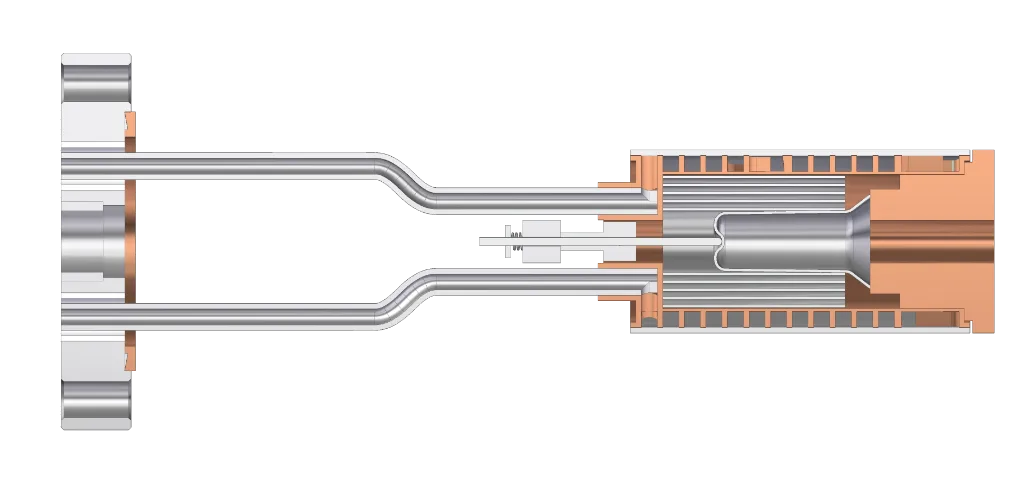
إن قدرًا عاديًا من الألومنيوم على الموقد لا يصدر جزيئات يمكن التقاطها بالضوء. ولكن إذا أخذت الألومنيوم وملح الألومنيوم وسخنتهما معًا في فرن صغير، فستحصل على تيار من جزيئات فلوريد الألومنيوم - مثل بخار الماء المتصاعد من فوهة إبريق الشاي، لكن بدلاً من قطرات الماء، تطير جزيئات صغيرة جدًا.
هذه الجزيئات يمكن تبريدها بالليزر، لكن في السابق كانت تُصنع بطريقة مختلفة - عن طريق قذفها من هدف باستخدام نبضة ليزر قوية. هذا المصدر يعطي ومضات ساطعة لكن قصيرة. الفرن الجديد يعمل بشكل مستمر: ينتج 5×$10^{15}$ جزيء في الثانية في اتجاه واحد - كما لو كان مليار إبريق شاي يطلق البخار في نفس النقطة في وقت واحد. عند درجة حرارة 923 كلفن (حوالي 650 درجة مئوية، أقل بقليل من درجة انصهار الألومنيوم)، يصبح التدفق أكثر كثافة من المصدر النبضي لبعض حالات الجزيئات.
بعد ذلك، تمرر الجزيئات عبر غاز نيون بارد. هناك تبرد إلى 30 كلفن (ناقص 243 درجة مئوية) وتتباطأ من 600 إلى 200 متر في الثانية. هذا مثل غمس عداء على مسار ساخن في حمام جليدي - سيخفض سرعته فجأة.
هذا المصدر يفتح الطريق أمام مصيدة مغناطيسية بصرية - جهاز يتم فيه احتجاز الجزيئات بالضوء والمجال المغناطيسي. الجزيئات فائقة البرودة ضرورية لساعات فائقة الدقة، والحوسبة الكمومية، والبحث عن قوى جديدة في الطبيعة.
الملخص الأصلي
كما كتبه المؤلفون، بالإنجليزية arXiv:2604.04509
The AlF molecule, currently subject to laser cooling and trapping efforts, has the advantage that it can be efficiently produced in a thermochemical reaction between sublimated aluminum trifluoride and aluminum metal. Here we present a series of experiments with continuous molecular beam sources of AlF, utilising this reaction. We demonstrate a compact AlF molecular beam oven whose total far-field brightness is $$5\times 10^{15}$$ molecules per steradian per second at 923~K, just below the melting temperature of aluminum metal. The continuous output from the oven begins to exceed the peak brightness of a jet-cooled, ablation-based supersonic AlF source for the $$v=0$$, $$J=7$$ level, and we obtain an excellent signal-to-noise ratio with the oven in pulsed laser ionisation spectroscopy experiments. By delivering flux from the oven into a cryogenic Ne buffer gas cell, we lower the rotational temperature of the beam to around 30~K and reduce its most probable forward velocity from 600~ms$$^{-1}$$ to 200~ms$$^{-1}$$. In addition, we demonstrate that AlF can be made in a simple dispenser package, and observe that molecules thermalise to the laboratory temperature after colliding with vacuum chamber walls of the experiment. The resulting transient AlF vapour may enable direct loading of a molecular magneto-optical trap.
درجة حرارة 923 كلفن تعادل تقريبًا 650 درجة مئوية، عند هذه الدرجة يكون الألومنيوم صلبًا لكنه جاهز للانصهار.