أنابيب الكربون النانوية مع الكالسيوم تحتجز الهيدروجين سريع
الهيدروجين هو وقود مثالي: عند استخدامه ينتج فقط ماء، وليس ثاني أكسيد الكربون. المشكلة هي أن الهيدروجين هو أخف غاز، وجزيئاته تتسرب من أي حاوية. حاليًا، يُحفظ الهيدروجين في السيارات في أسطوانات ثقيلة تحت ضغط هائل، مما يلغي مزايا الوزن.
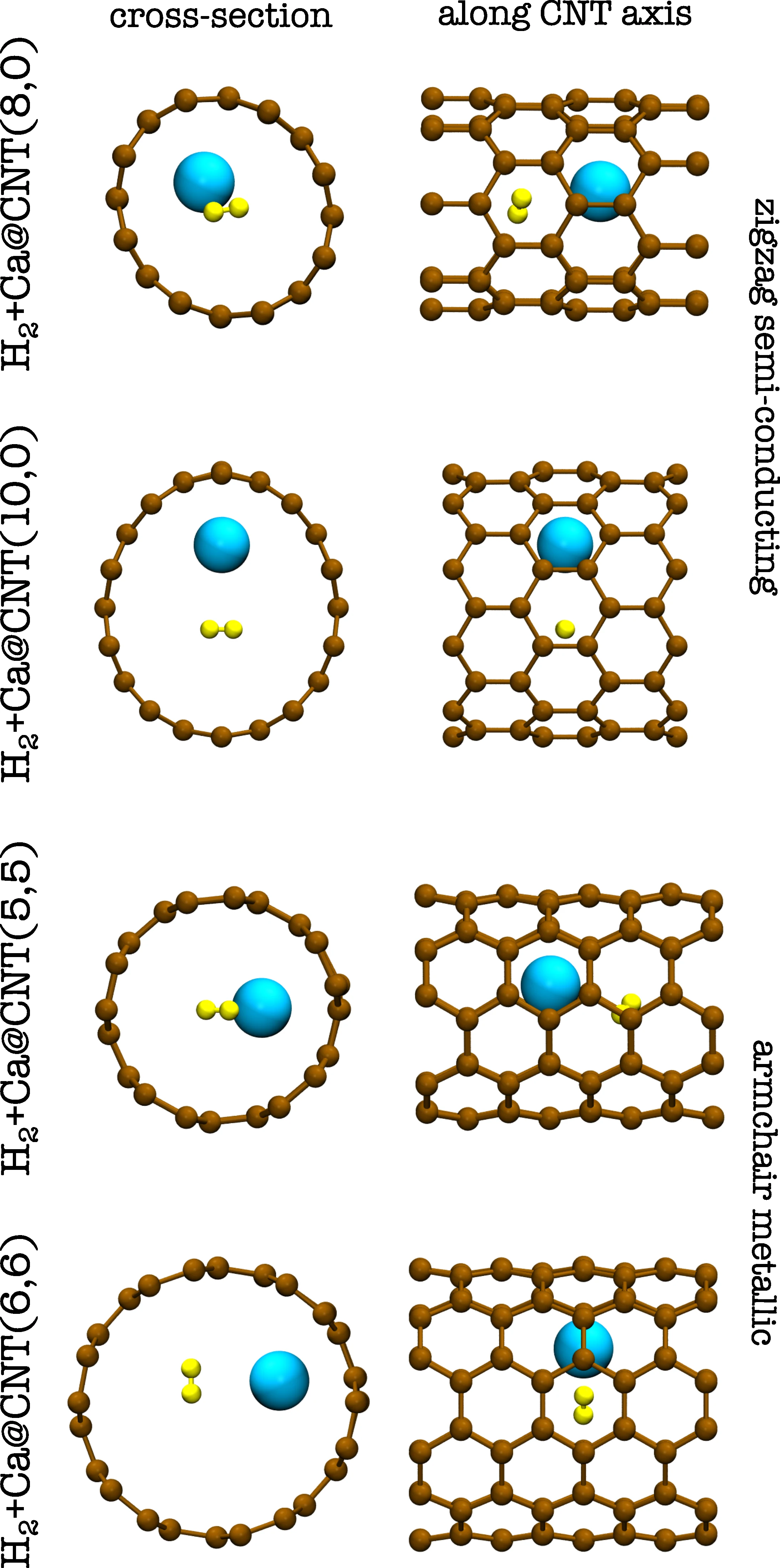
تغلب الباحثون على المشكلة بدون ضغط عالٍ. أخذوا أنابيب الكربون النانوية الكربون — أسطوانات مجوفة بسماكة ذرة واحدة، تشبه شبكة ملفوفة — ووضعوا بداخلها ذرات الكالسيوم. الكالسيوم — ذلك المعدن الذي يتكون منه هيكلنا العظمي — أثبت أنه "لاصق" مثالي: يلتصق به الهيدروجين بالقدر الكافي لئلا يطير، ولكن يمكن فصله بسهولة عند الحاجة.
يعطي هذا المبدأ توجيهات دقيقة للمواد. إذا تمكن المهندسون من إنتاج مثل هذه البنى النانوية، ستصبح سيارات الهيدروجين خفيفة حقًا وذات مدى طويل.
الملخص الأصلي
كما كتبه المؤلفون، بالإنجليزية arXiv:2604.07110
Hydrogen technology is set to be a key energy alternative for mitigating pollution and reducing CO$$_2$$ emissions. However, the current storage mechanism of hydrogen molecules in carbon fibre tanks detracts from the fuel economy of hydrogen in mobile applications, necessitating the development of alternative storage mechanisms. Adsorbing hydrogen in its molecular form (H$$_2$$) at typical operating conditions of proton exchange membranes can potentially meet storage requirements. However, H$$_2$$ is the smallest molecule with only two electrons and therefore it has very limited propensity to physisorb in a material within the binding energy window of $$-0.2$$ to $$-0.4$$ eV that is suitable for storage. Calcium atom decorators on graphene have previously shown promise for tunable H$$_2$$ binding, but the system is thermodynamically unstable toward the formation of calcium hydride. Moreover, the absolute adsorption of H$$_2$$ is challenging to predict accurately and is typically overestimated with van der Waals inclusive density functional approximations. In this work, we perform state-of-the-art fixed-node diffusion Monte Carlo alongside a selection of density functional approximations for two strategies of anchoring Ca: (i) Ca on boron doped graphene and (ii) Ca inside carbon nanotubes. We predict reliable Ca and H$$_2$$ binding energies, and establish that Ca is anchored inside carbon nanotubes and on boron doped graphene, while boosting the H$$_2$$ adsorption energy. Importantly, the H$$_2$$ adsorption energy is found to be improved by the anchoring strategies, with the energy inside a Ca decorated carbon nanotube reaching the viable storage window. The reference DMC binding energies provide much-needed benchmarks for developing data-driven methods and guiding experiment in the systematic design of hydrogen storage materials.
الهيدروجين هو العنصر الأكثر وفرة في الكون، لكنه نادرًا ما يوجد بشكل نقي على الأرض، ويجب استخراجه من الماء أو الهيدروكربونات.