الخيوط الكونية وولادة النجوم سريع
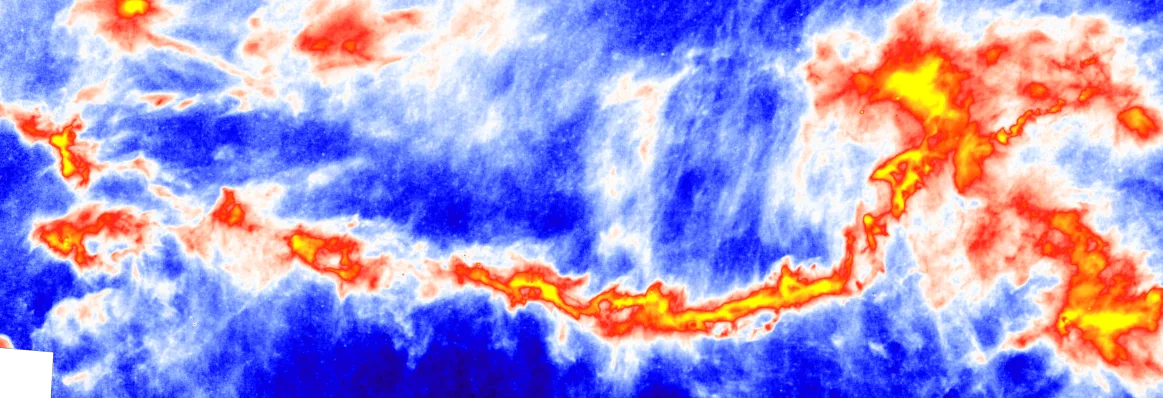
في السحب الباردة من الغاز بين النجوم تختبئ خيوط رفيعة طويلة، مثل الخيوط في كرة الصوف. وفيها تحديدًا، تنضغط وتولد نجوم جديدة. أخذ علماء الفلك سبعًا من هذه السحب على مسافات تتراوح بين 140 و920 سنة ضوئية، وقاسوا عدد الخيوط ذات السماكات المختلفة.
اتضح أنه في جميع السحب، بغض النظر عن نشاطها، يسري القانون نفسه: كلما زاد سُمك الخيط، قلّ تكراره. إذا رسمنا رسمًا بيانيًا، نحصل على خط شبه مستقيم بميل قدره 1,40. والمذهل أن هذا الميل يطابق تقريبًا الرقم 1,35، وهو الرقم الذي يصف عدد النجوم التي تولد بكتل مختلفة.
تطابق الميلين ليس مصادفة. يبدو أن التسلسل الهرمي للخيوط الغازية، من الرفيع إلى السميك، يحدد مباشرةً النجوم التي ستظهر: خفيفة، متوسطة، أو ثقيلة. وهذا يربط بنية الغاز البارد بغموض توزيع النجوم حسب الكتلة، الذي لم يُفسَّر منذ عام 1955.
الملخص الأصلي
كما كتبه المؤلفون، بالإنجليزية arXiv:2604.14093
The high-mass slope of the stellar initial mass function (IMF), first measured by Salpeter in 1955, appears nearly universal across star-forming environments, yet its physical origin remains unknown. Using the multiscale extraction method getsf, we measure the filament linear density function (FLDF) across seven nearby molecular clouds ($$140-920$$ pc) spanning a wide range of star-forming activity. The FLDF slope shows no systematic trend with spatial scale. Combining all clouds and scales, the composite FLDF follows a power law $${\rm d}N/{\rm d}\log\Lambda \propto \Lambda^{-\alpha}$$ with $$\alpha \approx 1.40$$, close to the Salpeter value of $$1.35$$, and the same composite slope is found in every cloud despite an order-of-magnitude spread in their supercritical-filament fractions. The close similarity between the composite FLDF slope and the Salpeter value suggests a possible physical link between the hierarchical filamentary structure of the cold interstellar medium and the IMF.
قانون توزيع النجوم حسب الكتلة اكتشفه إدوين سالبيتر عام 1955. ومنذ ذلك الحين، وُجد في أماكن مختلفة من الكون، لكن بقي السبب وراء هذا الشكل تحديدًا لغزًا.